Universe Today
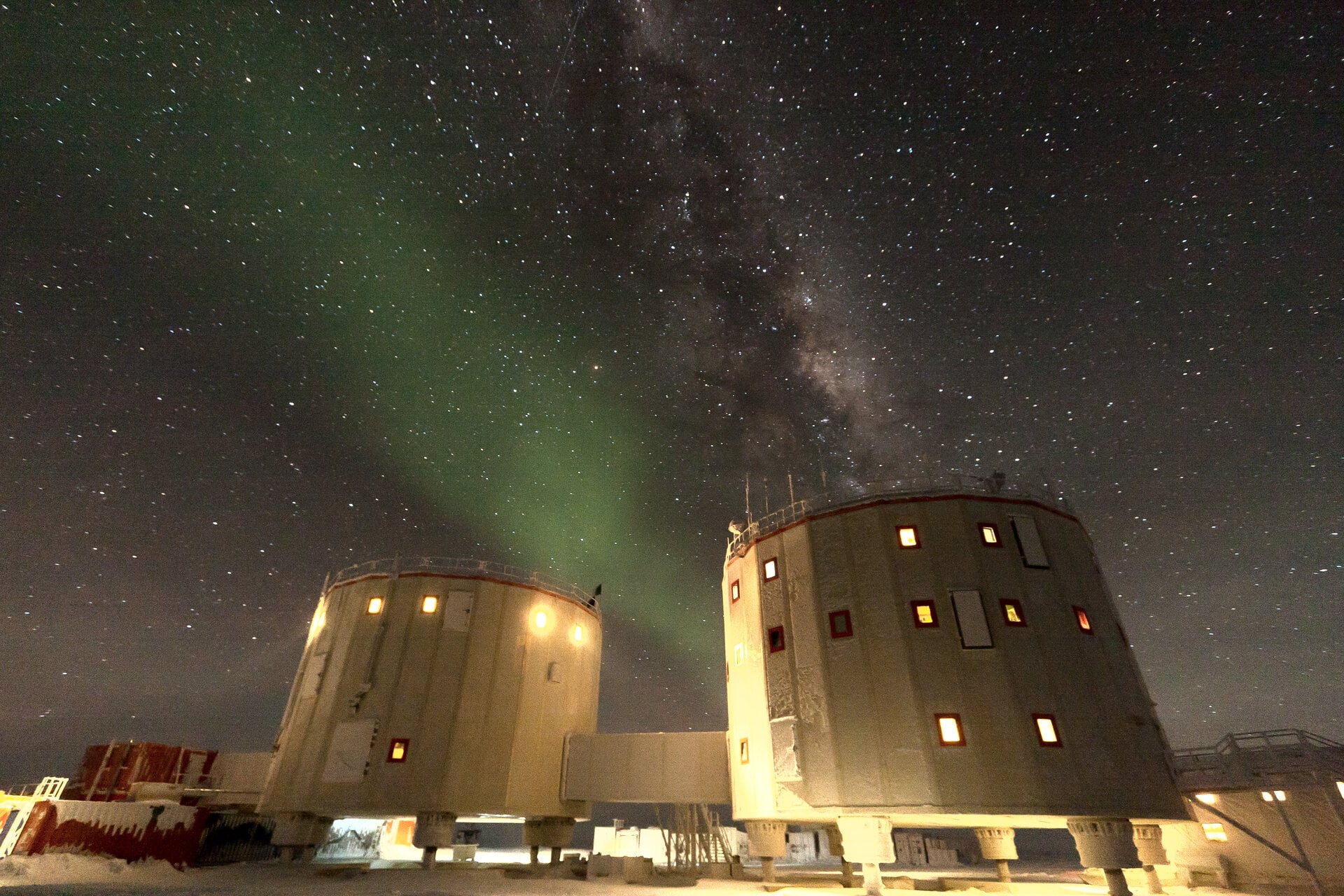
Antarctica, which harbors one of the harshest environments on Earth, would hardly seem to be a Valhalla for conventional astronomical observations. But for over a decade and a half, a French- and U.K.-led team of astronomers have been using a 40-cm telescope atop the high Antarctic plateau to look for transiting exoplanets.
Transiting planets are those whose orbits transit across the face of their parent stars causing a slight dimming of the parent star. The ASTEP (Antarctic Search for Transiting ExoPlanets) telescope uses a technique known as visible photometry to detect such transits. When used in astronomy, photometry measures the intensity of light from celestial targets, most often in the visible spectrum.
To date, ASTEP has contributed to the discovery of some twenty to thirty transiting extrasolar planets, all from its location some 1200km inland on the high Antarctic plateau.
The most recent is its participation in the characterization of TOI-201, an oddball planetary system orbiting a F-spectral type star 30 percent more massive and 30 percent bigger than the Sun. It’s also a very young star, estimated to be only about 600 million years old.
This oddball system is made up of a ‘super Earth’ some six times the mass of Earth which orbits TO1-201 every 5.8 days. There’s a gas giant half the mass of Jupiter which orbits the star every 53 days. Then there’s a brown dwarf --- some 15 times heavier than Jupiter on a very unusual and very elliptical 7.9-year orbit.
This particular brown dwarf is on an orbital trajectory more akin to a comet than a planet. Brown dwarfs have long puzzled planetary scientists. Sometimes called ‘failed stars,’ they are too small to burn hydrogen but are at least 13 times the mass of our own Jupiter.
But what makes TOI-201 particularly interesting is that has extremely different objects that are all gravitationally interacting on orbits that are changing fast enough to be seen in real time, notes the University of Birmingham in the U.K.
Astronomers from the University of Birmingham, The Observatoire de la Côte d’Azur, and the European Space Agency used ASTEP in conjunction with NASA’s TESS space telescope as well as a network of telescopes in Chile, Australia, and South Africa --- to discover the TOI-201 system, notes the University of Birmingham.
Of the 7000 plus extrasolar planets thus far discovered, most are not transiting, Tristan Guillot, an astronomer at the Observatoire de la Côte d’Azur, and the ASTEP lead, told me at his office in Nice, France. The fact that we have a transit implies that we can do transmission spectroscopy and more easily detect the characteristics of the atmosphere, Guillot told me.
This TOI-201 System Is Interesting, But It's Hardly Going To Be Habitable
The observing site lies atop some several thousand feet of solid ice on an Antarctic dome (or high, rounded ice summit). The location gives ASTEP access to the three-month long continuous night during Antarctica’s South polar winter which runs from June through August.
We've had a new camera system and a new mount, and now we are going to put the telescope on a ten-meter tower to have even better observing conditions, says Guillot. And hopefully in the future, we can get a larger telescope, he says.
And at any given time, there are generally a few thousand stars in ASTEP’s given field of view.
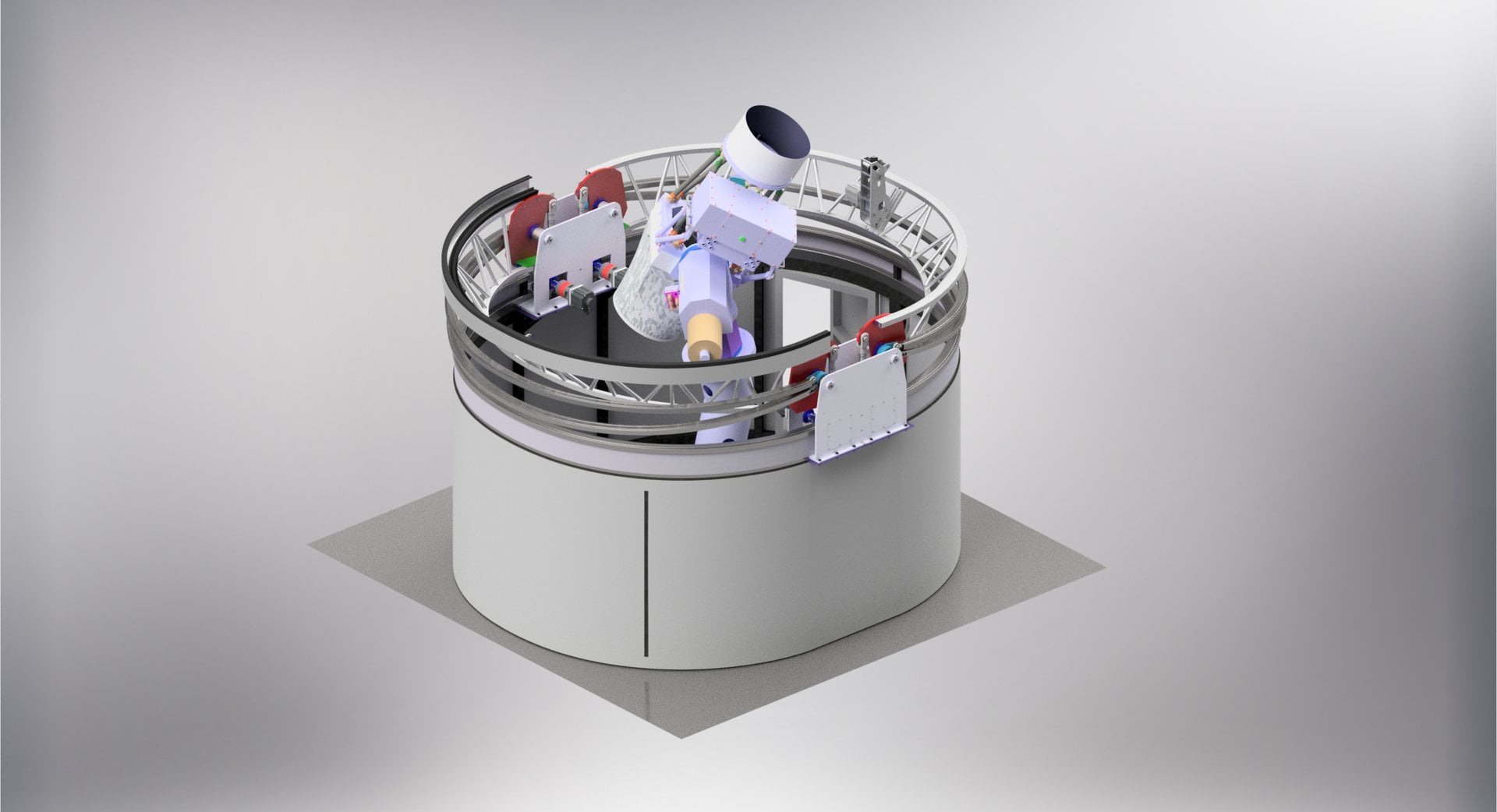 Graphic illustration of the ASTEP telescope installation. Credit: University of Birmingham
The telescope is technically not considered to be robotic, but it is automated in the sense that from halfway around the world, observers can send the telescope targets and then ASTEP does the pointing by itself. But there’s also a permanent team at the adjacent French-Italian Concordia research station who help maintain the telescope.
For decades, Guillot and colleagues have done their best to characterize exoplanetary systems, most of which hardly resemble our own.
But we must first better understand the planet formation process and the orbital hierarchies involved. We are still in the early days of exoplanet detections. Technology has continued to improve but astronomers have only detected a miniscule sliver of the extrasolar planets that must be orbiting other solar type stars just within our own galaxy.
In recent decades, there have arguably been overly sanguine predictions about the possibility of detecting extrasolar planetary biosignatures. Instead, we must look at exobiology as cathedral building.
Thus, how does understanding systems like this contribute to astrobiology?
Understanding the dynamic evolution of these systems is directly linked to whether life can be supported by some of these planets, says Guillot. Everything is interconnected, so it's very important to work also on all kinds of weird systems, he says.
As For Finding An Earth 2.0?
Guillot remains confident that there are systems with planets that have all the ingredients to have life.
But we must be a bit cautious because we don’t really know their composition, says Guillot. For the small mass, small radius planets, we don't know whether they have an atmosphere, so we don't know whether they will indeed have liquid water and the ingredients to form life, he says.