Universe Today
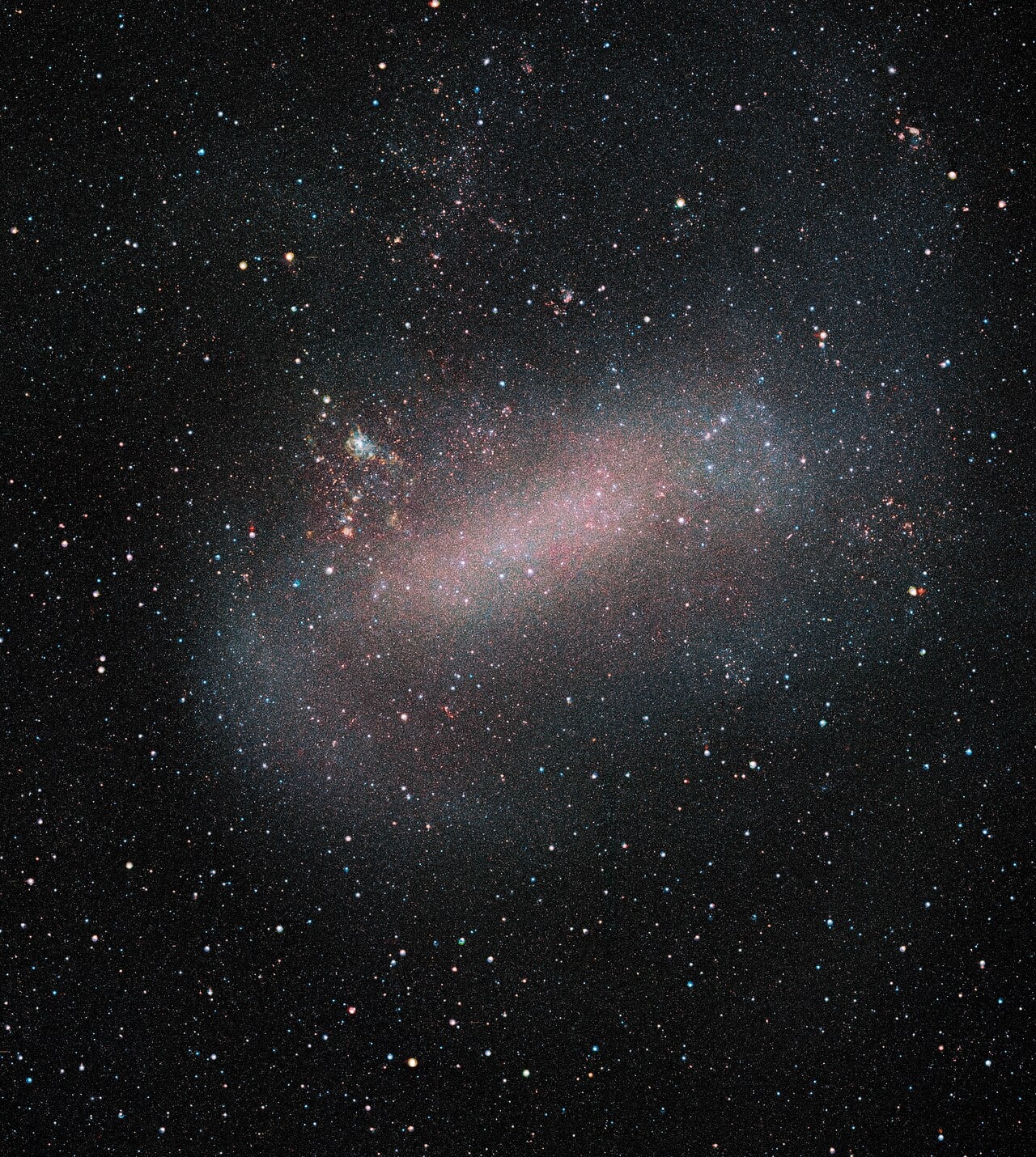
Weighing a galaxy is not straightforward, you can’t just put it on a scale. What you can do is study the gravitational fingerprints it leaves on everything around it and if you have precise enough instruments, those fingerprints can tell you an extraordinary amount. Researchers at the University of Alabama in Huntsville have just demonstrated a remarkable new way to do exactly that, using some of the most precise natural timekeepers in the universe, pulsars.
Pulsars are the collapsed remnants of massive stars that died in supernova explosions. What remains after that catastrophic death is an object roughly the size of a city but containing more mass than the Sun, spinning dozens or even hundreds of times per second and emitting beams of radio waves with the regularity of an atomic clock. That extraordinary precision is what makes them so useful. Any change in a pulsar's timing, even a shift of microseconds tells astronomers that something gravitational has nudged it. Used carefully, pulsars become the most sensitive gravitational detectors we have.
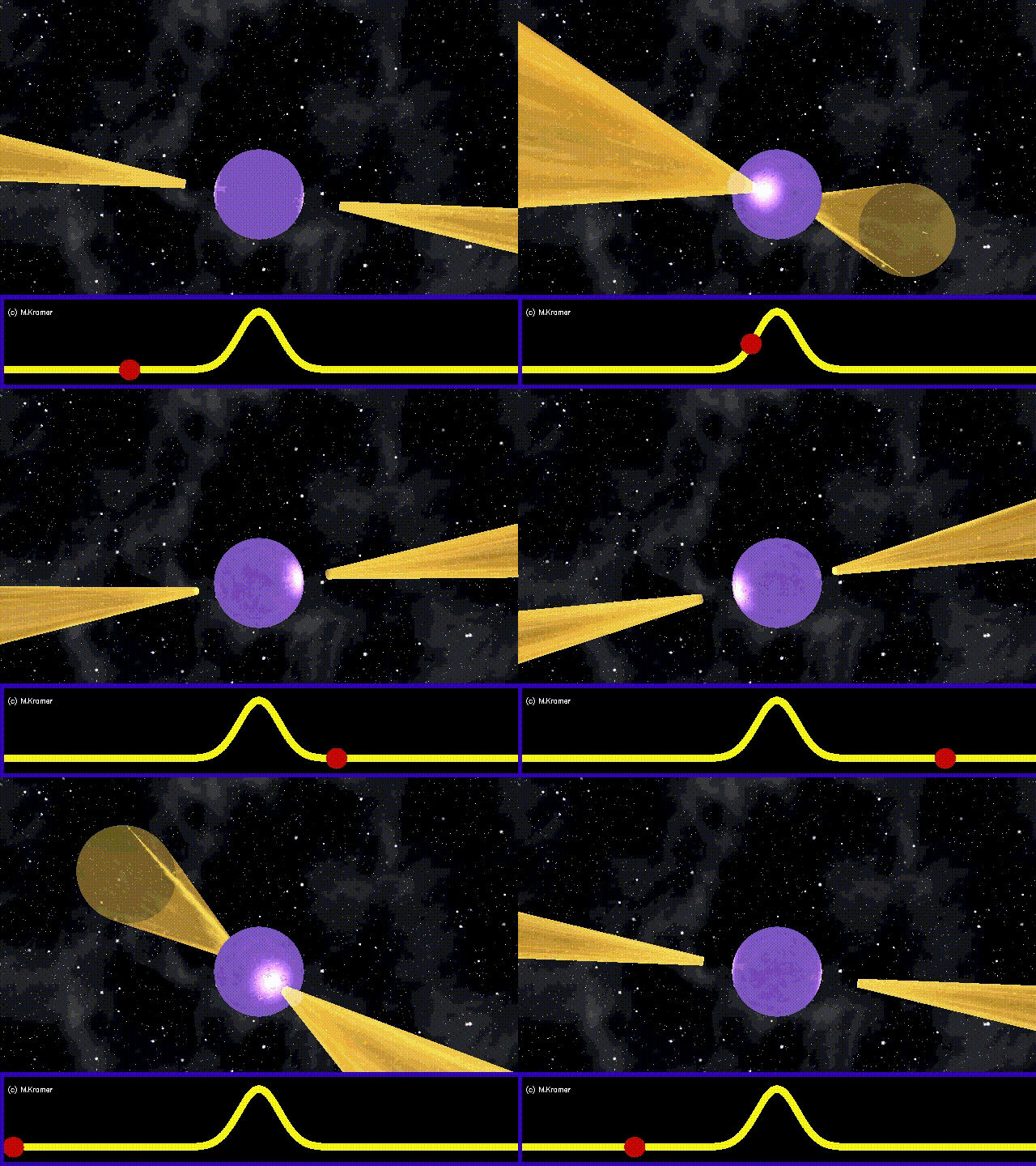 Illustration of the "lighthouse" effect produced by a pulsar. In reality the pulses of light repeat far more rapidly than the animation shows (Credit : Michael Kramer)
The UAH team, led by Dr. Sukanya Chakrabarti and Dr. Thomas Donlon, used timing data from 54 millisecond pulsars scattered across our Galaxy to measure tiny asymmetries in gravitational acceleration near our solar neighbourhood. Those asymmetries, they realised, carry the gravitational signature of two of the Milky Way's nearest satellite galaxies; the Large Magellanic Cloud and the Sagittarius Dwarf Spheroidal Galaxy, both of which are tugging gently on everything in our galactic neighbourhood right now.
The traditional method of estimating a galaxy's mass relies on watching how its stars move, a technique called kinematics. The problem is that stellar motions carry the accumulated history of billions of years of galactic interactions, spiral arms, gas clouds and past mergers, all layered on top of each other. Untangling which motion was caused by which event is enormously difficult, and it requires assumptions about whether the galaxy is in a stable, settled state which we now know is often simply not true.
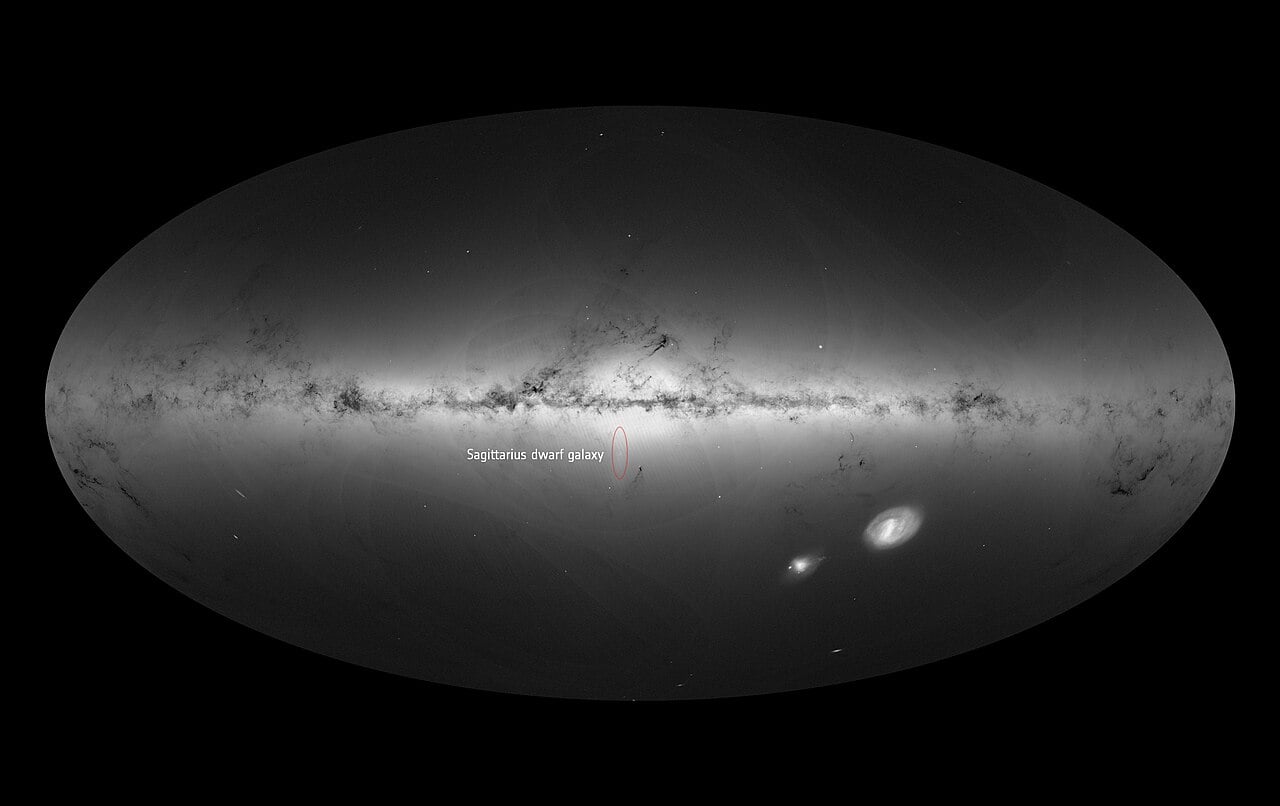 The Sagittarius dwarf galaxy, a small satellite of the Milky Way that is leaving a stream of stars behind as an effect of our Galaxy’s gravitational tug, is visible as an elongated feature below the Galactic centre and pointing in the downwards direction in the all-sky map of the density of stars observed by ESA’s Gaia mission between July 2014 to May 2016 (Credit : ESA/Gaia/DPAC)
Accelerations are different. Unlike velocities, which accumulate and persist long after their cause has gone, accelerations only exist while the force causing them is still active. The gravitational tug of a nearby galaxy is happening right now, and pulsars can detect it right now cleanly and directly, without the baggage of billions of years of prior history.
"Stars orbiting around our Galaxy will stay on fixed paths unless they are perturbed in some way. Accelerations don't stick around for long like velocities do. They disappear once the actual disruption is over.” - Dr. Thomas Donlon of the University of Alabama
Using the pulsar measurements combined with computer simulations, the team calculated the mass of the Large Magellanic Cloud at approximately 41 billion times that of the Sun, and the Sagittarius Dwarf Galaxy at roughly 350 million solar masses. Crucially, these figures include both the visible stars and gas and the invisible dark matter wrapped around them.
The same technique, applied to a larger array of pulsars as timing precision improves, could eventually map the distribution of dark matter clumps known as sub-halos, throughout the Milky Way. Understanding where those clumps are and how massive they are would go a long way toward helping us to finally understand what dark matter actually is.