Universe Today
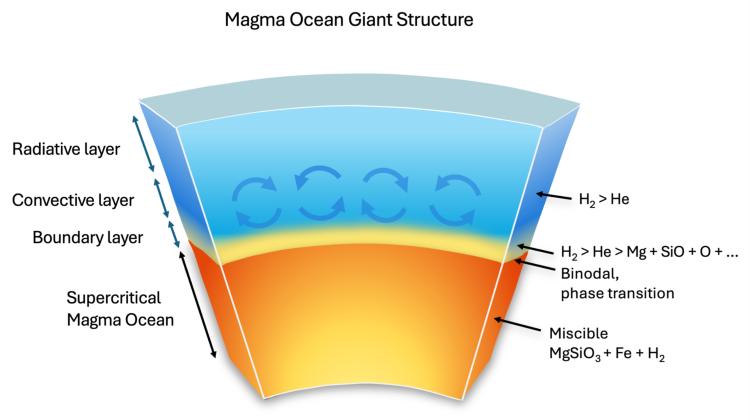
Uranus and Neptune remain two of the most mysterious objects in the solar system, primarily because they’ve only been visited by NASA’s Voyager 2 spacecraft in 1986 and 1989, respectively. Their “ice giant” moniker comes from longstanding hypotheses that their interiors are comprised of an icy mantle beneath their hydrogen/helium atmospheres. While Jupiter and Saturn are also comprised primarily of hydrogen and helium, Uranus and Neptune are hypothesized to have a layered structure comprised of icy elements within their interiors.
Despite decades of models, studies, and hypotheses, the debate over the longtime “ice giant” nickname for Uranus and Neptune is heating up. This is because a recently submitted study to The Astrophysical Journal could show this nickname might not be as frozen solid as scientists have long believed. In either case, a team of researchers from the University of California, Los Angeles (UCLA) could cause longstanding scientific passions to melt away.
For the study, the researchers used a series of computer models to simulate and ascertain the interior compositions and processes of Uranus and Neptune. The primary motivation behind the study was to confirm or refute the longstanding models and hypotheses regarding the “ice giant” status of Uranus and Neptune. While long standing models have given both worlds a hydrogen/helium atmosphere covering a vast mantle of “ices” comprised of water, ammonia, and methane, and finally a rocky core, studies into both worlds’ magnetic fields and heat distribution have puzzled scientists.
The researchers note that not only could this study explain the interiors of Uranus and Neptune, but that they could be used as analogs for sub-Neptune exoplanets. They are the most common type of exoplanet in our galaxy and have radii between 1 to 4.5 of Earth. Due to a lack of similar planet in our solar system, the formation and evolution of these exoplanets remain a mystery.
In the end, this study determined that the interiors of Uranus and Neptune are potentially comprised of a magma ocean, as opposed to an icy composition. The planetary layers the study proposes include a hydrogen/helium atmosphere that transports heat to the upper atmosphere and radiates it to space. Below this layer is a boundary layer comprised of several elements, including hydrogen, helium, magnesium, silicon monoxide (SiO), and oxygen. Finally, the bottom layer is a magma ocean comprised of silicate, iron, and hydrogen.
The study notes in its conclusion that, “While this is just one of a number of models that successfully reproduce the observed features of Neptune and Uranus, this model has several aspects to recommend it. One is the connection with other gas dwarf planets; it is not clear that ice giants and sub-Neptunes should be fundamentally different simply because of their distances from their host star. Related to this is the fact that the most basic chemical features of the ice giants resemble those of gaseous sub-Neptunes, perhaps indicating similar boundary conditions for the chemistry of the atmospheres imposed by the magma oceans.”
While Voyager 2 remains the only spacecraft to visit Uranus and Neptune, and there are currently no planned missions to return, several mission concepts have been proposed. These include the Uranus Orbiter and Probe (UOP) and Neptune Odyssey, with UOP using the probe to plunge into Uranus’ atmosphere, with both mission concepts entering orbit around both planets while also studying their many moons.
What new insights into Uranus and Neptune will researchers make in the coming years and decades? And what can they help teach scientists about exoplanets? Only time will tell, and this is why we science!
As always, keep doing science & keep looking up!