Universe Today
Nearly every galaxy has a supermassive black hole in its core. Whether the black hole forms first and then the galaxy around it—or the other way around—is still a matter of some debate, but we know the evolution of both are deeply connected. We can use that relationship to study the black holes.
When a supermassive black hole is active, we can look at things such as core luminosity and the black hole jets to determine its mass. But when it's quiet, we can't do that and have to use indirect means. One of these is the M-sigma relation. By measuring the spectra of stars at the core of a galaxy, we can determine their motion thanks to the Doppler effect. The spectra on one side of the core are blue-shifted because those stars are orbiting toward us and redshifted on the other side because they are moving away from us. This means the core spectrum has a statistical spread, or sigma. The bigger the black hole, the faster the core stars orbit the galactic center, and the bigger the sigma. Hence the M-sigma relation.
While the M-sigma relation is a simple and powerful tool to measure the mass of galactic black holes, it turns out it isn't always true. A new study has found that it doesn't work well for the largest supermassive black holes.[^1] The team focused on what are known as ultra-massive black holes (UMBHs). Those with masses of more than 10 billion Suns. In comparison, the only two black holes we've observed directly, M87* and our own SagA*, have respective masses of 6 billion and 4 million Suns.
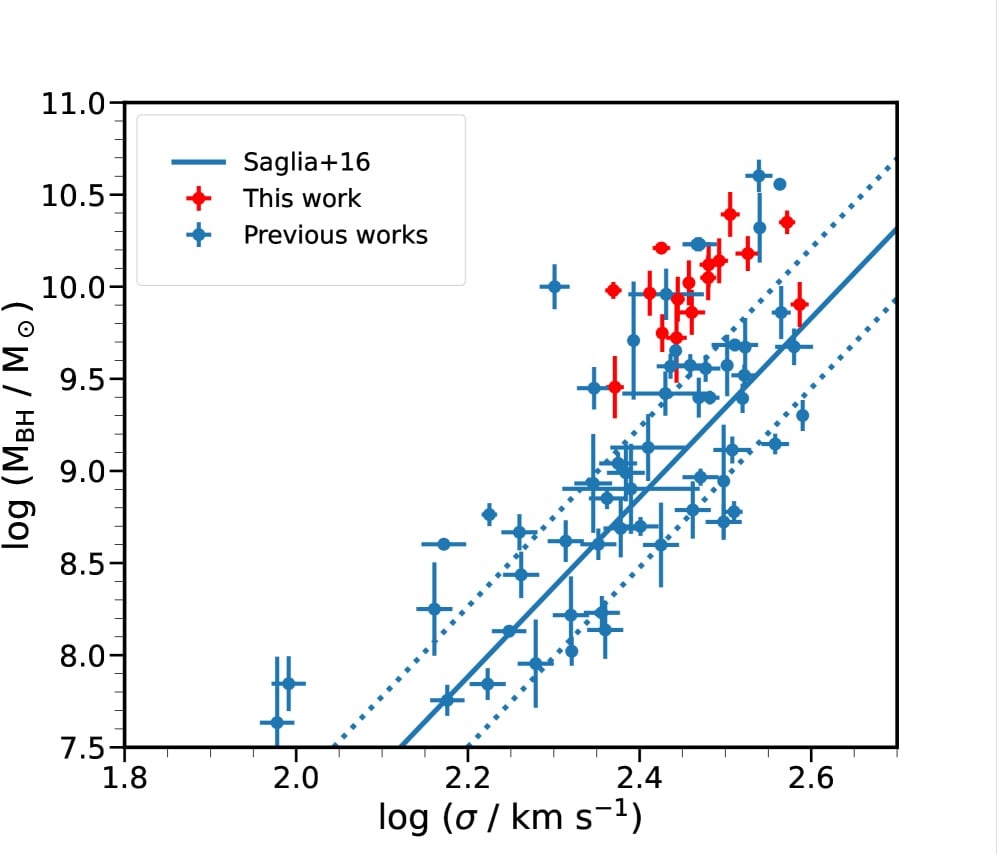 The M-sigma relation doesn't hold well for UMBHs. Credit: de Nicola, et al.
The team looked at 16 of the brightest cluster galaxies and compared the data to what is known as the triaxial Schwarzschild model. This is a model simulation where the various orbits of stars around the core are simulated to create a core brightness curve. The core is assumed to be an elliptical spheroid with three different axes, hence the name. It turns out that when you can get the necessary observations, the model gives an excellent measure of black hole mass.
The team was able to do this for 8 of the cluster galaxies. They then plotted them on an M-sigma graph, comparing them to other galaxies with known black holes. They found that these ultra-massive black holes trend higher than the M-sigma relation, meaning that the relation would underestimate the mass of UMBHs. The relation just isn't a good fit on the high end.
The authors then go on to show how you can use a different relation, known as the central light-deficient region. Since the largest black holes tend to consume more nearby stars, the brightness curves will have a dip in brightness right at the center. The bigger that region, the bigger the black hole mass. So even if you can't get the triaxial Schwarzschild data, you can still determine the mass of UMBHs.
Reference: de Nicola, Stefano, et al. "Eight New Ultramassive Black Hole Masses confirm Best Correlation with Galaxy Core Sizes." arXiv preprint arXiv:2512.04178 (2025).