Universe Today
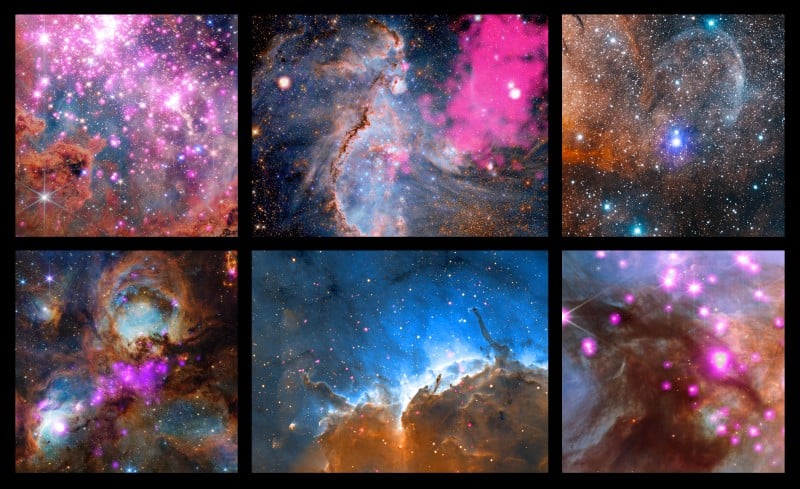
In the northern hemisphere, winter is giving way to spring. This means longer days, warmer nights, and lots of plants, trees, and gardens blossoming. To mark the occasion, NASA has released images acquired by the Chandra X-ray Observatory and other telescopes of several stellar "blossoms." These star-forming regions, also known as "stellar nurseries," are composed of gas and dust from which new stars form. This is what gives the nebulae their characteristic (and very beautiful) glow, but also makes studying their interiors very difficult.
In essence, these massive clouds of gas and dust obscure the light from the stars forming within them. Fortunately, X-rays are energetic enough to penetrate the gas and dust of these nurseries, allowing astronomers to gain insight into young stars and the processes at work within them. This includes information on how stars form and the effects that X-rays have on any planets or planet-forming disks surrounding them. And like different species of plants here on Earth, some stellar nurseries "blossom" with new stars before others.
The images feature the Pelican Nebula (NGC 7000), the Cat’s Paw Nebula, NGC 346, the Flame Nebula, Westerlund 2, and Cygnus OB3, arranged top to bottom, left to right. The Pelican Nebula is a composite image combining X-ray data from Chandra (pink) and optical light from NASA's Hubble Space Telescope (red, green, and blue). The image of the Cat's Paw Nebula combined Chandra data (pink again) with near, mid, and far-infrared data from NASA's James Webb Space Telescope (red, orange, yellow, green, cyan, and blue).
The image of NGC 346, located in the Small Magellanic Cloud (SMC), includes X-ray data from Chandra (purple) combined with optical data from Hubble (red, green, and blue). The composite of the Flame Nebula shows X-rays again in purple, while Webb data highlights the dust clouds in red, green, and blue. The Westerlund 2 image combines Chandra data (purple) and infrared data from Webb (red, orange, green, cyan, and blue). Last, there's Cygnus OB3, combining Chandra (blue) with optical data from the Kitt Peak National Observatory (red and blue).
The images are arranged by age, representing the transition from early to late spring. These two nebulae are very young by cosmic standards, as they contain many stars that are about a million years old. Meanwhile, NGC 346, the Flame Nebula, and Westerlund 2 contain stars ranging from one to three million years old. The oldest stars are located in the region around Cygnus X-1, a binary system consisting of a black hole and a massive star.
This collage not only showcases some of the most beautiful cosmic objects in the night sky but also highlights the effectiveness of combining data from different observatories (and across different wavelengths). And the colorful, blossom-like appearance is just the thing to celebrate the coming of spring!
Further Reading: Newswise