 Universe Today
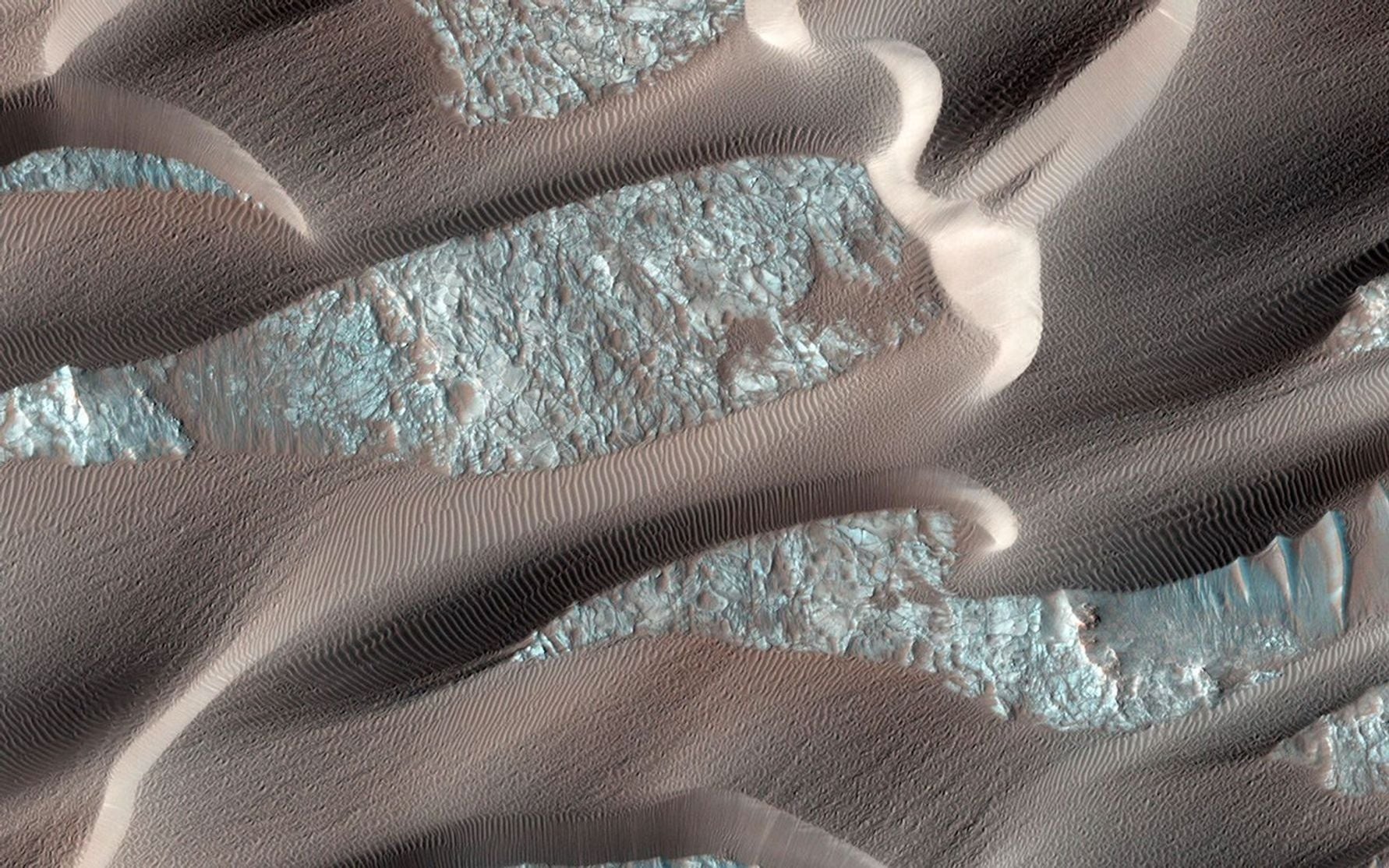
We’ve managed to take high-resolution orbital images of many worlds across our solar system, and many of them with an atmosphere have one feature in common - sand dunes. Scientists have been using the size and orientation of these dunes for decades to act like a weather vane, figuring out which way the wind blows on these other worlds. Unfortunately, weather vanes aren’t good at telling the full windy story - they can’t tell you how fast the wind is going. However, according to a new paper published in the Proceedings of the National Academy of Sciences by researchers at Stanford, sand dunes can.
Earth and Mars, the two most commonly thought of planets with sand dunes, aren’t the only ones. We’ve also seen them on Venus, Titan, and, surprisingly, Comet 67P/Churyumov-Gerasimenko. Each is made up of different materials, but all share a crucial characteristic - their “sand” consists of small grains of similar particles, which could be blown around by wind.
Understanding why this is important requires looking at how wind actually moves sand in the first place. When air is moving across a dune, individual grains stay stationary until the wind itself reaches a critical speed known as the transport threshold. Once it rises above that, the grains begin bouncing across the ground in a movement known as saltation. Each time a grain crashes back to the surface, it kicks up other surrounding grains into the air, creating a self-sustaining cascade of moving sand.
Fraser talks about whether Martian dust storms are dangerous.What was unclear to scientists was whether these motions were primarily driven by violent dust storms that were relatively rare, or moderate winds which are much more common on the other worlds where dunes have been seen. It might seem counter-intuitive that a comet would have “wind”, but a 2017 study showed that the “ripples” ESA’s Rosetta probe found on the comet's surface were created by localized vapor flows caused by extreme day-night temperature cycling.
Solving the mystery of what type of wind causes these shifting sands was the focus of the paper. Lead author M. Colin Marvin, a PhD student in the Department of Earth and Planetary Sciences at Stanford, collected wind speed data and detailed grain-size measurements from twenty-four different dune fields spread all over the world. From the Coral Pink Sand Dunes State Park in Utah to the ancient, hundred-meter-tall dunes in the Namib Sand Sea in Namibia, the researchers found a remarkable similarity.
Across every terrestrial site, the most sand was moved when the wind was slightly above the speed required to start moving it. And, crucially, the same relationship also held on a Maritan sand dune. The process didn’t require the odd violent gale to get sand moving, just every day wind speeds common throughout the globe. For example, a dune made of sand 0.2 mm across (about the width of two pieces of paper) is mostly moved by winds blowing at only 26 kilometers per hour 10 meters above the ground.
Fraser talks about the Dragonfly mission, which will land next to dunes on Titan.With that data set in hand, the researchers then turned to simulations. Using a tool called ReSCAL, they grew virtual dunes from flat sand beds using different wind speeds. As part of that process, the team confirmed that, as long as a world has plenty of loosely bound grains of sand and winds that grow rarer as they grow stronger, dunes will largely be formed by the wind speeds that correspond directly to the grain sizes that compose them.
Despite the challenges of finding individual sand grain size from orbit, this technique is useful on more than just Earth. Curiosity has already drilled into the Stimson formation, a layer of sandstone that used to be a windblown dune billions of years ago. Another upcoming interplanetary mission – Dragonfly – is expected to touch down on the surface of Titan, where there are dunes of hydrocarbons, sometime in the 2030s.
Combining the grain size measurements from these missions with the math laid out in the new paper will provide scientists with a rough indication of the history of wind speed in the area. There will also undoubtedly be other missions to other dune-ridden planets - Venus comes to mind as a potential target. And from now on, scientists will be able to read a major part of a world’s geological history directly written into its sand.
Learn More:
Stanford - Scientists discover sand dunes can reveal wind speeds on Earth and beyond
M. Colin Marvin et al - Windblown dunes are born in sand at the brink of transport [Author's note - PNAS page not fully indexed at time of writing]
UT - Interpreting Dune Patterns: Insights from Earth and Mars
UT - Compare Sand Dunes Across the Solar System, From Venus to Pluto

