 Universe Today
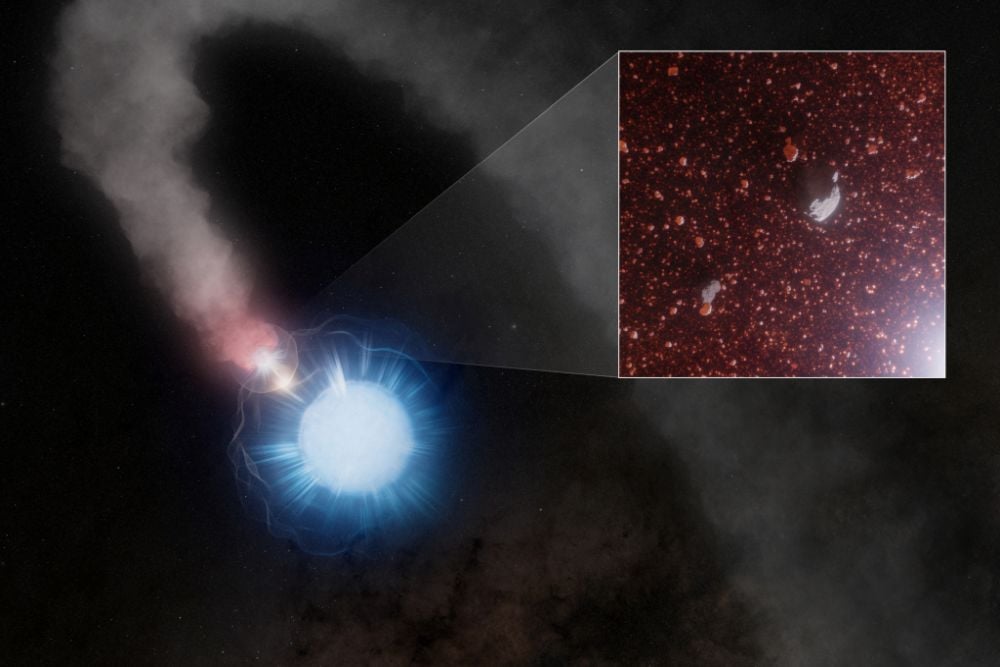
Aging stars are prolific producers of dust, and the dust plays an important role in the cosmos. Their dust is ejected into the interstellar medium (ISM) where it is taken up in the next generation of stars and planets. This is how stars seed their environments with metals, elements heavier than hydrogen and helium, which are necessary for rocky planets and life to form.
Astronomers study this stellar dust to learn more about how it's produced and spread into the cosmos. Wolf-Rayet (WR) binaries are natural laboratories for this work. WR stars are extremely massive and hot stars whose winds have blown away their outer hydrogen envelopes.
Studying dust in binary pairs involving a WR star is important because of the vast amounts of dust that these stars generate. In a binary system, this becomes even more advantageous. The wind from a lone WR star can be too hot and too diffuse to condense into dust. But in a binary situation, especially where the second star is an O-type star, the two powerful stellar winds collide. This forms a shock zone of dense dust that's thicker than either single wind. In this configuration, the gas can rapidly cool and form massive amounts of dust. That's why WR binaries are natural laboratories for studying dust.
When observing these binary star systems, astronomers have measured the size of the dust grains and found conflicting results. Some of these binary systems produce larger grains, while others produce only very tiny grains. This is important because grain size can affect how the grains interact with light, what type of chemistry can occur on their surfaces, and how planets form.
In new research, a team of scientists used the ALMA and the JWST together to try to understand these conflicting results. Their work is titled "Constraining Properties of Dust Formed in Wolf–Rayet Binary WR 112 Using Mid-infrared and Millimeter Observations." It's published in The Astrophysical Journal, and the lead author is Donglin Wu, undergraduate at Yale University.
"Binaries that host a carbon-rich Wolf–Rayet (WC) star and an OB-type companion can be copious dust producers," the authors write. "Yet the properties of dust, particularly the grain size distribution, in these systems remain uncertain." This research is based on observations of WR 112, a binary WR/OB star known for its complex dust patterns as revealed in observations by Keck and other observatories.
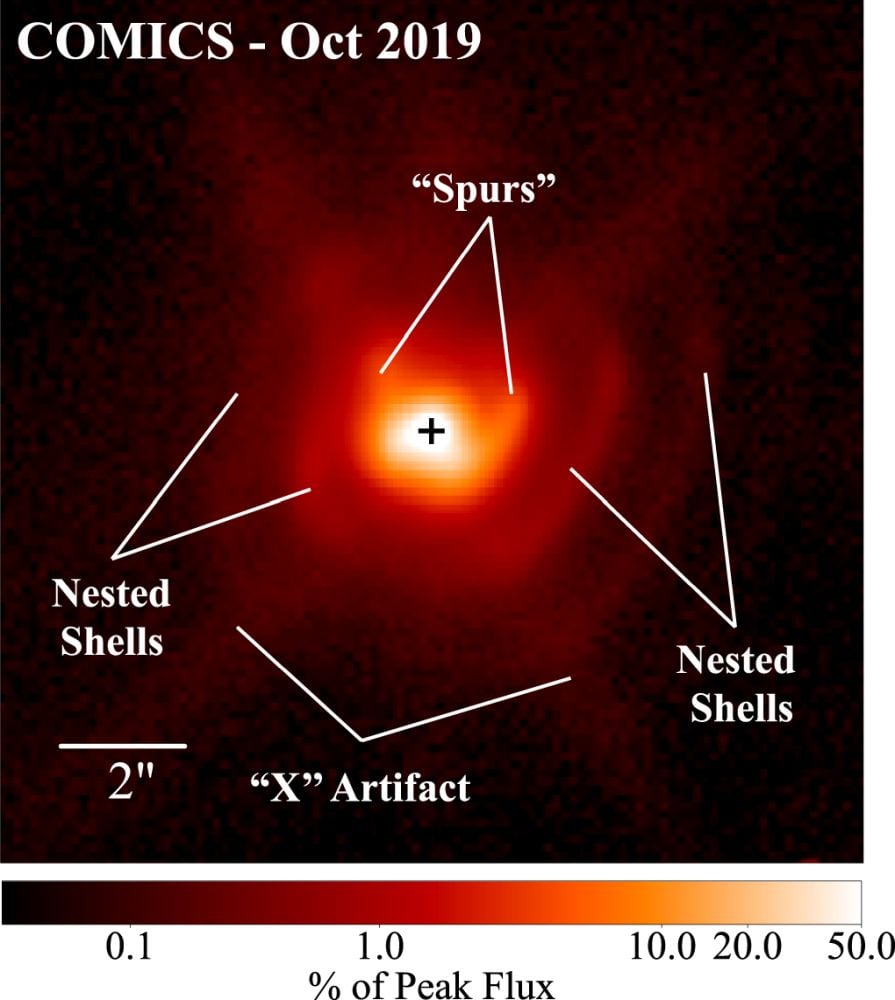 This image from previous research shows some of the complex morphology around WR 112. The complexity is generated by the powerful colliding winds from the binary pair. Image Credit: Lau et al. 2020. ApJ
Though often observed, this is the first time that WR 112 has been studied with ALMA's critical Band 6. Band 6 is considered the workhorse band because cold dust and gas are so visible in it. JWST observations also played a role in this work.
"By combining ALMA observations with James Webb Space Telescope images, we were able to analyze the spatially resolved spectral energy distribution (SED) of WR 112," the researchers explain. The spectral energy distribution of the star and its dust reveals important important information about grain size, composition, and other characteristics.
The observations show that the majority of the dust grains are smaller than one micrometer. They also show that WR 112's extended dust structures are dominated by nanometer-sized grains. So there are two populations of dust grain sizes.
"Among four parameterizations of the grain radius distribution that we tested, a bimodal distribution, with abundant nanometer-sized grains and a secondary population of 0.1 μm grains, best reproduces the observed SED," the researchers explain. This bimodal distribution explains why previous dust-grain observations produced conflicting results.
“It’s amazing to know that some of the most massive stars in the Universe produce some of the tiniest dust particles before they die. The difference in size between the star and the dust it produces is about a quintillion to one,” said lead author Wu in a press release.
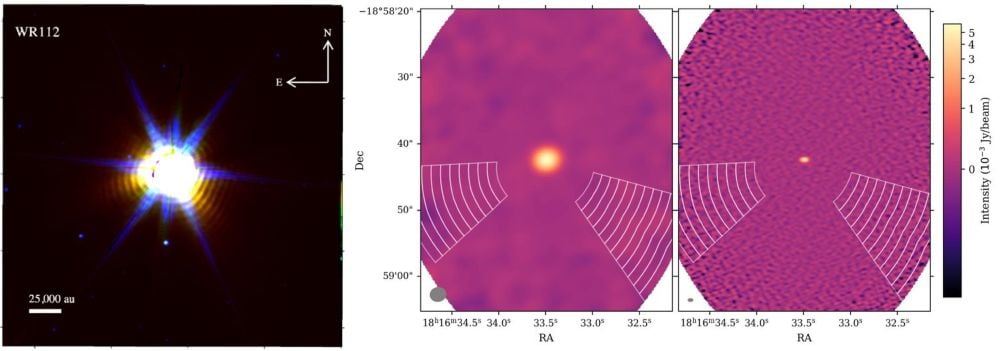 The image on the left shows large concentric dust structures around WR 112 as observed by the JWST. In the image on the right, the white segments show different ALMA apertures matched to those dusty arcs. Image Credit: Wu et al. 2026. ApJ
The researchers couldn't conclude why this bimodal distribution exists, but it could involve particle collisions.
"It is a challenge to account for how the system is driven into the bimodal radius distribution. Collisions can be caused by turbulence in the gas, but it is uncertain how they can lead to a bimodal distribution," the authors write. Sorting this out will require further work and further modelling the researchers say.
While much of astronomy is concerned with massive objects like stars, galaxies, and supermassive black holes, tiny dust grains play a huge role in the cosmos. For example, the molecular hydrogen that forms stars first forms on tiny dust grains. Research shows that smaller dust grains accelerate its formation.
The ability of dust grains to stick together is also important. Tiny grains stick together more easily, affecting how planets can form around stars.
The authors acknowledge some caveats in their work. They explain that their parameterizations of grain sizes are "necessarily simplified," and that more data will allow them to test other, more complex size distributions.
"Future observations of higher quality will be critical to refining these constraints, and extending our approach to other WC binaries will be essential for developing a broader understanding of dust production in these systems," they conclude.

