 Universe Today
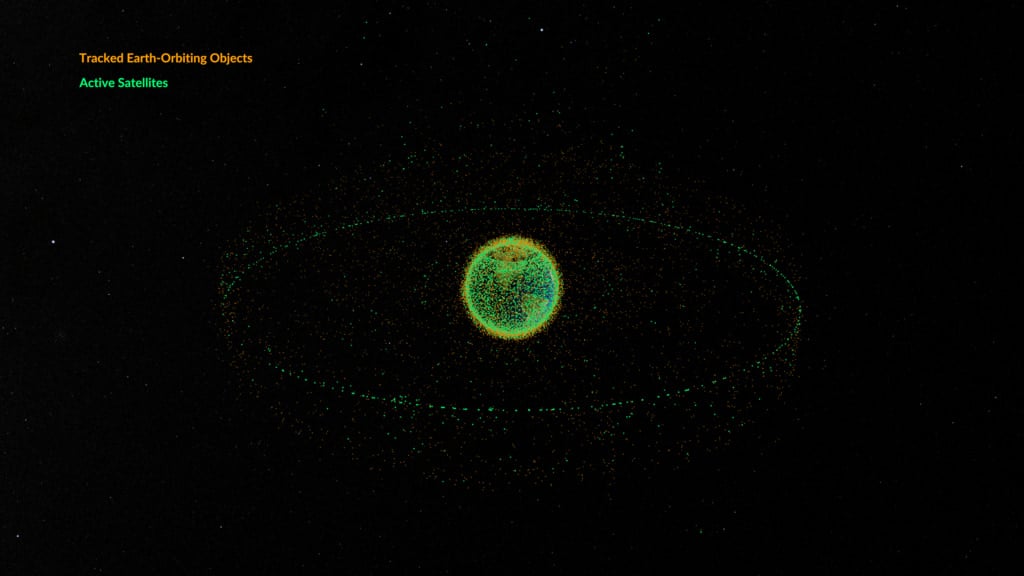
Satellite imaging is increasingly important to every field from crop monitoring to poverty reduction. So it’s no surprise that there have been more and more satellites launched to try to meet that growing demand. But with more satellites comes more risk for collision - and the debris field that comes after the collision. A new paper in Advanced in Space Research from John Mackintosh and his co-authors at the University of Manchester looks at how we might use mission design to mitigate some of the hazards of increasing the number of satellites even more.
Surprisingly, the answer isn’t bigger satellites at higher orbits. That might seem the obvious answer, but let’s walk through the logic as to why more, smaller satellites are actually better. That logic starts with some assumptions, as almost all logic does. In this case, the assumption is that, to prove an effective Earth monitoring tool, the images must have a resolution of .5m per pixel. That would allow researchers to monitor minute changes in forest or building cover, enabling the most up-to-date studies using this data.
Another assumption is that these systems should be optical, and capture light in the visible spectrum. New Earth-monitoring technology, such as synthetic aperture radar (SAR) offer some advantages in terms of data collection, but they lack the optical system’s ability to analyze what is actually happening on the ground.
Fraser discuss the capabilities of orbital imaging.With those two assumptions, it’s time to do some math. The size of an optical sensing system is determined by its altitude and by its required resolution - the higher the altitude or the higher the resolution, the larger the optical system must be. So a trade-off of having satellites in a higher orbit, where there’s more space to maneuver, is requiring a larger satellite to support the optical system.
This difference is pretty significant - moving from a 300km orbit to a 750km orbit bumps the aperture size from 0.33m to 0.83m. Increasing the size also increases the weight - which in space is exponential because more fuel is required to maintain the position of the satellite. So ultimately, the size of the satellite itself grows from an estimated 107kg for one located at 300km to 1,360kg for one located at 750km with the same observational capabilities.
Admittedly, with higher altitude comes better coverage. A constellation of satellites at 750km would only require 10 satellites of that size to cover anywhere on Earth within one hour. On the other hand, a constellation at 300km would require 22 smaller satellites. Which again seems to favor the larger, higher orbit satellites for safety.
Satellites are getting more and more capable, as this video discusses. Credit - Astrum YouTube ChannelBigger satellites make for bigger cross sections, though, and that means more likelihood of a collision. The larger satellites that would be orbiting higher up are much more likely to run into a piece of debris. In fact, some of this highest “debris flux” in orbit currently is already at a relatively high altitude - between 850-950 km, which is where legacy “sun-synchronous orbits” used to sit. In contrast, satellites lower down in the atmosphere are pulled down quickly by atmospheric drag, making debris at these altitudes much less prevalent. That’s part of the reason Starlink has recently moved some of its satellites down out of a 550km orbit into one closer to 480km.
Big targets also make for more debris if they are in fact hit, and that is very much the case for satellites in higher orbits. Knocking one of them out of commission has much more destructive potential, due to their increased size compared to ones lower down in orbit. This would further increase the debris field other satellites would have to deal with, thereby increasing the likelihood of further collisions.
In essence, that means that fewer larger satellites higher up in orbit are more likely to be destroyed and create an impenetrable debris field than more numerous, albeit smaller, ones down in lower orbits. While there is still no global regulation on satellite spacing or orbits, if and when an organization decides that it’s time to develop one, they should be sure to review this paper as part of their research.
Learn More:
University of Manchester - New tool could reduce collision risk for Earth-observation satellites
J. Mackintosh, K. Smith, & C. McGrath - Collision risk from performance requirements in Earth observation mission design
UT - How a Single Atomic Sensor Can Help Track Earth's Glaciers

