 Universe Today
Supernovae explosions are hard to miss. When they explode, they can outshine all of the stars in their host galaxies for months. But understanding the physics behind these powerful phenomena requires studying their progenitors before they explode.
Since only huge stars explode as supernovae, they should be easy to find.
But Nature doesn't concern itself with the struggles of human beings. A long-standing barrier to understanding Type II supernovae is finding the red supergiants that are their progenitors. We know they're out there in large numbers, but for some reason, we struggle to find them. Now, new research in The Astrophysical Journal Letters may have the answer to the missing red supergiant problem.
It's titled "The Type II SN 2025pht in NGC 1637: A Red Supergiant with Carbon-rich Circumstellar Dust as the First JWST Detection of a Supernova Progenitor Star." The lead author is Charles Kilpatrick, a Research Assistant Professor at Northwestern University. The research is based on a supernova that exploded in a nearby galaxy, and some serendipitous pictures of the star captured by the JWST before it exploded.
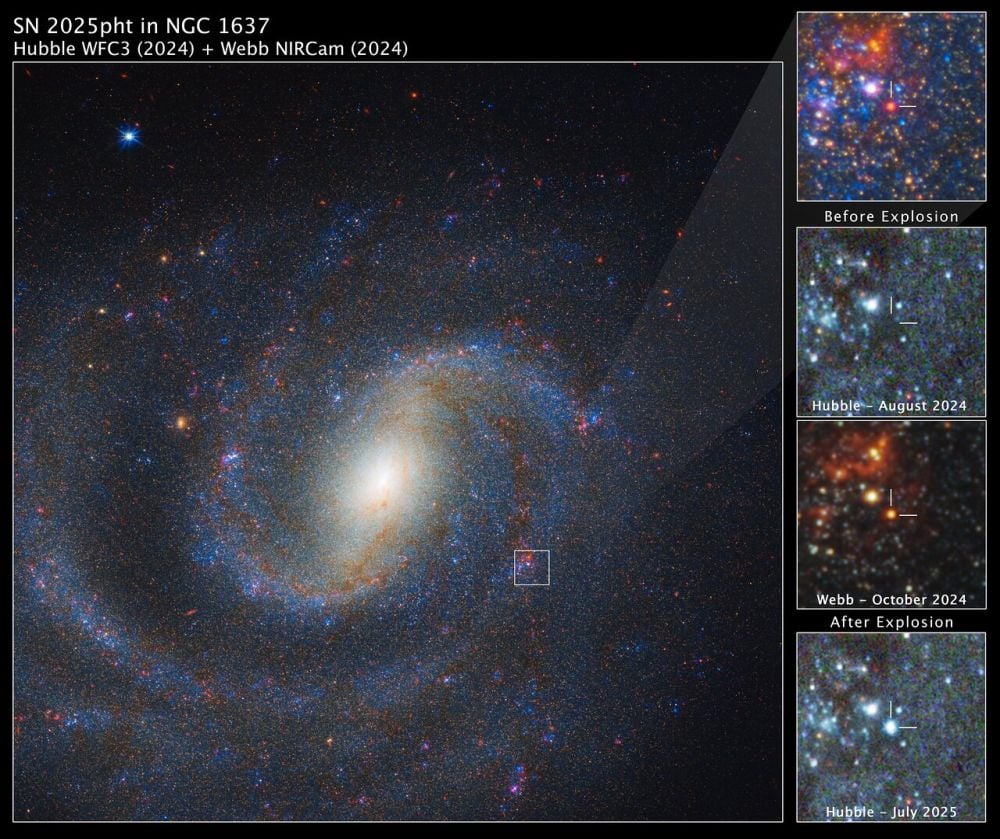
It was June 29th, 2025 when the All-Sky Automated Survey for Supernovae (ASAS-SN) detected a supernova in NGC 1637, a spiral galaxy about 30 million light-years away. Astronomers were alerted, and follow-up observations were performed. In this work, the authors observed the site of the explosion on July 31st with the Hubble Space Telescope's WFC3/UVIS. Other telescopes around the world also observed the site of the explosion.
But Kilpatrick and his co-researchers also took a different tack. They decided to examine archival JWST images of the galaxy to see if the progenitor was visible in them. They found a red supergiant (RSG) in the exact same location as SN 2025pht in MIRI and NIRCam images from 2024.
“We’ve been waiting for this to happen – for a supernova to explode in a galaxy that Webb had already observed. We combined Hubble and Webb data sets to completely characterize this star for the first time,” lead author Kilpatrick said in a press release.
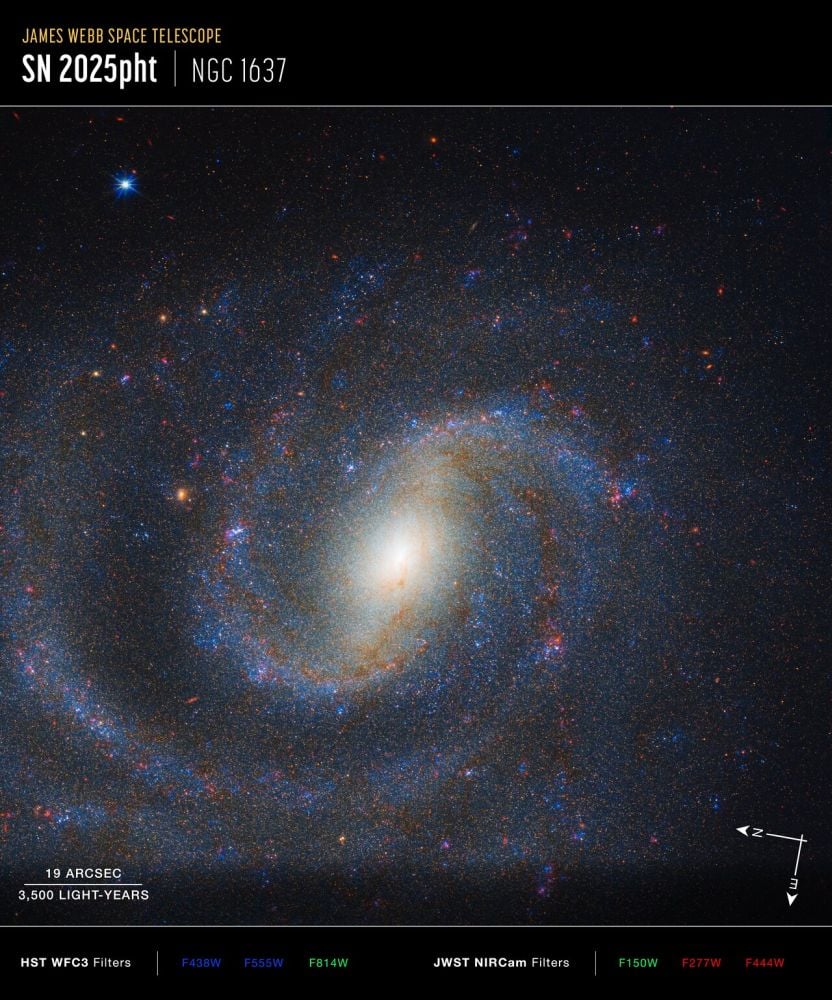 This composite image of NGC 1637 is made up of filtered images from both the Hubble Space Telescope and the JWST. The pair are a powerful duo, and their combined imagery has made a huge contribution to astronomy. Image Credit: NASA, ESA, CSA, STScI, C. Kilpatrick (Northwestern), A. Suresh (Northwestern); Image Processing: J. DePasquale (STScI)
The key part of the observations is that the star appeared much redder than expected, even though it's a red supergiant. That suggests that it's surrounded by dust, and that can explain the missing RSG problem.
“It’s the reddest, most dusty red supergiant that we’ve seen explode as a supernova,” said study co-author Aswin Suresh, a grad student at Northwestern University.
The culprit is carbon-rich dust. More specifically, it's graphite, a crystalline form of carbon. The RSG seems to be surrounded by it. But this is surprising, since RSGs tend to produce silicate dust.
"The implied carbon-rich dust composition is unusual for high-mass RSGs that tend to be oxygen-rich and produce silicates in their circumstellar environments," the researchers write. "If the SN 2025pht counterpart had a carbon-rich circumstellar environment, it may imply that the surface abundances of some evolved, carbon-burning and later RSGs are significantly enhanced owing to convection."
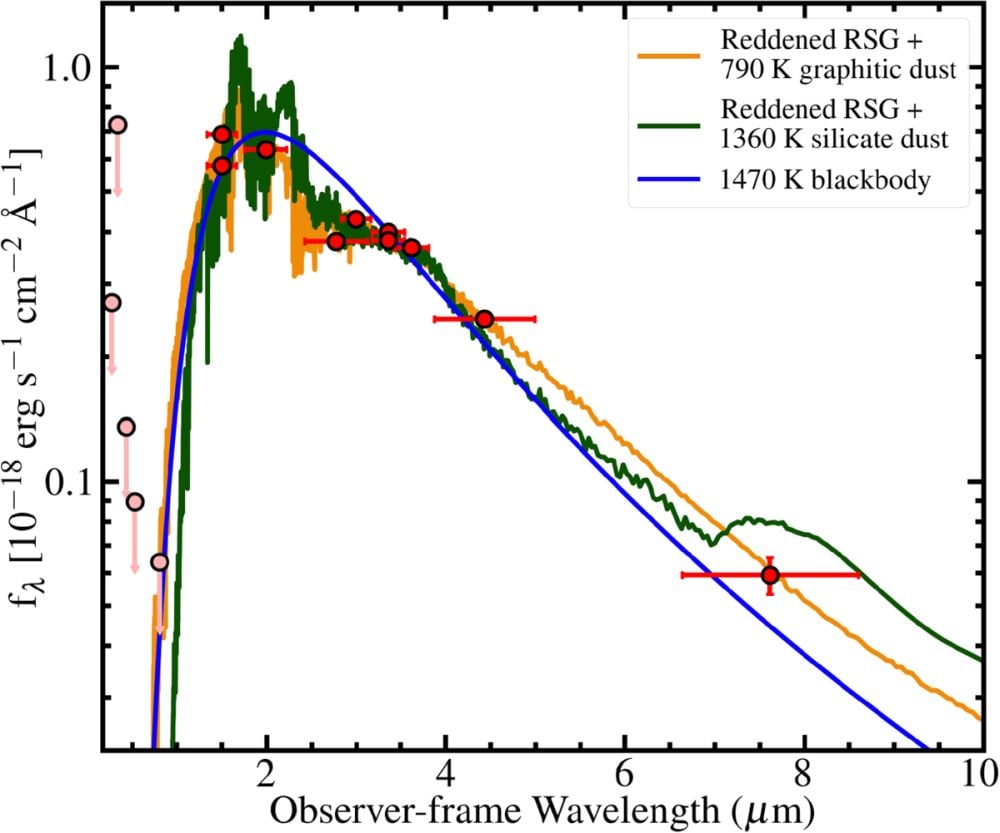 This figure from the research shows how the team determined that the dust around the progenitor was carbon-rich rather than silicate-rich. It compares three modelled spectral energy distributions to the actual data from the star. The blue line represents a black body for comparison, while the orange and blue lines represent graphitic and silicate-rich dust, respectively. At around 8 μm near the end of the graph, the silicate-rich SED no longer matches the data, leading the researchers to conclude that a thick veil of carbon-rich dust likely obscures the SN progenitor. Image Credit: Kilpatrick et al. 2026. ApJL
At this stage of their evolution, RSGs are expected to be oxygen-rich, and have oxygen dominating their surfaces. They have complex layers of different elements, and nuclear burning processes have created an abundance of surface oxygen compared to carbon. It's possible that deep convective activity has dredged the carbon up and brought it to their surfaces. If it is convection, then the discovery can place some constraints on how convection works in these massive stars. This convection in the late stages of stellar evolution is poorly understood, so this discovery can be helpful.
The discovery of the dust-obscured RSG can also explain why astronomers struggle to detect Type II SN progenitors. These thick veils of dust are shielding the stars from our attentive gaze.
“I’ve been arguing in favor of that interpretation, but even I didn’t expect to see it as extreme as it was for supernova 2025pht. It would explain why these more massive supergiants are missing because they tend to be more dusty,” said Kilpatrick.
These dusty veils have been hypothesized before, and now there's direct evidence of them, thanks to the JWST, NIRCam, and MIRI.
“Having observations in the mid-infrared was key to constraining what kind of dust we were seeing,” said Suresh.
With data from these observations in hand, the researchers are going to look for more of these carbon-obscured RSGs.
"SN 2025pht represents the beginning of SN progenitor star analyses performed with JWST," the authors write. These results show how the precise photometry and broad wavelength coverage provided by the JWST and its powerful instruments can shape our understanding of RSGs by placing some constraints on their physics.
"By answering long-standing questions about the terminal states of massive stars, we are now better able to bridge the gap between direct imaging of SN progenitor systems and indirect constraints from their pre-explosion outbursts, early light curves, and flash spectroscopy," the authors conclude.

