Universe Today
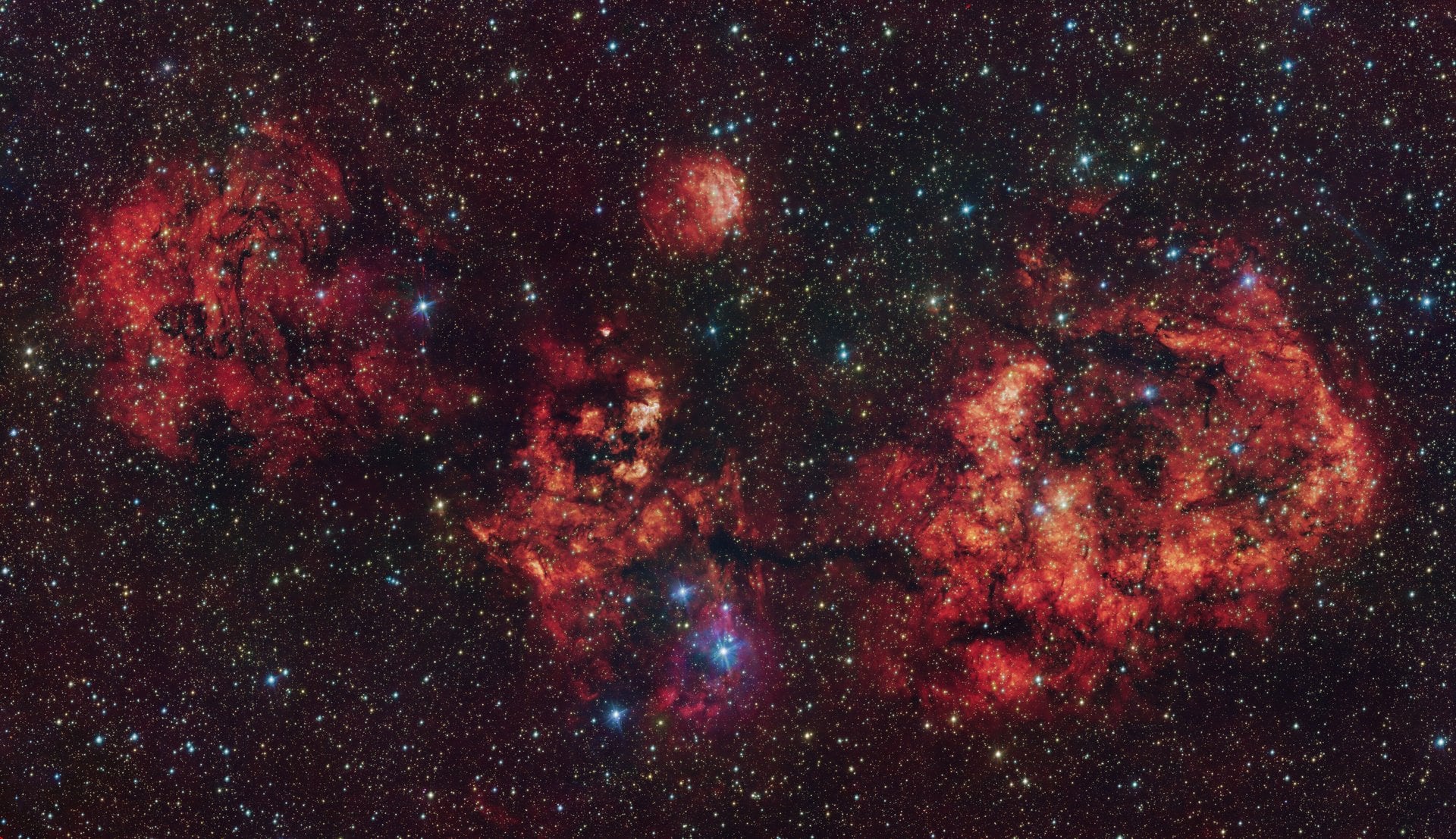
Just in time for Halloween, the ESO's Paranal Observatory in Chile spotted a spooky cosmic structure resembling a bat as it passed overhead in the night sky. The structure was a nebula located about 10,000 light-years from Earth, a stellar nursery composed of cosmic gas and dust where new stars are born. Thanks to the wide field of view on the VLT Survey Telescope (VST), part of the ESO's Very Large Telescope (VLT) at Paranal, astronomers were able to capture the silhouette of a bat in all of its spooky detail.
The nebula is located between the constellations of Circinus and Norma, located in the southern hemisphere, and spans an area of the sky equivalent to four full Moons. The most prominent clouds are RCW 94 and RCW 95, which resemble the bright right and left wings of the bat, respectively. These and other bright patches are caused by new stars forming from the nebula's gas and dust, which release enough energy to excite clouds of hydrogen, making them glow brightly.
The intense glow in this picture was captured thanks to additional infrared data provided by ESO’s Visible and Infrared Survey Telescope for Astronomy (VISTA), also at Paranal. The darker filaments, which resemble the skeletal structure of the bat, are accumulations of gas that are colder and denser than their surroundings, while concentrations of dust obscure the light of the newborn stars.
The VST is owned and operated by the Italian National Institute for Astrophysics (INAF). The telescope has the necessary resolution to capture these large-scale structures, while its state-of-the-art 268-megapixel OmegaCAM enables the VST to image vast areas of the sky. The image was created by combining observations from various observation programs that utilize different filters to capture distinct wavelengths of light.
Most of the bat's shape was captured in visible light as part of the VST Photometric Hα Survey of the Southern Galactic Plane and Bulge (VPHAS+), a campaign to observe half a billion stars in the Southern Galactic Plane and Bulge. The VISTA instrument gathered infrared data, as part of the VISTA Variables in the Vía Láctea (VVV) survey, a large-scale project that observes variable stars in the Milky Way's bulge and mid-plane.
It is a rare thing when observations of the cosmos align so well with activities here on Earth. But of course, the Universe is a REALLY big place, and once in a while, some special happens at just the right time!
Further Reading: ESO