 Universe Today
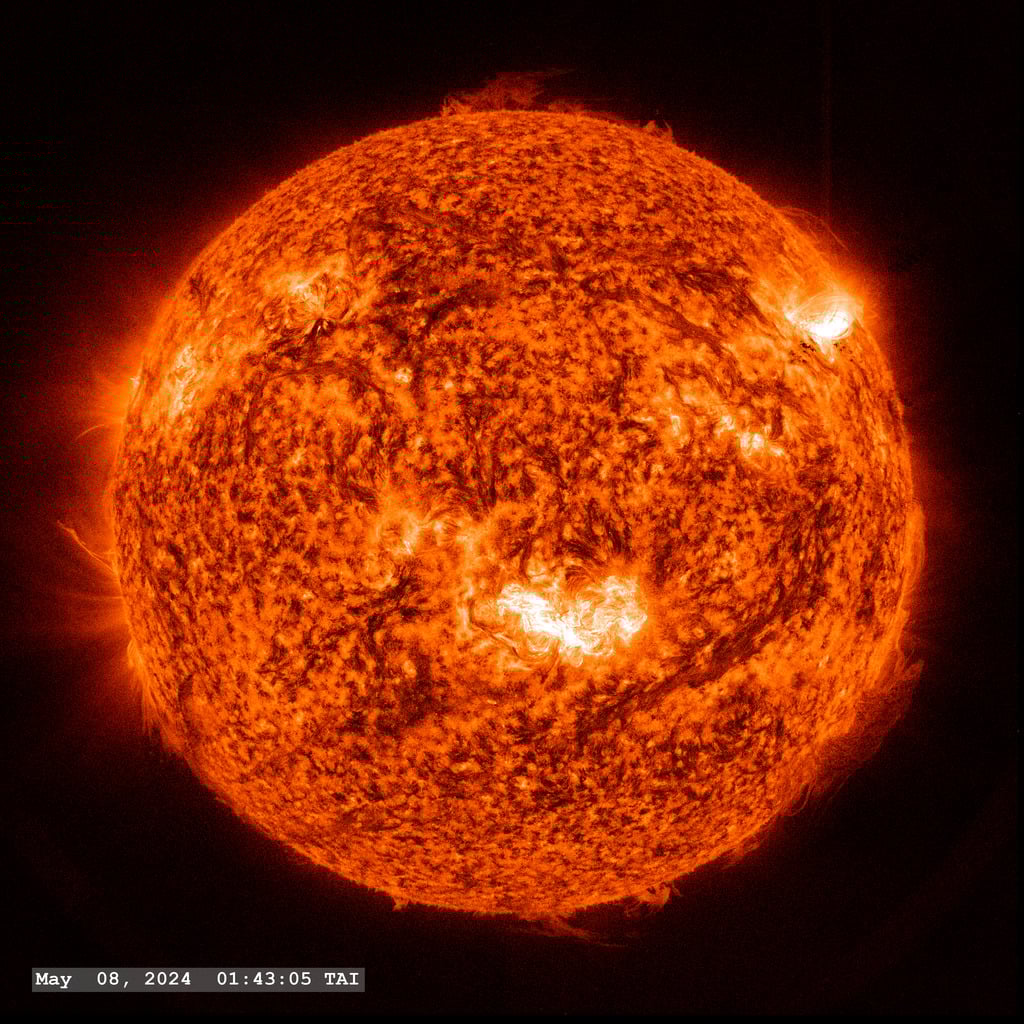
Space weather is a fascinating subject, but one we still have a lot to learn about. One of the main components of it is the active regions (ARs) of the Sun. These huge concentrations of magnetic fields show up throughout the Sun’s photosphere and are the primary source of solar flares and coronal mass ejections (CMEs). They can be simple pairings of magnetic flux or huge, magnetically complex tangles that spend weeks creating massive solar storms before dissipating. But tracking the longest lived of these ARs has been a headache for solar physicists, and a recent paper by Emily Mason and Kara Kniezewski, published in The Astrophysical Journal, both dives into this tracking problem and uncovers some interesting features of the Sun’s most persistent ARs.
To understand the problem of tracking ARs, we have to understand the system of how it's currently done. Since 1972, the National Oceanic and Atmospheric Administration (NOAA) has assigned a sequential, five-digit number to each sunspot traveling the face of the Sun. But the Sun rotates, and not in a typical way that the Earth does. Since it's made of plasma, its equator rotates faster than its poles in a process known as Carrington rotation.
Astronomers have known this for years, and they also have known that some active regions are robust enough to rotate off the western side of the Sun, transit across its far side, and then reappear on the eastern side weeks later. While it's transiting across the far side, it can be tracked using a series of extreme ultraviolet maps and farside helioseismic data to make sure they were tracking the same AR.
Fraser talks about the Carrington Event - the most powerful solar storm ever recorded.But when it appears back on the side of the Sun facing us, the NOAA number system assigns it a completely new number again. As any computer scientist will tell you, tracking information in databases when they assign different identifiers to the same thing is a difficult task, and typically has to be done manually. The authors decided to do just that, and looked at 1611 unique NOAA AR designations between 2011 and 2019. Of that they found 101 distinct long-lived active regions (LLARs), which accounted for about 214 individual NOAA numbers. They found that LLARs comprised about 13% of all identified ARs.
There are a few interesting features about these longer-lived counterparts to regular ARs. Their frequency changes in line with the solar cycle, the same as their shorter-lived counterparts. But they are physically larger and contain significantly more concentrated magnetic flux. However, according to a factor known as the Mt. Wilson classification scheme, which looks at the “magnetograms” of a sunspot, they have around the same distribution of magnetic complexity.
Despite having the same complexity, LLARs are wildly more disruptive than a traditional AR. They are four times as likely to release a C-class flare, five times as likely to release an M-class flare, and six times as likely to release an X-class flare, the most massive of them all. According to the authors, it’s possible LLARs release so many more flares because they are formed from stronger flux regions rooted deeper in the Sun’s surface. This would also explain their extreme longevity, but so far this is just a theory that must be proven with data.
Fraser talks about how bad solar storms can get.Some of the data for this paper was originally planned to be categorized using a citizen science project called “Solar Active Region Spotters” on Zooniverse. It was intended to test if crowdsourced volunteers could accurately track AR evolution, but the task was extremely complex for laymen. It required untrained volunteers to interpret magnetograms, EUV images, and coronal loops, and the accuracy of actively tracking ARs was only about 64%, so their efforts weren’t included in the final results. However, as the authors pointed out, it was very successful as an outreach tool.
Ultimately there’s still plenty we don’t understand about LLARs. We now know they constitute a relatively small, but highly explosive, subset of a common solar phenomena. Reconfiguring the method to number and track them would provide one potential boon to their study, but that would require significantly more computational power and effort from NOAA, which, given current governmental budget constraints, is likely not forthcoming. If we want to develop our ability to truly predict space weather rather than just monitor it, though, we’re going to need to come up with some better system than having researchers manually correlate data to keep track of the most devastating storms.
Learn More:
NASA - Volunteers Find Oddly High Solar Flare Rates
E. I. Mason & K. L. Kniezewski - Statistical Overview of Long-lived Active Regions Observed across Multiple Carrington Rotations
