Universe Today
Astronomers gain new key insights from old solar observations.
It’s tough sometimes, living with a tempestuous star. Modern human civilization and technology lives at the whim of the Sun, as it sends solar storms and punishing coronal mass ejections our way. And while we understand the overall pitch of the 11 year solar cycle, it's hard to predict exactly what the Sun is going to do next. Now, a recent study has reached back and examined over a century of solar observations, in an effort to make more accurate near-term predictions of solar activity.
The study was a collaboration between Germany’s Max Plank Institute, the Southwest Research Institute (SwRI) and the Aryabhatta Research Institute of Observational Science based in India.
At the heart of the study was 100 years of solar data gathered from the Indian Institute of Astrophysics’ Kodaikanal Solar Observatory (KoSO), based in Bangalore. Established in 1901, Kodaikanal has carried out uninterrupted observations of the Sun for more than a century.
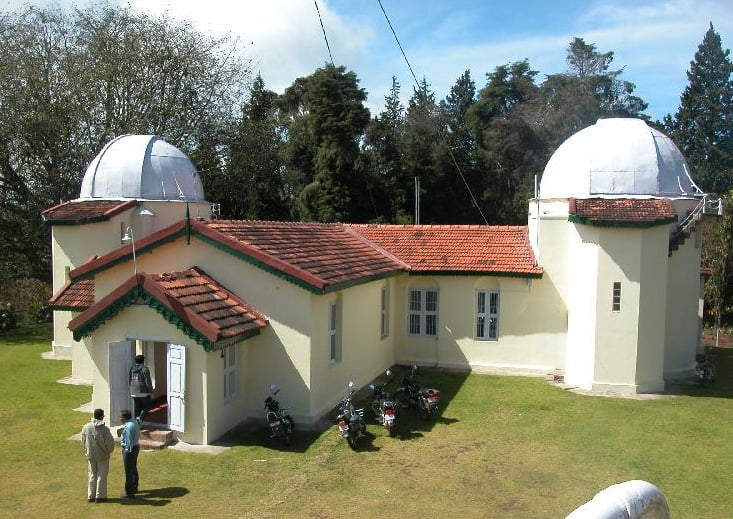 The Kodaikanal Observatory. Credit: Wikimedia Commons/Marcus334/CCA 2.5 license.
One key piece of the solar activity puzzle the study sought to understand is the Sun’s polar magnetic behavior over time. The Sun is tipped 7.25 degrees relative to the ecliptic, with the north rotational pole tipped towards us on September 8th, and away from us on March 6th. This means polar activity is largely hidden from our Earthly vantage point, though we do get to peek over the poles biannually as the Sun seems to nod back and forth.
To apply these older observations with modern activity, the team turned to observations from the joint NASA/European Space Agency’s Solar Heliospheric Observatory. Launched in 1995, SOHO has now observed the Sun for over a quarter of a century now. This is more than one Hale Cycle, which is equal to 22 years (two 11-year solar cycles), the time it takes the hemispheres of the Sun to flip and return back to the same polarity.
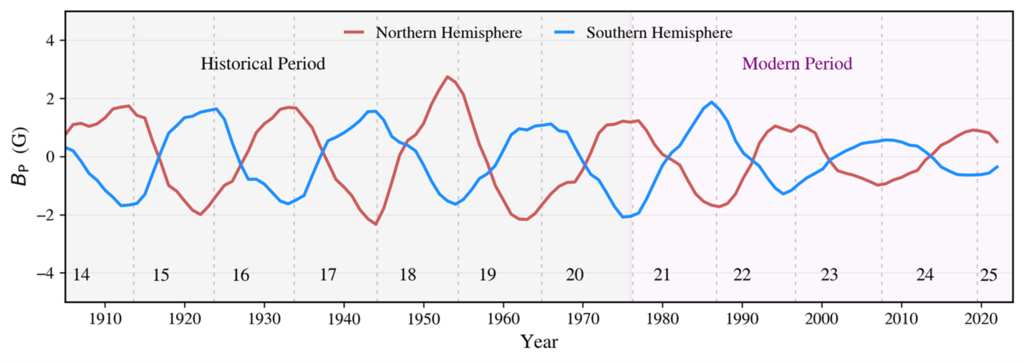 The Sun's polar magnetic activity over a one century span. Credit: SwRI/KoSO/IIA.
Specifically, the team noticed a strong correlation between SOHO’s Michelson Doppler Imager measurements of the Sun’s magnetic field, and bright regions seen in Calcium-K. Although the first direct measurements of the Sun’s polar magnetic field only started in the 1970s, KoSO has been making Calcium-K observations since 1904.
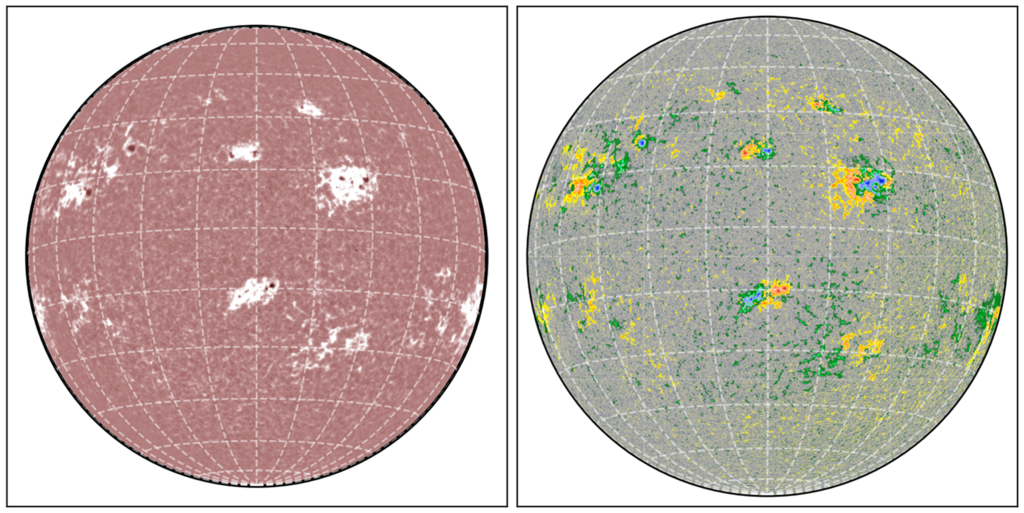 A comparison between SOHO's Michelson Doppler Imager (left) and KOSO's observations. Credit: KoSO/IIA/SOHO/NASA/ESA
Bright patches seen in the Sun’s chromosphere in Cal-K are known to correlate with solar magnetic activity. What’s more, we’ve watched sunspot activity going all the way back to the start of Solar Cycle 1 in 1755. New sunspots tend to start at higher solar latitudes heralding the beginning of a new cycle, and work their way towards the Sun’s rotational equator later in the cycle, in what’s known as Spörer’s Law. Clearly, magnetic activity at the Sun’s poles plays a key role in driving the solar cycle.
But examining such a large dataset was challenging. The team needed to correct for rotation errors and time zone slips in the more than 50,000 images examined by the study’s algorithm. As an incandescent ball of gas, the Sun does not rotate in a uniform fashion, but instead varies from a spin of 25 days near the solar equator, to just over 34 days near the polar regions.
"We needed to find the polar magnetic information hidden in the historical data," says Bibhuti Kumar Jha (SwRI) in a recent press release. "To start, we cleaned up and calibrated early data to today's standards and then correlated patterns with modern observations. I addressed anomalies like time zone slips and rotation errors to enable this kind of study."
Current capabilities can accurately project solar activity for out to about five years, though researchers would like to extend that further out for long term mission planning. To date, NASA’s Ulysses mission which ended in 2009 was the only dedicated mission to study the solar poles, although ESA’s Solar Orbiter and NASA’s Parker Solar Probe do offer oblique views. The next step is to dispatch a new polar orbiter mission to the Sun. One current proposal, China’s Solar Polar Orbit Observatory, would launch around 2029.
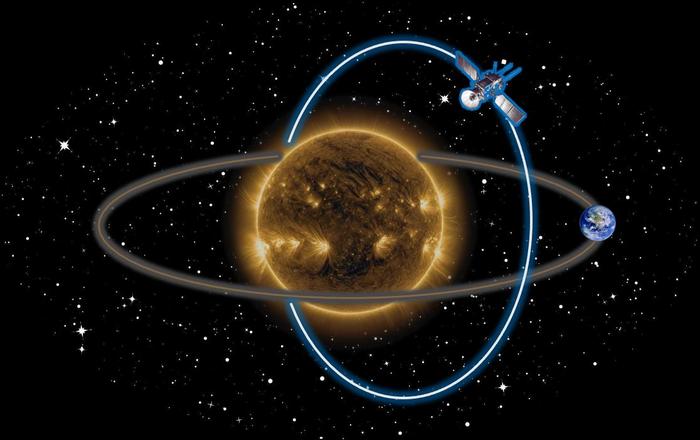 A proposed solar polar orbiter. Credit: CNSA
You can see how unpredictable the Sun can be just looking at activity in early 2026, as we come down off of the peak of Solar Cycle 25. First, the Sun produced one of the biggest sunspots in recent years last month, (Active Region 4366). Then, it abruptly fell silent, as the Earthward face of Sol saw a three day spotless stretch almost immediately afterwards. This marked the first span without sunspot activity since 2022.
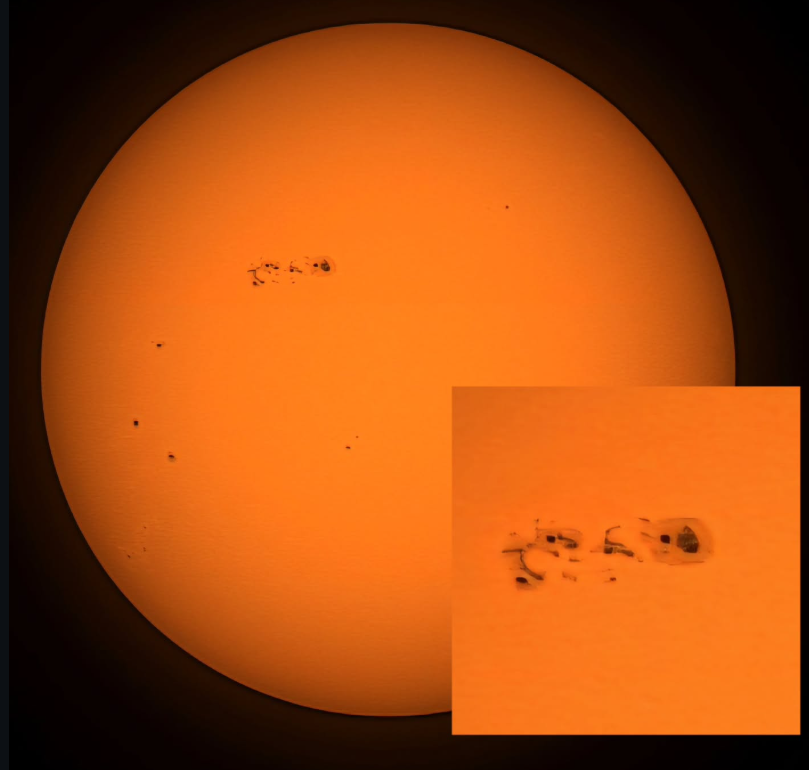 February's massive sunspot group. Credit: Dave Dickinson/Dwarf Mini
Are there longer, as yet undiscovered cycles in solar activity? Why is the 11-year span ‘baked in’ to the Sun’s activity, and will this always be the case? This study demonstrates the value of incorporating old observations and coupling them with new data, in an effort to understand our host star.