 Universe Today
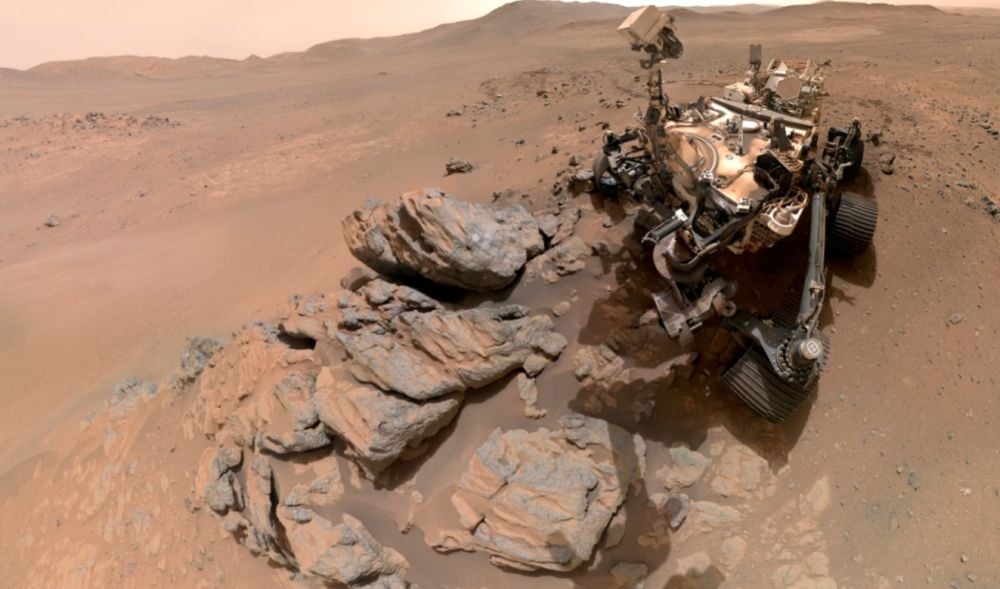
NASA's Perseverance was at a location named “Lac de Charmes" (Lake of Charms) when it captured its latest self-portrait. Lake of Charmes, or Lake Charmes, is a reservoir in France. It's a nickname, based on the fact that the rover is exploring an ancient paleolake. By informal convention, the rover team names locations and features by themes, and lakes and waterways are the theme.
The Lac de Charmes region sits just to the west of Jezero Crater's rim. The area contains some of the most scientifically interesting features Perseverance has explored. It may contain the oldest rocks the rover will encounter, and also contains megabreccia. Megabreccia are massive fragments of rock, and these ones were launched into the air by an ancient massive meteorite impact on Isidis Planitia 3.9 billion years ago.
Perseverance had just finished abrading and analyzing the rocky outcrop in the image, named Arathusa, when it captured this composite selfie. This is the furthest the rover has travelled siince landing in Jezero Crater in February 2021.
“We took this image when the rover was in the ‘Wild West’ beyond the Jezero Crater rim — the farthest west we have been since we landed at Jezero a little over five years ago,” said Katie Stack Morgan, Perseverance’s project scientist at NASA’s JPL. “We had just abraded and analyzed the ‘Arathusa’ outcrop, and the rover was sitting in a spot that provided a great view of both the Jezero Rim and the local terrain outside of the crater.”
Perseverance abrades rocks before it studies them so it can see what's under the surface. Abrading is also a common technique in geology here on Earth. It removes the outer layer, which is altered by weathering and exposure to radiation and the Martian atmosphere over billions of years. It's like cleaning a window before looking through it, and gives Perseverance a better look at a rock's pristine composition. It's no different than what any geologist would do with their hammer. In this case, the Perseverance team learned the Arathusa is probably older than Jezero Crater and is composed of igneous minerals.
Mars is a desolate, wind-swept planet, but Perserverance's presence there livens it up a little, even though it's just a robot.
 Perseverance created this enhanced-colour panorama of the Arbot area with 46 separate images. The rover's tracks can be seen receding into the background on the right. To the untrained eye, the image shows only plain rock and dust. But it's actually one of the most geologically rich regions in the rover's mission, and contains diverse types of rock. Image Credit: NASA/JPL-Caltech/ASU/MSSS
Perseverance captured the above image of the Arbot region on April 5th. It shows rounded rocks in the foreground, and sharp-edged rocks on the ridgeline. The sharp-edged rocks are likely megabreccia from the ancient impact.
“What I see in this image is excellent exposure of likely the oldest rocks we are going to investigate during this mission,” said Ken Farley, Perseverance’s deputy project scientist at Caltech in Pasadena. “There is a sharp ridgeline visible in the mosaic whose jagged, angular texture contrasts starkly with the rounded boulders in the foreground. We also see a feature that may be a volcanic dike, a vertical intrusion of magma that hardened in place and was left standing as the softer surrounding material eroded away over billions of years.”
Just as on Earth, some ancient rocks from deep in the crust are naturally exposed, giving scientists an opportunity to study the planet's interior composition. If the sharp-edged rocks are megabreccia, they were likely blasted from deep below Mars' surface by a massive impact.
“The rover’s study of these really ancient rocks is a whole new ballgame,” said Stack Morgan. “These rocks — especially if they’re from deep in the crust — could give us insights applicable to the entire planet, like whether there was a magma ocean on Mars and what initial conditions eventually made it a habitable planet.”
Perseverance will abrade and examine more rocks in the Arbot area. When it's done there, it will travel to a region named “Gardevarri." Gardevarri has clearly exposed olivine, which forms at high temperatures deep inside planets. Olivine is the primary component of Earth's mantle, and studying it reveals a lot about our planet's history.
Studying Mars' olivine can not only shed light on the planet's volcanic history, but also contains carbonates that form in the presence of water. So studying Martian olivine can reveal things about the planet's watery past. In fact, the presence of olivine was one of the reasons Perseverance was sent to the region.
Following its visit to Gardevarri, the team might send the rover to a place called "Singing Canyon." It holds more ancient rock, which is always scientifically valuable.
Perseverance has almost completed a marathon. It's travelled 42 kilometers, and a marathon is 26.2 miles, or 42.195 km. It's next milestone after this one may be an ultramarathon. There's no single defined length for an ultramarathon, but the shortest one can be is 31 miles, or 50 km.
“Having the benefit of four previous rover missions, the Perseverance team has always known our mission was a marathon and not a sprint,” said acting Perseverance project manager Steve Lee at JPL. “We’ve almost reached marathon distance. Our selfie may show that the rover is a bit dusty, but its beauty is more than skin deep. Perseverance is in great shape as we continue our explorations and extend into ultramarathon drive distances.”

