 Universe Today
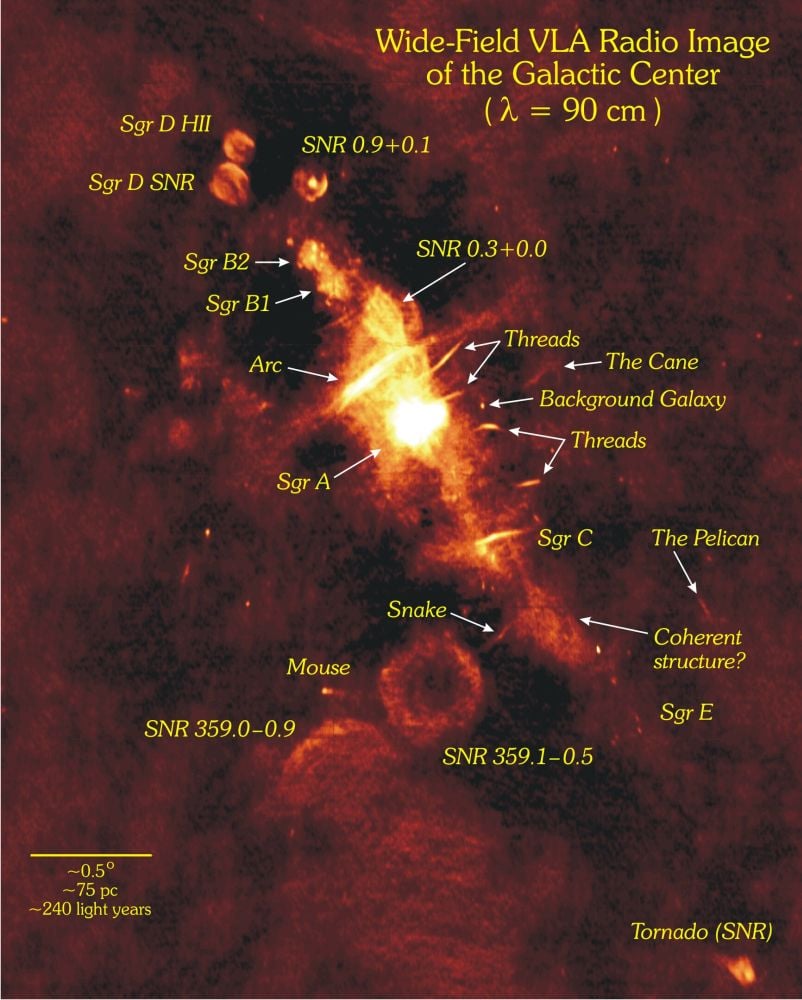
The center of the Milky Way is an extreme environment dominated by the supermassive black hole (SMBH) Sagittarius A star (Sgr A-star). Sgr A-star has about 4 million solar masses, and its powerful gravity and radiation defines the region. Its gravity accelerates the orbits of stars and gas clouds in its vicinity. Radiation from the SMBH's accretion processes, from the stellar winds coming from colliding stars, from abundant supernovae explosions, and from superheated gas falling toward the black hole, saturates the region.
It's a slow-motion catastrophe playing out on a timeline far longer than all of human history.
The focal point of this calamity is the galaxy's central parsec. It's densely packed with stars, and the stellar density is millions of times greater than near the Sun. One group of stars in the region is named the S-stars, a small cluster of high-velocity stars that were critical in determining Sgr A-star's mass. There are actually two distinct sub-groups in the S-stars: the S-stars themselves and another group called the dusty G-objects. Astronomers have wondered how these dust-shrouded objects fare in this extreme environment, and whether they're inevitably drawn into the black hole and destroyed.
The region is choked with dust, making observations difficult. But the Very Large Telescope was able to observe the region with two instruments named SINFONI and NACO, now retired and replaced by an instrument named ERIS (Enhanced Resolution Imager and Spectrograph). New research used two decades of SINFONI and NACO data, as well as new observations with ERIS, to track the S-stars and the G-objects near Sgr A-star.
The research is titled "Closing the gap: Follow-up observations of peculiar dusty objects close to Sgr A* using ERIS," and it's published in the journal Astronomy and Astrophysics. The lead author is Dr Florian Peißker, a post-doc researcher at the University of Cologne.
In the new research, the authors explain that the S-cluster is one of the astrophysical environments in the Milky Way's (MW) inner parsec. "One of these environments is the S cluster, which consists of two distinct populations: the main-sequence S stars, and the dusty G objects. While the majority of the brightest S stars can be classified as young B stars, the G sources can be described as dusty objects whose nature is still under debate," the authors explain.
This work focuses on three of the dusty G objects: G2/DSO, D9, X7. It also examines a young stellar object (YSO) named X3. The idea that the region is extremely destructive endures, but is it really true? The goal of this work was to determine how destructive the region near Sgr A-star actually is, and if stars in the region are doomed, or if they can maintain stable orbits.
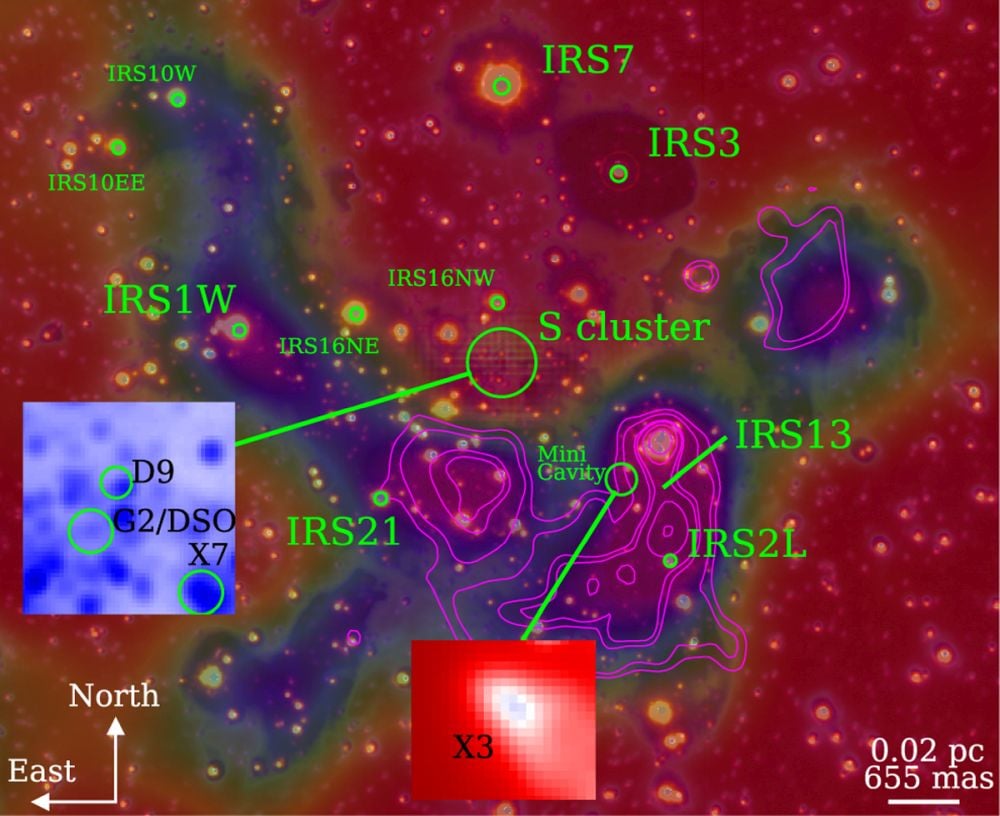 This image from the research is a multiwavelength finding chart of the inner ≈0.8 pc of the Galactic center. In callouts, it shows the three G-objects (blue) and the YSO X3 (red). Image Credit: Peißker et al. 2025. A&A
The researchers used two decades of SINFONI and NACO observations of the MW's inner parsec. They used that data to predict the current positions of the four objects according to Keplerian trajectory. Then they used the VLT's new ERIS instrument to determine if the objects were in their predicted locations.
One of the objects, G2/DSO, was also examined more closely. It has long been regarded as a dust and gas cloud. It's elongated, and that "spaghettification" has been attributed to the massive gravitational pull from the black hole. The idea is that the stretching and deformation of the cloud is a precursor to its eventual destruction at the hands of Sagitarrius A-star.
But the results show that G2 is on a stable orbit That proves that it's a star inside a cloud, rather than just a cloud, and that the region isn't as destructive to stars as thought.
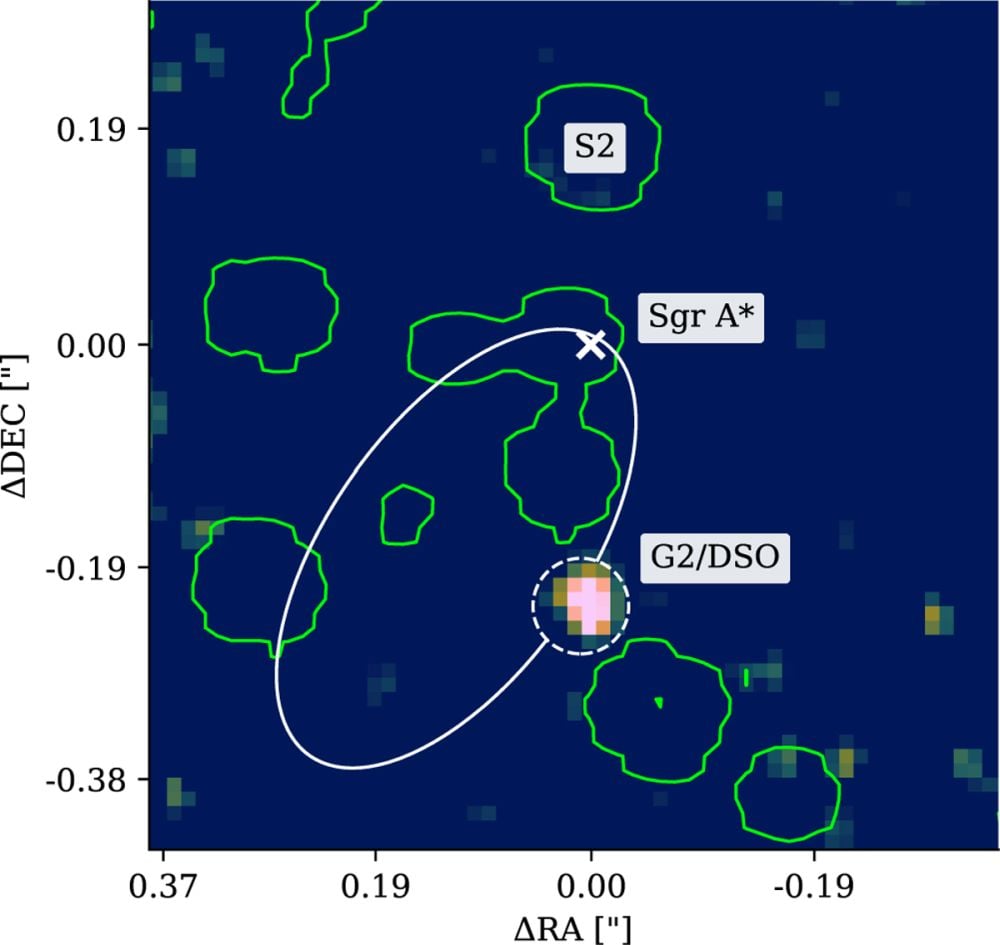 This figure from the research shows G2/DSO on its Keplerian orbit as measured by ERIS in 2024. This is evidence that the black hole isn't affecting the star as much as thought. Image Credit: Peißker et al. 2025. A&A
The ERIS observations of the other objects agree. D9 is a binary star system, and ERIS observations also showed that it was in its expected position, indicating that it's also on a stable orbit.
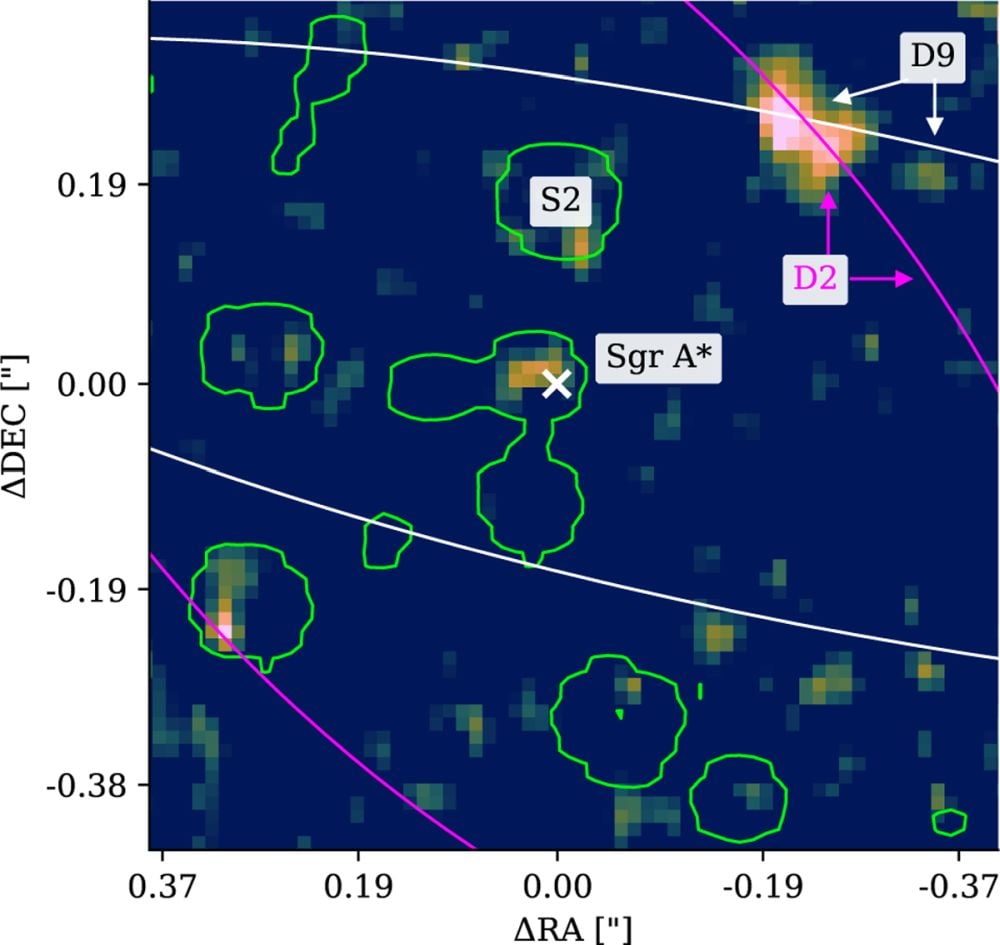 This figure based on ERIS observations shows that the binary star D9 is also in its expected position. The fact that it's on a stable orbit is more evidence that the region near the SMBH isn't as destructive as thought. Image Credit: Peißker et al. 2025. A&A
The same is true for the other two objects in the study, X3 and X7. X7 is interesting because it's an elongated object that features a bow-shock. A 2023 paper observed it in detail, saying "We present a simple model showing that these results are compatible with the expected effect of tidal forces exerted on it by the central black hole, and we propose that X7 is the gas and dust recently ejected from a grazing collision in a binary system."
But these results don't agree. The researchers didn't find any evidence that it's being stretched by the SMBH's gravity. "... we find no indications that the head significantly approaches Sgr A*," they write, adding that "The bow-shock source X7 follows its trajectory northward."
X3 is different because its offset from the S cluster. It's a massive YSO with a bow shock, according to the authors. The ERIS observations show that it's also following its projected Keplerian orbit, relatively unaffected by the SMBH, although it has sped up.
Taken together, the research shows that the MW's central parsec around Sagitarrius A-star is not as destructive as thought.
“The fact that these objects move in such a stable manner so close to a black hole is fascinating,” said lead autho Peißker in a press release. “Our results show that Sagittarius A* is less destructive than was previously thought. This makes the centre of our galaxy an ideal laboratory for studying the interactions between black holes and stars.”
There's no doubt that the SMBH dominates the region. But it's looking more and more like that domination may not be as simple as thought. The processes that take place there, and which it fuels, seem to be more complicated than thought.
“The supermassive black hole at the centre of the Milky Way has not only the capability to destroy stars but it can also stimulate their formation or the formation of pretty exotic dusty objects, most likely via mergers of stellar binaries,” said study co-author Michal Zajaček from Masaryk University in Brno (Czech Republic).
There's much more to be observed and learned in this dense, action-packed environment. There are some uncertainties in this data just as there is with all astronomical data. Future observations with the JWST, and with the upcoming Extremely Large Telescope will see even more clearly into this perplexing region and further reduce the observational uncertainties.

