Universe Today
(This is Part 2 of a series on primordial black holes. Check out Part 1 here!)
At the same time that Vera Rubin was turning cosmology upside down with conclusive evidence for the existence of dark matter, Stephen Hawking was doing…Stephen Hawking things. Which at the time largely concerned minor questions like the ultimate origins to the universe and the true nature of black holes.
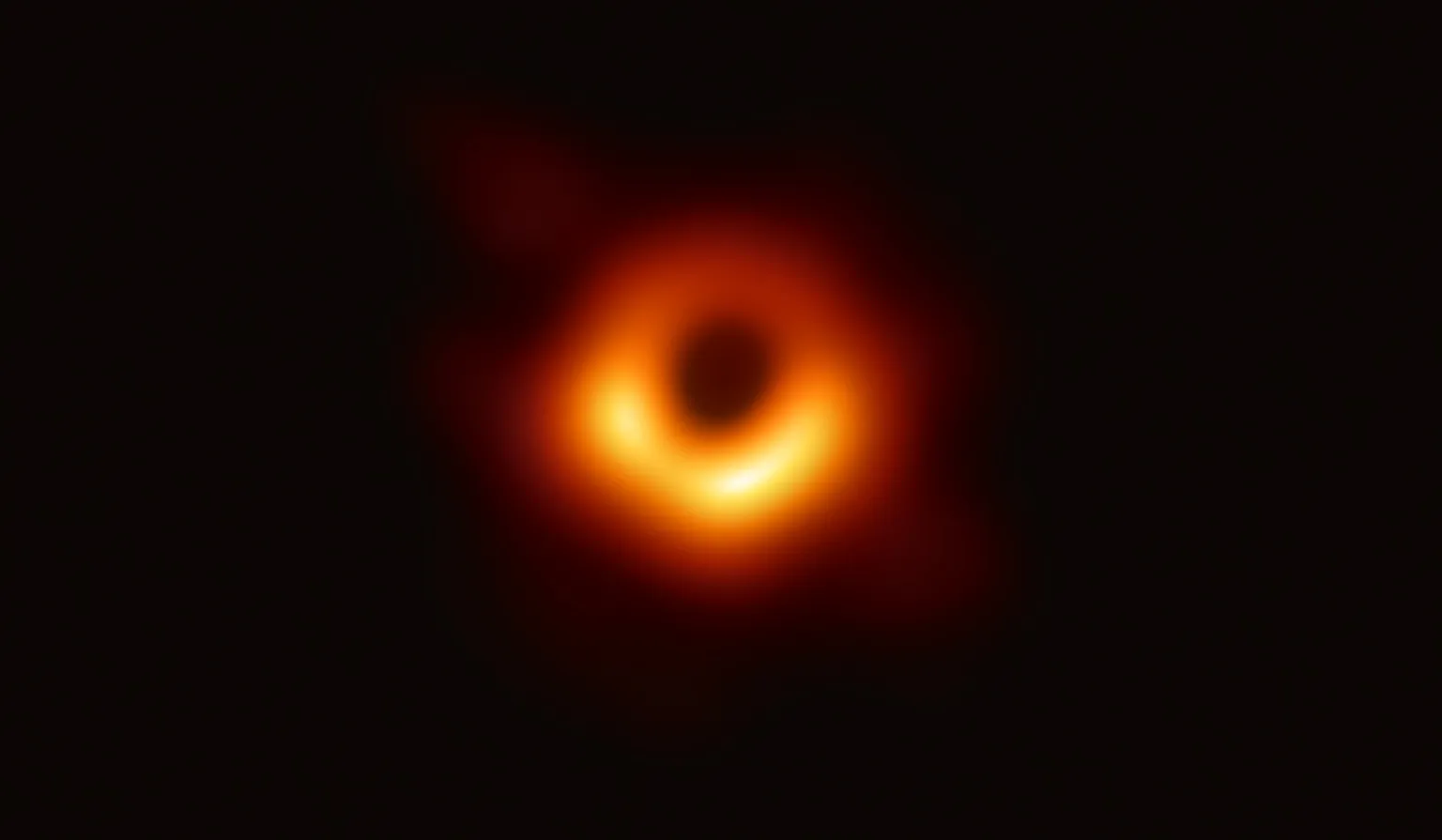
In his work Hawking realized that black holes aren’t exactly, precisely, totally, 100% black. They’re a little…gray. Or maybe dusty maroon. Or maybe something else, but definitely not black. Due the complex relationship between a black hole’s event horizon and the quantum fields that soak all of spacetime (which for now we’ll just call magic and move on, but feel free to ask and I’ll do a whole episode on it) that black holes slowly emit radiation.
Now this isn’t a lot of radiation. For a typical solar mass black hole, we’re talking a rate of around one photon a year. Which…okay it’s not nothing which is the important part.
But what does all this have to do with dark matter?
From all available evidence we suspect that dark matter is matter. It’s not a new force or change to how gravity operates. And the easiest way to make dark matter is for it to just exist. Like normal matter that’s not exactly very bright. Of which we have plenty of examples in the nearby universe. Planets and asteroids and bits of dust aren’t particularly glowy, all things considered. And black holes, even the radiating kind, are…well they’re close enough to black that they might as well be invisible.
So case closed! You just take a galaxy or cluster or whatever and fill it up with a bunch of black holes, and boom, you’ve soled the dark matter mystery. Can’t see the black holes, but they still have gravity, and the rest of cosmology can proceed.
Except for one teensy tiny little problem: the universe can’t make enough black holes.
There’s only one bona fide confirmed way to manufacture black holes, and that’s through the deaths of massive stars. You take a giant star, let it run long enough that it fuses iron in its core, ad before you know it, it turns inside out and you’ve got a supernova explosion on your hands. And in the brief instant right before total catastrophe, the pressures in the core reach such insane levels that nothing can stop total and complete collapse, aka the formation of a black hole.
So to make black holes you need stars, and to make stars you need stuff. But there’s only so much stuff in the universe.
We know this through a completely different calculation that doesn’t involve dark matter at all. It’s called Big Bang nucleosynthesis, and it’s our understand of how the universe worked when it was only a few minutes old. At that time, when the entire observable cosmos was smaller than a light-year or so, the temperatures and pressures were so high that nuclear fusion could take place. This made protons and neutrons bind together to make deuterium, helium, and a little bit of lithium.
But the universe was also expanding, and once it got too big it got too cold for the fusion party to keep going. This locked in the total amount of matter available for the entire future history of the universe. And what’s most amazing about this story is that it predicts the ratio of hydrogen to helium in the universe to be 75% hydrogen and 25 % helium (which everything else being a rounding error).
And that’s…what we see in the real universe. So that’s nice.
What big bang nucleosynthesis also tells us is that the total amount of normal matter, the kind of matter made out of protons and neutrons, can be no more than 4 or 5 percent of the total amount of stuff available in the universe.
It’s just locked in from the very beginning. So you can’t have the dark matter be black holes, because for there to be enough black holes you first need a lot of stars, and to have a lot of stars you need a lot of material, and to have a lot of material you need a lot of protons and neutrons, and all of our calculations and estimates and theories and observations and experiments all tell us that there aren’t enough protons and neutrons.
So black holes are not the dark matter.
Unless you’re Stephen Hawking. Or, at least thinking like he did in the 1970’s, because he’s dead now and not up to much thinking anymore.
Hawking didn’t set out to solve the dark matter mystery. He knew it was happened and was curious about the new developments, but never made it the focus of his research. Instead he was interested in finding ways to test his new discovery that black holes emit radiation.
His calculation suggested that smaller black holes emit more radiation than larger ones. And that REALLY small black holes pop off like mini-supernovas in flashes of intense energy. But once again, the known process of building black holes kills all the joy: stars have to be big enough to fuse iron to trigger black hole formation, which means the smallest black holes are going to be a few times the mass of the Sun.
And those black holes will eventually evaporate in about…10^100 years. Astronomers are patient people but good luck getting funding for an experiment that will have to run for many multiples of the present age of the universe.
Case closed. Unless there’s another way to build black holes.
To be continued...