 Universe Today
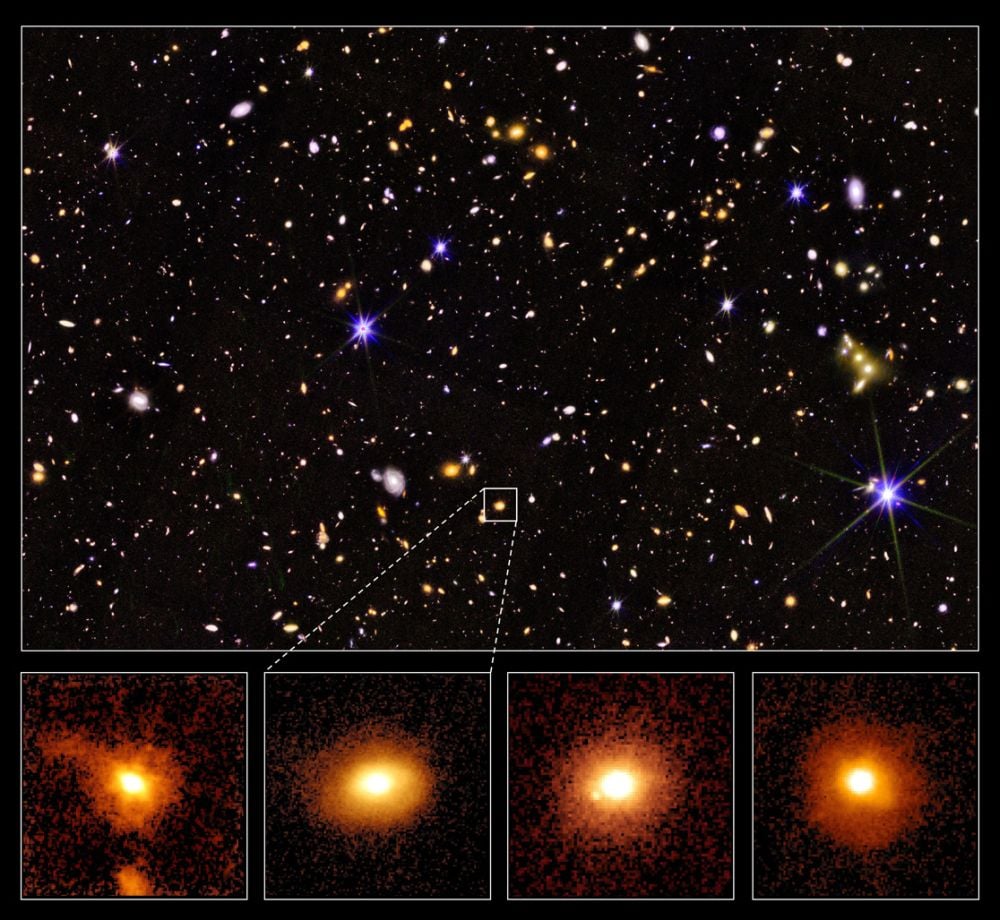
The James Webb Space Telescope has applied relentless pressure on our understanding of the Cosmos. The powerful infrared space telescope is exquisitely tuned to sense and analyze red-shifted light from galaxies in the early Universe. Its observations have presented astronomers with a two-pronged problem.
Universe Today readers know that the JWST found galaxies in the early Universe that were already far more massive than astronomers thought they could be. But there was more to that puzzle. The JWST also discovered that some of these massive galaxies had already stopped forming stars much earlier than thought. One well-known one is ZF-UDS-7329, a massive galaxy that was already quenched only two billion years after the Big Bang.
ZF-UDS-7329 isn't the only massive quenched galaxy in the early Universe, and it and other galaxies in its cohort require an explanation. The further the JWST looks back in time, the fewer massive galaxies it should detect. Yet it's found many extremely massive quiescent galaxies only 1 to 2 billion years after the Big Bang. That means that there were post-Starburst (PSB) galaxies in existence hundreds of millions of years sooner than thought.
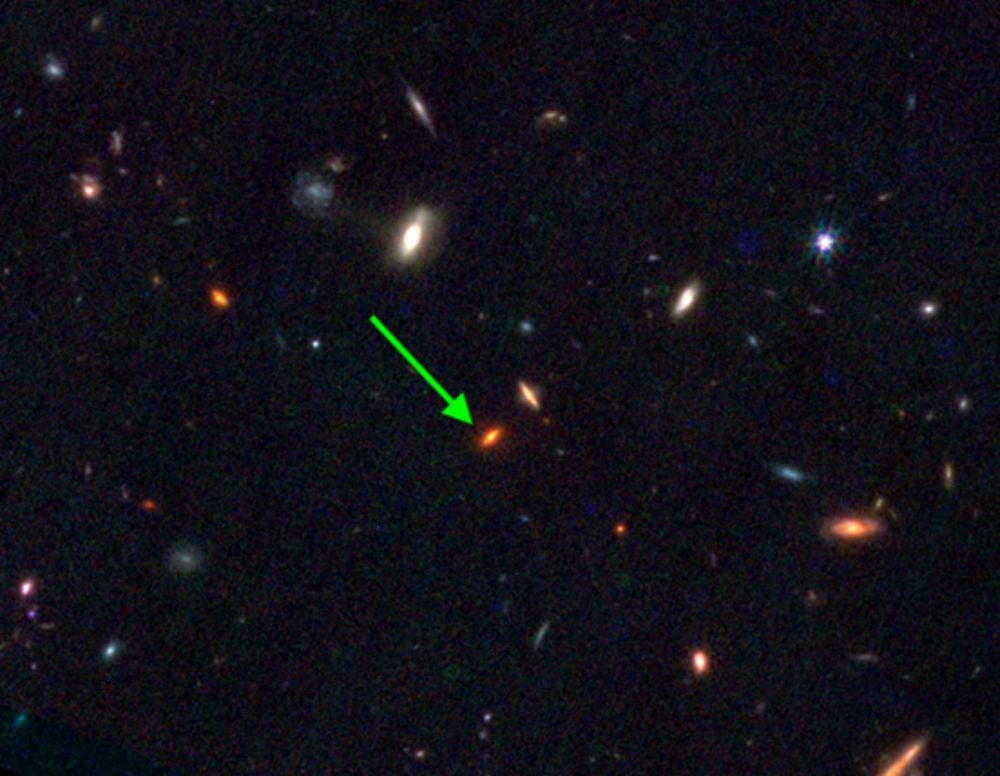 This image shows ZF-UDS-7329, one of the Universe's early massive galaxies that quenched early. These galaxies are a challenge to understand, and new JWST observations have made headway. Image Credit: Glazebrook et al., doi: 10.1038/s41586-024-07191-9
Recent research published in Astronomy and Astrophysics has an explanation. It's titled "The multiwavelength structure of post-starburst galaxies at 0.5 < z < 3 with JWST PRIMER: compact morphologies and residual disturbances," and the lead author is Dr. David Maltby. Maltby is from the School of Physics and Astronomy at the University of Nottingham.
There are only two basic things that can quench star formation. Stars form from collapsing cold gas, and removing that gas or cutting off the supply stifles star formation. The injection of heat and turbulence can also disrupt star formation, but without removing the gas. Different scenarios can trigger either of these causes.
Gas stripping through tidal interactions with other galaxies or galaxy clusters is one way star-forming gas can be removed. Supermassive black hole/AGN feedback can heat gas and introduce turbulence. Those are just two possibilities among many.
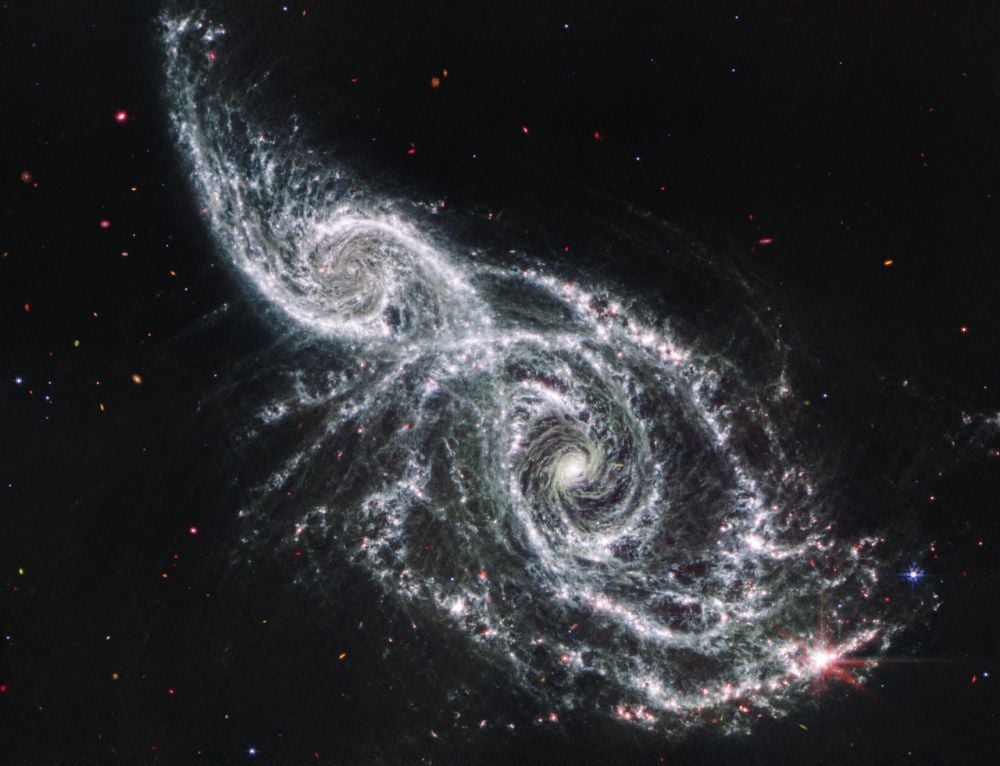 This JWST MIRI image shows two galaxies in the early stage of merging. The larger spiral, NGC 2207, is tidally stripping the gas from the smaller galaxy, IC 2163. Eventually, in about a billion years, they will merge. Image Credit: NASA, ESA, CSA, STScI - Galaxies IC 2163 and NGC 2207 (Webb MIRI Image), Public Domain, https://commons.wikimedia.org/w/index.php?curid=154773560
To try to determine what quenched these early galaxies, the researchers analyzed the light from 120 post-Starburst galaxies (PSBs) from 0.5 < z < 3, a range which captures the rise, peak, and aftermath of the Cosmic Noon, when star formation in the galaxies was at its peak.
“This was the epoch of peak activity in the Universe, when many of the most massive galaxies we see today were formed,” said Professor Omar Almaini, who led the team behind the new study. "A long-standing problem has been to understand why these galaxies stop forming stars. With Webb we can see detail that was completely hidden before, allowing us to search for clues to what drives this dramatic transformation."
Quenched galaxies have different spectra than star-forming galaxies and the JWST can see the difference. One of the JWST's surveys is called PRIMER (Public Release IMaging for Extragalactic Research). PRIMER provides deep JWST NIRCam and MIRI imaging for two deep fields initially surveyed by the Hubble. In this work, the researchers used a large sample of galaxies from one of the fields.
With clever use of the JWST's instruments and filters, the researchers also studied the structural parameters of their PSB sample. The PSBs follow a known trend. At z > 1, the most massive galaxies have already formed their stars rapidly and have quenched first. But as cosmic time passed, this switched. The most massive galaxies were already quenched, and now the lower mass galaxies are quenching.
For the first time, the researchers were also able to systematically quantify what they call disturbance indicators for their PSB sample. These include asymmetry and residual asymmetry, and RFF, the residual flux fraction. "At z > 1, massive PSBs show enhanced residual asymmetry relative to the passive population, indicating a previously unrecognized level of structural disturbance masked beneath a smooth stellar distribution," the authors write.
These shut down galaxies are not only massive, they're also compact spheroids. They're like giant blobs of stars. The researchers say they're "significantly more compact" than their normal passive counterparts. (By passive counterpart, they mean a spiral or disk galaxy that has quenched, when these galaxies are typically forming new stars.) This is an indication that whatever quenched them was a powerful, even violent event.
The authors say that these PSBs likely suffered violent mergers. These mergers drove gas into the galaxies' centers, triggering rapid star formation. So some star-forming gas was turned into stars, then the rest was removed, driven out by powerful AGN feedback. That leaves behind a dense, spherical, quenched galaxy. Simulations show that collisions between gas-rich galaxies produce very compact remnants like these.
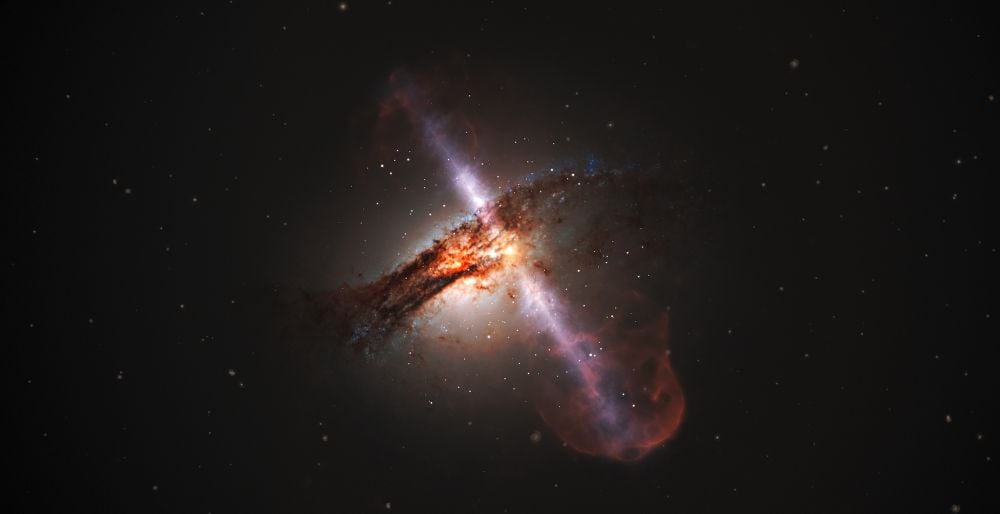 This artist's illustration shows powerful jets and winds coming from an AGN. This feedback can drive star forming gas away. It can also disturb gas and heat it up. Altogether, the feedback can drive quenching. Image Credit: ESA/Hubble, L. Calçada (ESO)
"These galaxies look calm on the surface, but Webb allows us to see the subtle signs of past violence," said lead author Maltby. "The galaxies show clear signs of disturbance, telling us that something dramatic happened to them not long before their star formation shut down, most likely a merger with another galaxy."
But later, in the Cosmic Afternoon, something else happened with the PSBs. These ones retained their disk-dominated structure rather than becoming compact spheroids. That's proof that they didn't suffer through a powerful merger. Instead, they were quenched by a gentler process that didn't disrupt their structure. A minor merger could be responsible, or their gas could've been stripped away by interactions with a galaxy cluster. Once they were starved of their supply of star-forming gas, they burned through their final gas in a brief, more modest star-formation phase. They became passive disks without losing their disk-dominated shape.
So there are two quenching scenarios that explain different PSBs. Massive galaxies at high redshifts are quenched by powerfully disruptive merger events, while less massive galaxies at lower redshifts, after the Cosmic Noon peaked, are quenched more gently.
"These results suggest that, while structural transformation is largely complete by the PSB phase, residual disturbances persist at high redshift, supporting a scenario in which rapid quenching proceeds via two distinct pathways: highly disruptive events (e.g. major mergers) at high z and high mass, and comparatively gentle processes at later times," the authors write.
This is another victory for the JWST.
"The results presented here highlight the power of deep, high-resolution JWST imaging to dissect the internal structure of transitional galaxy populations," the authors write. Its observations let the researchers link galaxy morphology and structure to different quenching mechanisms and different evolutionary stages.
There's more work to do, though. By incorporating things like stellar kinematics, researchers will be able to better constrain the mechanisms and timings revealed in this work.
"Together, such analyses will allow a more complete understanding of how galaxies transition from star-forming to quiescent, and of the diverse physical routes through which this transformation proceeds across cosmic time," the authors conclude.
