 Universe Today
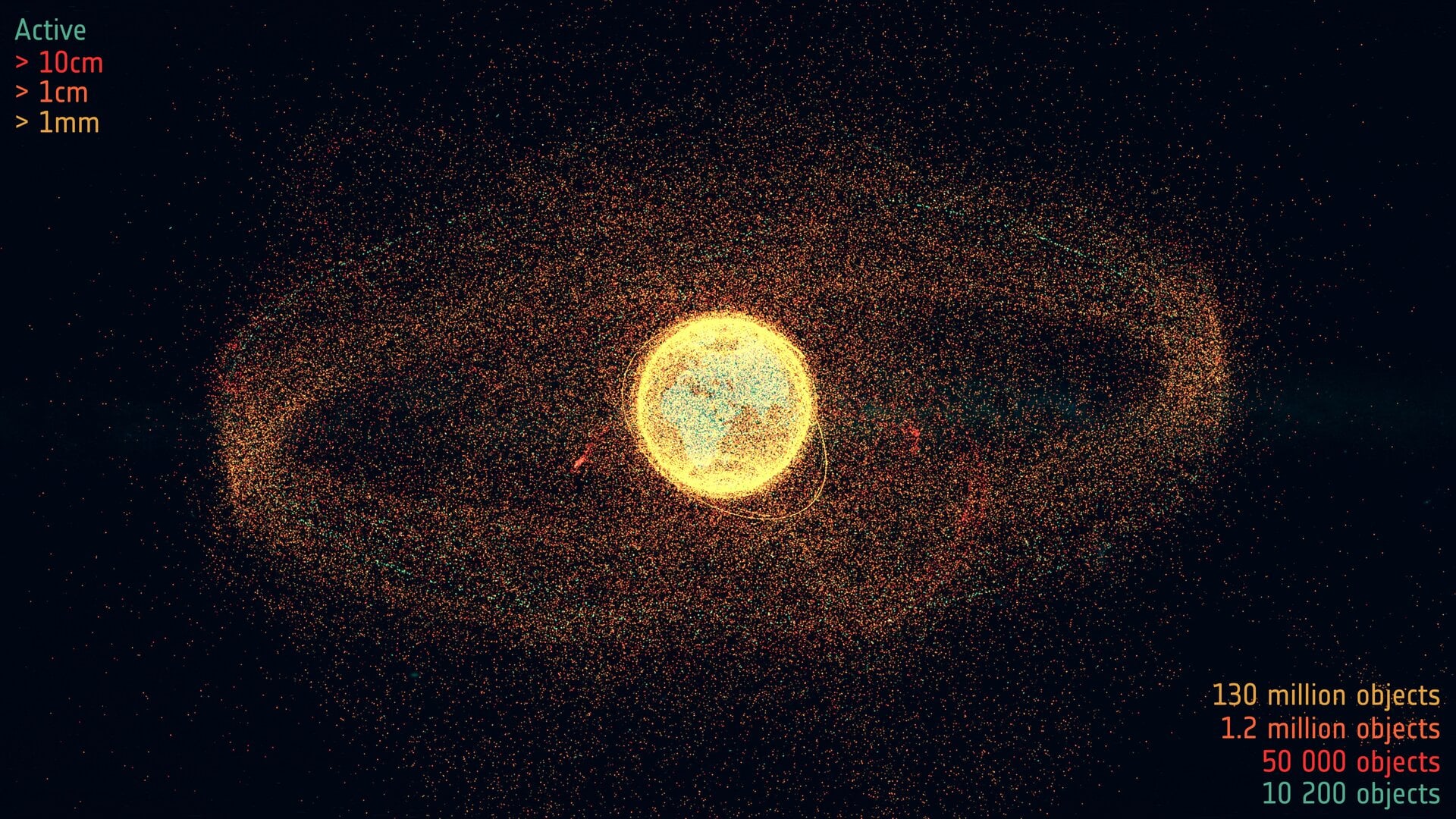
Aerospace engineers have to consider numerous factors when designing a spacecraft, but one that comes up more and more often is the need to design against Micro-Meteoroids and Orbital Debris (MMOD). While most designers understand the threat, designing structural solutions capable of withstanding the hypervelocity impacts these undercontrolled pieces of material can cause can take a significant bite out of a mission’s mass budget. A new paper from Binkal Kumar Sharma of the University of Bremen and Harshitha Baskar, an independent researcher, provides a detailed review of cutting-edge options for defending against those deadly particles.
To be clear, there are actually two distinct threats designers must look out for. One is from micrometeoroids - small rocks from space that have broken off a comet or asteroid and are the dominant threat at orbits lower than 270km and above 4800km. In between those two altitudes, human-derived space debris is the major threat to the structural integrity of a spacecraft.
Micrometeoroids have characteristics that simplify defense. They are almost exclusively coming from one direction (up), and they are most likely already actively being ripped apart by the atmosphere. However, there’s also the tradeoff that they could be rocketing out of outer space at hypervelocities of up to 72 km/s compared to an orbiting spacecraft - meaning no matter how small they are they can still deliver significant kinetic energy.
Fraser discusses the issue of how many satellites we can actually have in orbit.Orbital debris, on the other hand, is ubiquitous and can approach from any direction. We can track bigger pieces, and typically satellites are capable of avoiding them to some degree. But the smaller pieces, which are impossible for us to track at this point, can still deliver significant kinetic energy, colliding with a satellite at up to 15km/s. This, in turn, creates more hazardous orbital debris, a growing threat known as Kessler Syndrome, unless we come up with better ways to defend against them.
The current industry standard way to do so is called the Whipple Shield. Basically, it's a sacrificial aluminum bumper designed to vaporize any impacting material before it reaches the valuable internals of the satellite. In recent years, the traditional design has been augmented into variants like the “stuffed” and “multi-shock”. These pack the gap between the shield itself and the valuable parts with high-tensile fabrics like Kevlar and Nextel ceramic cloth. These continue to pulverize the debris in an attempt to ensure that nothing potentially damaging reaches the satellite’s core.
But there’s still room for improvement, especially where weight is concerned. And since weight is equivalent to cost in space exploration, researchers have spent plenty of time attempting to lower it. One of the most promising technologies comes from additive manufacturing processes, more commonly known as 3D printing - particularly Laser Powder Bed Fusion (LPBF), a type of 3D printing technology that can produce metal parts. Estimates put the weight savings at using LPBF-produced parts at up to 70% - enough for any spacecraft engineer to sit up and take notice.
Video describing the mechanical benefits of UHMWPE. Credit - Predatorarmor YouTube ChannelIt comes at a cost though - current LPBF-produced parts are notoriously porous and lack the rigid mechanical properties of their traditionally machined cousins. In an environment where “shock” is a part of the design philosophy, those porous holes are even more potentially dangerous.
The next development in using LPBF to reduce weight involves a structural design refinement: the 3D printed metal lattice. Recent literature has pointed to a 3D printed metal lattice with advanced polymer sheets in between. The most promising of these polymers is Ultra-High Molecular Weight Polyethylene (UHMWPE). This would act like a kinetic sponge, soaking up the residual energy of the projectile that was originally fragmented by the metal lattice. They also have the added benefits of acting as thermal and radiation shields, if combined with additives like natural graphene flakes and boron carbide.
With these improvements, the material options spacecraft designers can choose from have taken a step forward. While they won’t necessarily stop the potential hazards of MMOD, knowing that there are passive technologies we can develop to mitigate some of their dangers will hopefully allow at least some spacecraft designers to sleep better at night.
Learn More:
B.K. Sharma & H. Baskar - Space Environment and Debris: A Review of Micro-Meteoroids and Orbital Debris Impact Protection
UT - Flexible 3D-Printable Shielding for Extreme Environments
UT - Spacecraft Shields Will Need to be Tough. Here's an Aluminum Bullet Shattering a Shield at 7 km/s

