 Universe Today
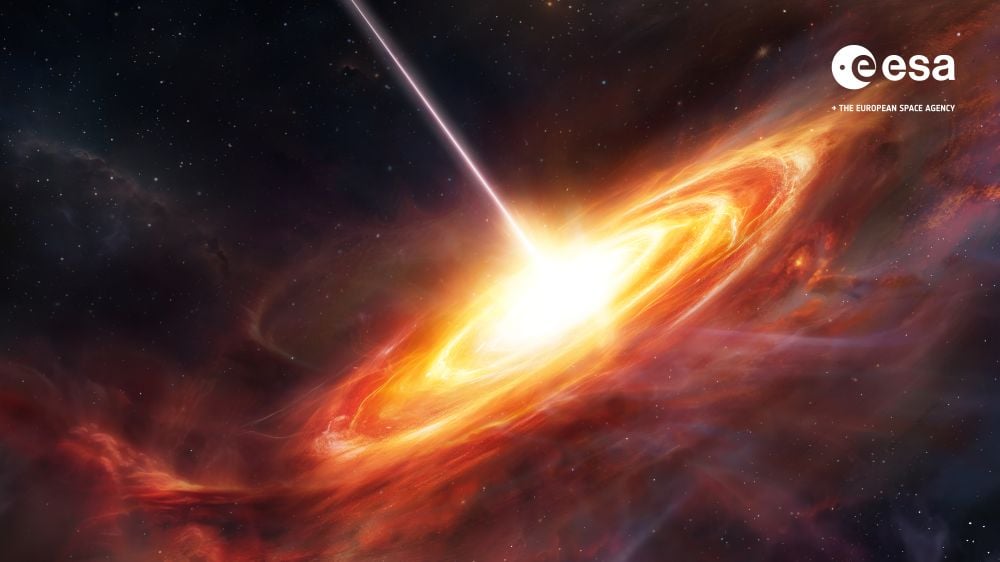
The ESA's Euclid space telescope was built to study the "dark Universe." That means dark matter, which is most of the matter in the Universe, and dark energy, the force that drives the Universe's expansion. Finding quasars in the high-redshift Universe is part of that.
Quasars are extremely luminous active galactic nuclei (AGN) powered by supermassive black holes (SMBH). Since the galaxies that form them are themselves formed in dark matter halos, quasars can be a useful probe of dark matter structure in the early Universe. Cosmologists are finding that galaxies and their SMBH were more massive in the early Universe than thought, prompting a re-think of theoretical models.
Finding the odd high-redshift quasar is helpful, but it's not as good as finding many of them. Astronomers have struggled to find them, and it took more than a decade to find the first 10 of them at z≥7. But Euclid is changing that.
Euclid is a wide-angle telescope with a 600 megapixel camera. During its six-year mission, it will survey an enormous area of the sky. Not only that, it will observe more than 200,000 high-redshift galaxies with near-infrared photometry and spectroscopy. This is almost the perfect setup for finding luminous quasars during the Epoch of Reionization (EOR), which spans from z=6 to z=9.
As a result, Euclid has now found 31 new quasars at 6.6 < z < 7.8. The highest redshift quasar in the sample is at z=7.7, with the second one coming in at z=7.69. Both of them beat the previous record holder at z=7.64. These two were shining with the light of trillions of Suns only 670 million years after the Big Bang, when the Universe was only about 5% of its current age.
The findings are in new research published in Astronomy and Astrophysics titled "Euclid: Discovery of 31 new quasars at 6.6 < z < 7.8." The lead author is Daming Yang, a PhD in astronomy at Leiden University in the Netherlands.
"We report the discovery of 31 new high-z quasars in the redshift range 6.6 < z < 7.8," the researchers write. "These quasars were selected from approximately 3000 deg2 of sky covered during the first 1.5 years of the Euclid Wide Survey, representing the initial results of the Euclid high-z quasar search."
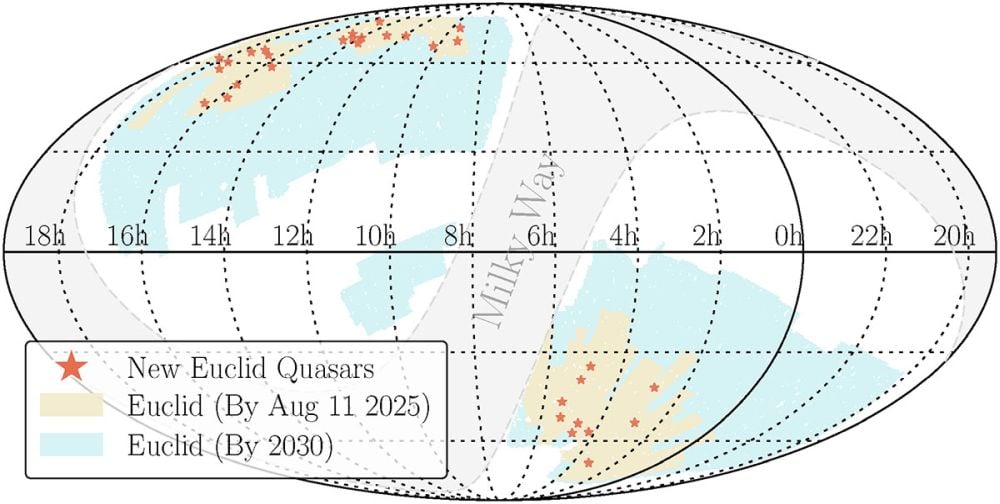 This figure shows the Euclid Wide Survey area projected onto the sky. Yellow shows the portion completed so far and light blue shows the total area of the EWS to be completed by the end of the decade. Red stars show the locations of the 31 newly-discovered quasars. Image Credit: Yang et al. 2026. A&A
Finding them required multiple machine-learning and probabilistic techniques according to the authors. The also used the Keck, Magellan, and the Large Binocular Telescope (LBT) to perform follow-up spectrscopy. Since 12 of the new quasars are at z ≥ 7, this more than doubles the number of quasars discovered at that redshift, which corresponds to the Universe's first 770 million years.
“These early quasars date back to the Universe's infancy,” said lead author Yang in a press release. "By finding and studying them, we can better understand how these enormous systems formed and grew so quickly – one of the greatest mysteries in astrophysics.”
Finding these high-redshift quasars isn't easy. Since only the most massive galaxies can host them, they're not plentiful. Their dim light can also mimic the light from other sources like foreground stars in the Milky Way.
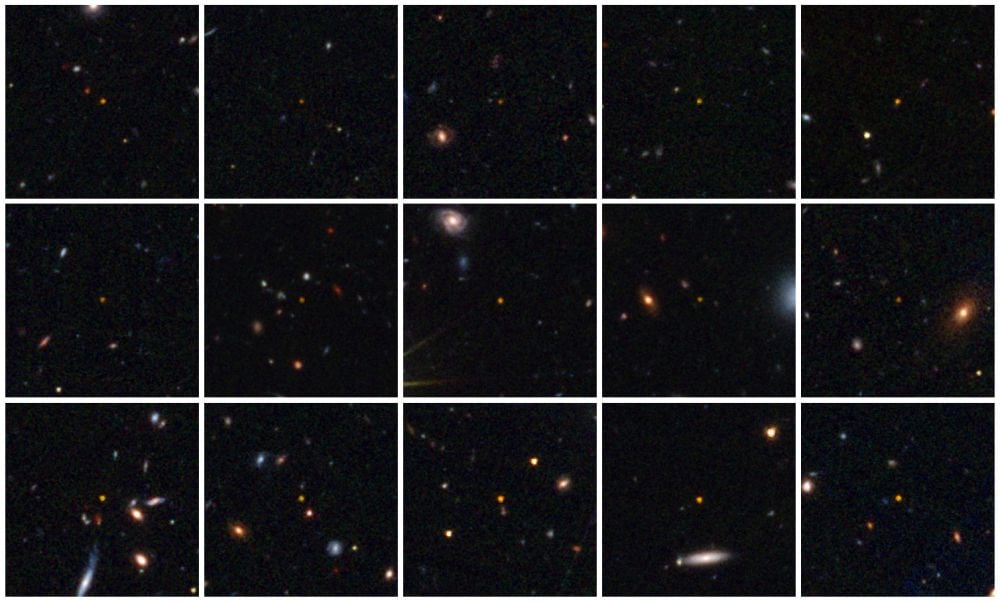 These are 15 of the 31 newly discovered high-redshift quasars. The two oldest ones are on the top row, first and second from the left. Image Credit: ESA/Euclid/Euclid Consortium/NASA, image processing by the Euclid Science Ground Segment and Antoine Basset (CNES). Licence: CC BY-SA 3.0 IGO or ESA Standard Licence
The earliest quasars ever found by astronomers were the brightest. But they were the outliers, and regardless of the subject being studied, outliers don't make up a solid sample. But with these 31 new high-redshift quasars, scientists have more of a representative sample to work with.
“Euclid is a true game-changer,” added Yang. “Before, we could only find a handful of the very brightest ancient quasars, but Euclid lets us search far more efficiently across huge areas of sky to capture much fainter light. It’s a unique tool for quasar hunting.”
With a larger quasar sample in hand, researchers can explore the link between ancient galaxies, SMBH, and dark matter. For an early galaxy to host such a luminous quasar only 670 million years after the Big Bang, an enormous dark matter halo must have been assembled by that time. A larger quasar sample means that researchers can test the Lambda-CDM model more thoroughly, rather than with outliers only. And since these high-redshift quasars also can also illuminate the intergalactic medium, they can also help map the the Universe's large-scale structure.
“This finding more than doubles the number of quasars we know of that are so ancient,” says Antonio La Marca, an ESA Research Fellow in the Euclid team. “The Euclid team has taken a true ‘census’ of quasars at the dawn of the Universe for the first time. It’s a big step towards understanding these fascinating objects on a more fundamental level.”
Since these quasars were observed during the Epoch of Reionization (EOR), when the Universe 'switched' from dark to light, they're also important probes of that milestone. During the EOR, the first stars and galaxies began illuminating the cosmos with UV light and ionizing hydrogen, allowing photons to travel.
“Ancient quasars are rare discoveries. They're interesting in themselves, but also time machines that enable us to explore the early Universe and understand how the first generation of galaxies came to be,” says ESA Euclid Project Scientist and study co-author Valeria Pettorino.
Ever since Euclid was being designed and planned, scientists have looked forward to these quasar discoveries, even though the telescope wasn't specifically designed to hunt for them.
"Euclid has long been anticipated to revolutionise the search for high-z quasars," the authors write, noting that it's found 31 in only 1.5 years. Without a doubt, Euclid will find many more.
"These discoveries demonstrate Euclid’s transformative role in high-z quasar discovery and set the stage for future follow-up studies of the early galaxies hosting quasars, supermassive black hole growth, and the intergalactic medium in the epoch of reionisation," the researchers write.

