 Universe Today
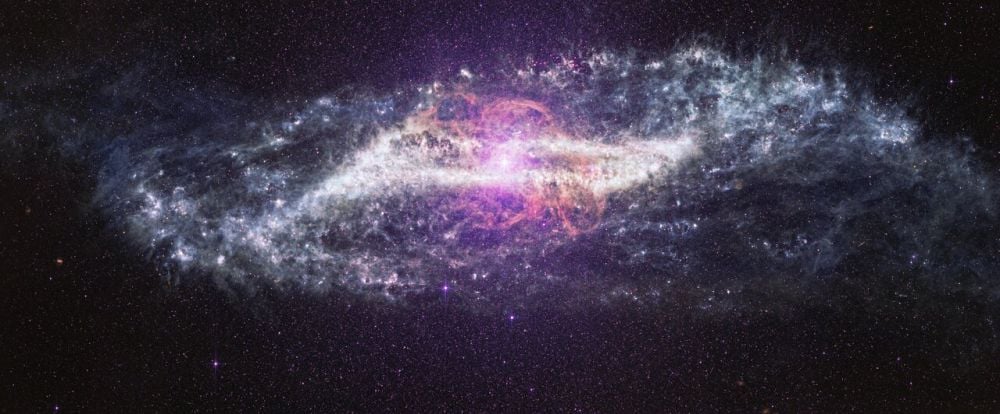
The galaxy Centaurus A is about 11 million light years away and is the fifth brightest galaxy in the sky. Because it's so bright, it's been studied extensively by amateur and professional astronomers alike. Also called NGC 5128, it's a starburst galaxy, meaning its forming stars at a rapid rate.
Most starburst galaxies are experiencing a merger or have in the recent past. Centaurus A is no exception, and new JWST observations have revealed evidence of a past merger.
Galaxy mergers can take hundreds of millions of years to play out—even longer. At first, two or more galaxies on a collision course interact gravitationally, and a first pass can form long streams of gas and stars called tidal tails or bridges. Friction between the galaxies' stars and dark matter creates drag, and that reduces orbital energy on each pass. The galaxies loop back on each other and collide again, and this process repeats itself.
Eventually, violent relaxation takes hold. This is when the gravitational potential of the dark matter in the galaxies changes, and the orbits of stars changes. What was once orderly becomes more random.
All of this change can drive star-forming gas to greater density, triggering rapid star formation, and the result is a starburst galaxy like NGC 5128.
Near the beginning of a merger, telltale tidal tails make the merger obvious to any observer.
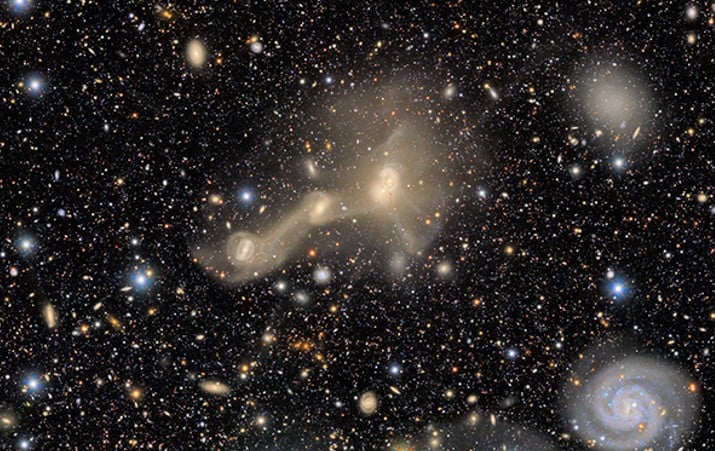 The Rubin Observatory captured this image of merging galaxies in its stunning Cosmic Treasure Chest image. The telltale tidal streams and tails are clear evidence of an ongoing merger. Image Credit: NSF–DOE Vera C. Rubin Observatory/NOIRLab/SLAC/AURA
But over time, those obvious visual signs of a merger become obscured.
In visible light images of NGC 5128, thick dust lanes obscure much of the galaxy's center. Those lanes hold not only dust, but stars and gas, too. Signs of mergers are still there, in the form of bright young star clusters and red, glowing clouds of star forming hydrogen. But they're not as obvious and aren't definitive signs of a merger.
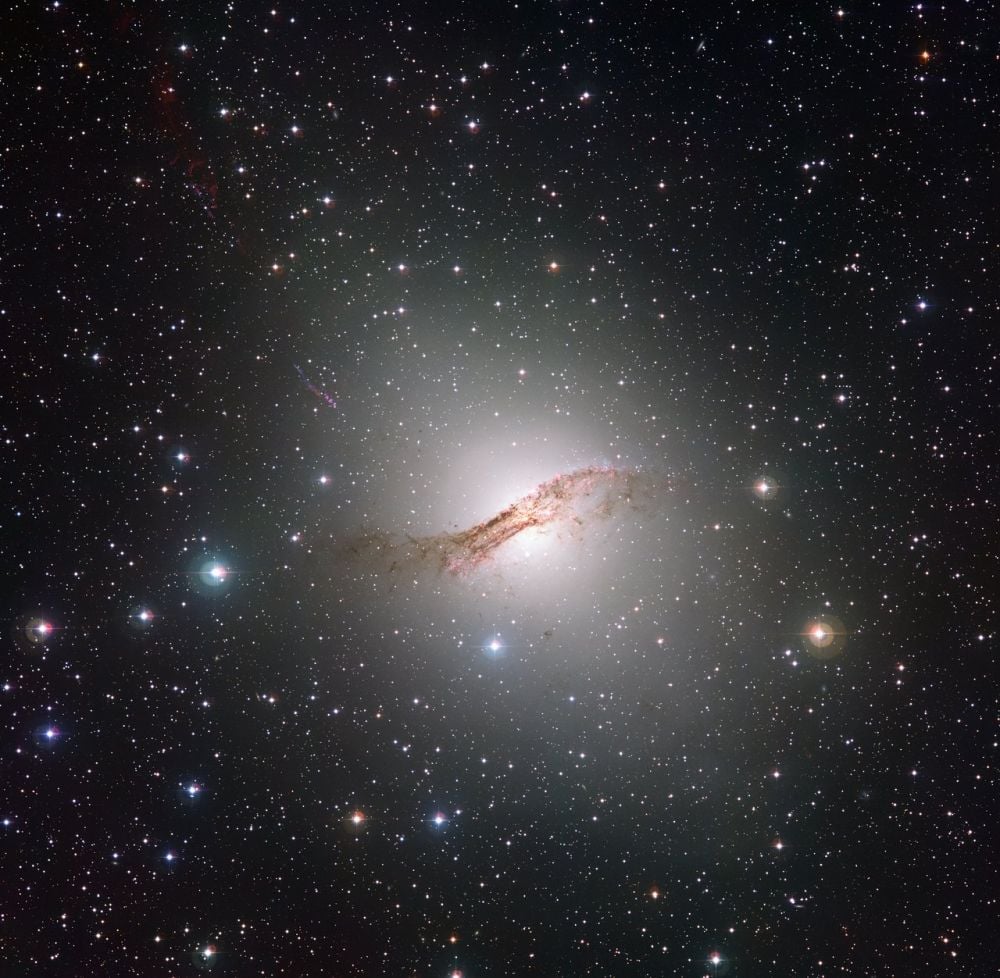 This visible light image of NGC 5128 was captured with the MPG/ESO 2.2-metre telescope at the La Silla Observatory in Chile. Though the warped shape of the galaxy hints at a past merger, deeper evidence of the merger can't be seen in visible light. Image Credit: ESO
Only a deeper look beyond visual light can provide definitive proof of a merger so long after its first passes. That's what the JWST did with NGC 5128, capturing images that mark the space telescope's fourth year of observations.
“No single telescope tells the whole story,” said Shawn Domagal-Goldman, division director, Astrophysics, NASA Headquarters in Washington. “Discoveries build over time and new observatories expand on the foundations laid by earlier missions. Webb represents the most powerful step forward yet, opening a window into wavelengths and details never before accessible. This allows astronomers to examine structures and processes that other telescopes could not see.”
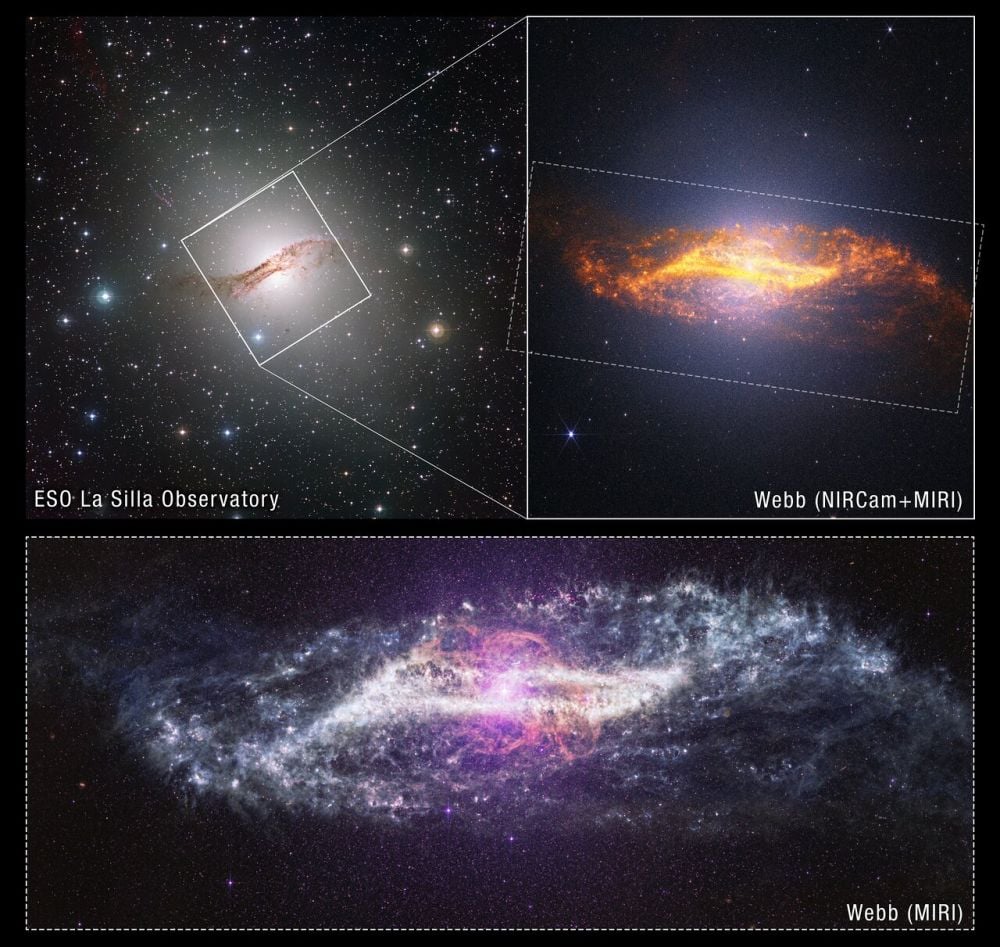 These images show how NGC 5128 appears to different telescopes in different wavelengths. The ESO's La Silla Observatory captured the visual light image in the upper left. The white box shows what the JWST zoomed in on. The upper right image comes from the JWST's MIRI and NIRCam combined. The bottom image is from only the MIRI. Each image brings different elements into view. Image Credit: ESO, NASA, ESA, CSA, STScI, ESO; Image Processing: A. Pagan (STScI)
The JWST's MIRI highlights the unexpected dust formations in Centaurus A. Wispy filaments stretch out on either side of the galaxy, while an odd parallelogram feature runs across the center. There's also the strange, looping S-shaped feature that's wrapped around the galactic center. Astronomers aren't certain what created it. The galaxy has an active black hole emitting powerful jets that are visible in x-rays. Could they be responsible?
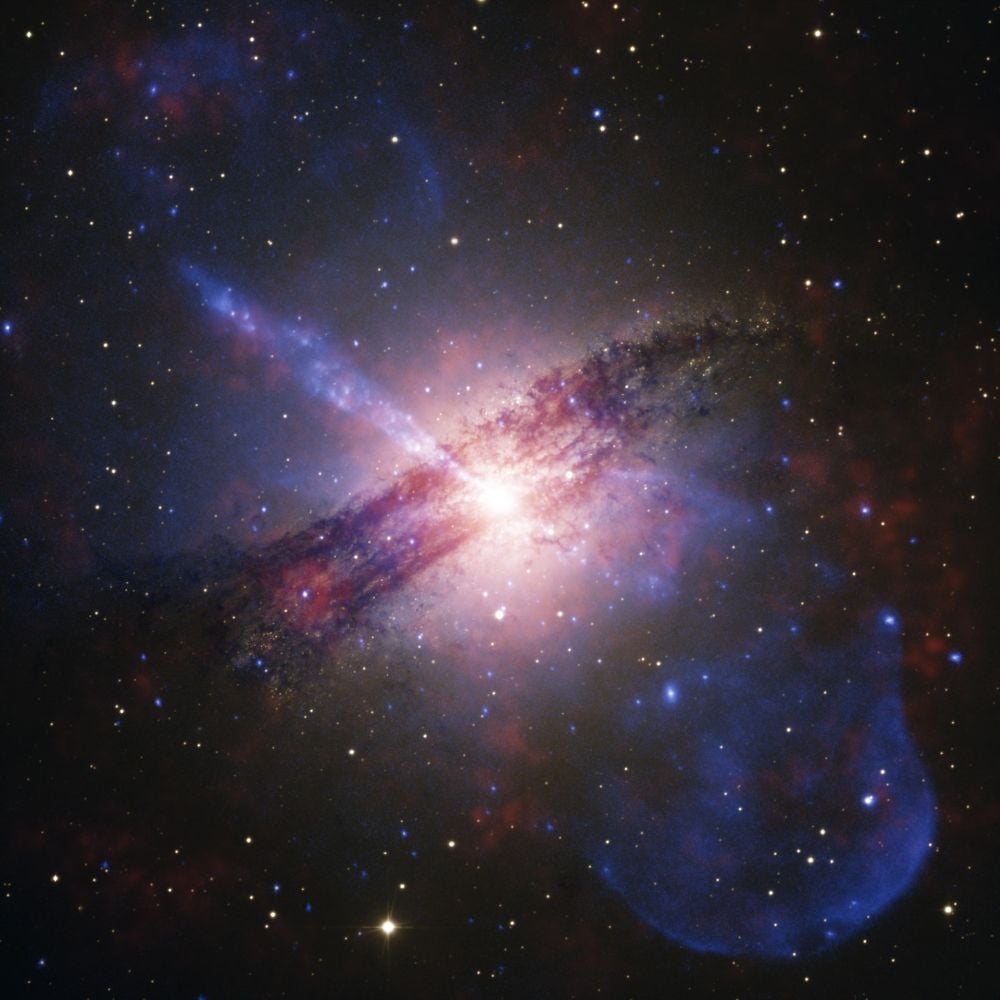 This is a composite image of Centaurus A. Blue shows X-ray light captured by Chandra, orange represents X-rays detected by IXPE, and optical light from the ESO is white and gray. The active black hole is ejected material at near light speed, forming the jet seen in this image. Image Credit: NASA / MSFC / IXPE / Ehlert et al. / CXC / SAO / ESO / WFI / J.Schmidt.
Overall, evidence of a merger has been building for decades. Centaurus A's globular clusters (GC) have a bimodal distribution of metallicities, which can often indicate a merger. One of the populations, the metal-poor one, is about as old as the Milky Way's GCs, while the other is billions of years younger and is metal-rich.
The JWST does more than capture images. It also has a powerful spectrograph, and scientists use that to measure how gas moves around in the galaxy. In Centaurus A, ionized gas is moving rapidly outward, probably driven out by the active SMBH. Nearer the galactic center, warmer molecular hydrogen rotates in a warped disk. Spectroscopic data like this can illuminate a black hole's effect on its galaxy, even though exactly how it all works is not yet clear. Black holes can both trigger star formation and slow it.
While the JWST can't provide answers to all of our questions about galaxies, their mergers, and their black holes, the powerful telescope can at least nudge those questions towards answers. With its ability to trace dust and the structures it forms, its ability to measure gas movement, and its ability to resolve millions of individual stars in NGC 5128, it's delivering progress on the scientific questions it was designed and built to address.
The telescope's fourth anniversary images of Centaurus A are proof of that.

