 Universe Today
We've been waiting a long time for the Extremely Large Telescope's first light, scheduled for March 2029. Telescopes this large, powerful, and costly always have multiple science goals, and that's true for the ELT. One of its science goals is to study fundamental aspects of the Universe, including dark matter.
The current model of cosmology is called Lambda Cold Dark Matter (Lambda-CDM or ΛCDM.) It's basically the Big Bang model of cosmology. There are, as every space-head knows, unanswered questions about Lambda-CDM, including the fact that we don't even know what dark matter is. (Some don't think it even exists.)
This is where the ELT comes in. One of its proposed instruments, and telescopes like this always have multiple instruments attached, is called NEXUS@SHARP. SHARP stands for Spectrograph for High Angular Resolution Physics, and NEXUS is a Multi-Object Spectrograph designed to work with SHARP.
New research in the journal New Astronomy outlines how NEXUS@SHARP can probe questions about Lambda-CDM. It's titled "SHARP(ening the) view of unresolved globular clusters in ultra diffuse galaxies," and the lead author is Marco Mirabile. Mirabile is a PhD student at INAF-Astronomical Observatory of Abruzzo (INAF-OAAb) and Gran Sasso Science institute (GSSI) in Italy.
"Ultra-Diffuse Galaxies (UDGs) challenge current galaxy formation models within the ΛCDM framework, particularly regarding their dark matter content and formation histories," the authors write. "Globular Clusters (GCs) serve as excellent tracers for probing the halos of these faint systems; however, current spectroscopic facilities struggle to reach the depth required to fully characterize GC populations beyond the local neighborhood."
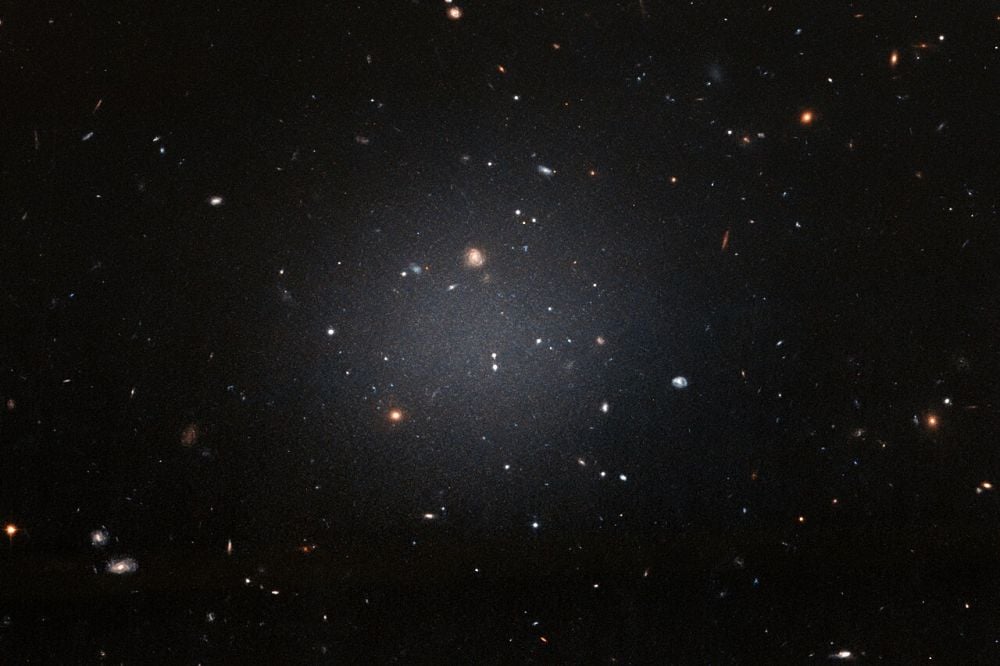
UDGs are unusual because they're about as large as the Milky Way, but can have thousands of times fewer stars. The stars are spread out and the galaxies are dim. Basically they're too puffy to agree with Lambda-CDM.
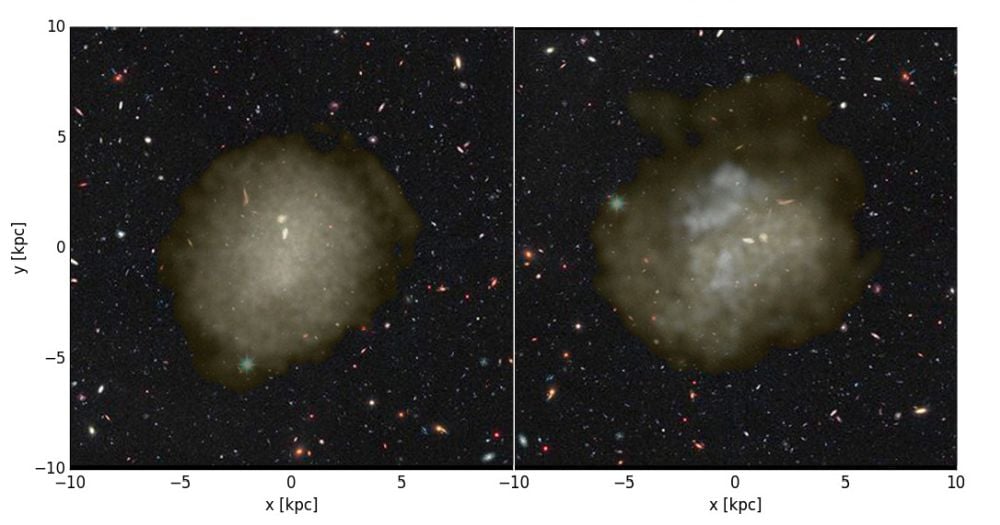 This visualization shows how stars are distributed in a simulated UDG. UDGs are as faint as dwarf galaxies, but are spread out like large galaxies like the Milky Way. Astronomers thought that supernovae explosions could've been responsible for spreading out the stars, but that interpretation hasn't endured. Image Credit: Arianna Di Cintio, Chris Brook, NIHAO simulations and HST
A galaxy's size is shaped by its dark matter halo, one of the cosmos' basic structural units. There's an apparent mismatch between the sizes of UDG halos and the sizes of the UDGs themselves. The expected size of the halos shouldn't produce such diffuse galaxies.
A way to understand this is to examine the globular clusters around UDGs. But the problem is, the spectroscopes astronomers have at their disposal now aren't powerful enough to fully characterize the globular clusters around UDGs. NEXUS@SHARP can extend their reach.
"In this work, we present the scientific potential of NEXUS@SHARP, a near-infrared multi-slit spectrograph proposed on the upcoming Extremely Large Telescope (ELT). We demonstrate that NEXUS is uniquely positioned to overcome current observational limitations by combining high spatial resolution with efficient multiplexing," the authors write. Multiplexing means it's a Multi-Object Spectrograph (MOS) that can observe and capture data from many GCs at once. MOSs are common; Keck, the VLT, Gemini, and the JWST all have them, so do many others. But NEXUS@SHARP would be attached to the extraordinarly powerful ELT and its 39.3-metre-diameter segmented mirror.
All galaxies have globular clusters, including our own. Globular clusters are important when studying UDGs because they're brighter than the UDGs that hosts them, and are easier to observe. They also extend outward further than the UDGs, so they can help measure the dark matter halo better. That should let astronomers measure a more accurate mass constraint. Not only that, but the number of GCs can help determine the mass of the halo because their number scales with mass.
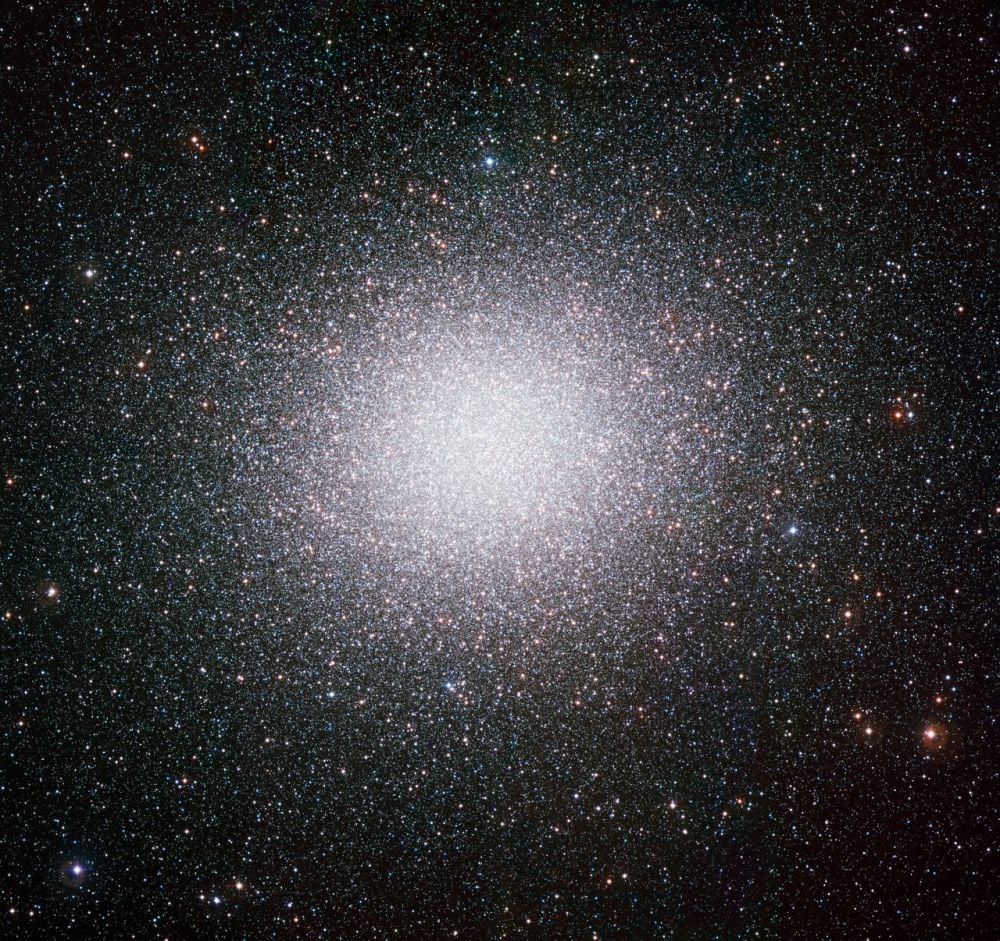 Omega Centauri, seen in this image captured with the WFI camera from ESO's La Silla Observatory, is probably the most well-known of the Milky Way's globular clusters. It has as many as 10 million stars. GCs are bright, so when they're satellites of ultra-diffuse galaxies, they serve as good probes of the galaxies. Image Credit: ESO
Another important thing GC spectra tells scientists is their formation history. The spectra show the ages and the metallicities of GCs, which reveals how quickly the stars in the GC formed. That can show astronomers what kind of UDG they're looking at.
Measuring a handful of GCs around a small number of UDGs won't sufficiently characterize the population of either. NEXUS@SHARP will bring more of them within observational rearch, and it won't require much telescope time because NEXUS examines many GCs at once. "We show that NEXUS can efficiently help to characterize the GC population in UDGs across diverse environments – out to 60 to 70 Mpc – with a few hours of ELT time," the authors write. 70 megaparsecs is about 230 light years.
 The ELT is a beast of a telescope, and its heart is the 39.3 meter segmented primary mirror. Its instruments, including NEXUS@SHARP if its built, sit on a separate stationary platform. Image Credit: ESO
What this boils down to is two different scenarios for how UDGs form, and what it tells astronomers about dark matter and Lambda-CDM.
"These capabilities will allow for precise measurements of radial velocities and stellar populations, enabling robust dynamical mass estimates and distinguishing between competing UDG formation scenarios," the authors write.
One scenario says that UDGs are failed massive galaxies that were quenched early on. These ones preserved their dwarf-like stellar masses, but lie within more massive halos typical of a regular galaxy. "These galaxies would thus appear red, old, metal-poor, DM dominated, and host unusually rich globular cluster (GC) populations," the authors write.
The second says that UDGs are puffed-up dwarfs. They are genuinely low-mass galaxies that have expanded in space for some reason. "Relative to the previous scenario, such objects are expected to be bluer, exhibit extended star formation histories, and have DM content and GC populations resembling those of typical dwarfs," the authors explain.
NEXUS@SHARP can shed light on these scenarios and help explain how UDGs formed by examining globular clusters around Ultra-Diffuse Galaxies. That's why the authors wrote that ""Globular Clusters (GCs) serve as excellent tracers for probing the halos of these faint systems."
"To shed light on the nature of UDGs, deep spectroscopic observations of a large sample of UDGs are needed, as combining the analysis of GC richness with the kinematic and evolutionary properties of field stars provides a powerful diagnostic for distinguishing between different formation channels," the authors write.
Basically, the dataset gathered by NEXUS@SHARP will have two independent mass measurements for each UDG, both arising from measuring many GCs at once. One mass measurement comes from the velocity dispersion of the GCs, which shows how much mass is required to keep them in orbit. That's dynamical mass.
The second is also from GCs, but measures their total number. That relies on the knowledge that the number of GCs roughly rises linearly with the mass of a UDG's dark matter halo. That's GC-count mass.
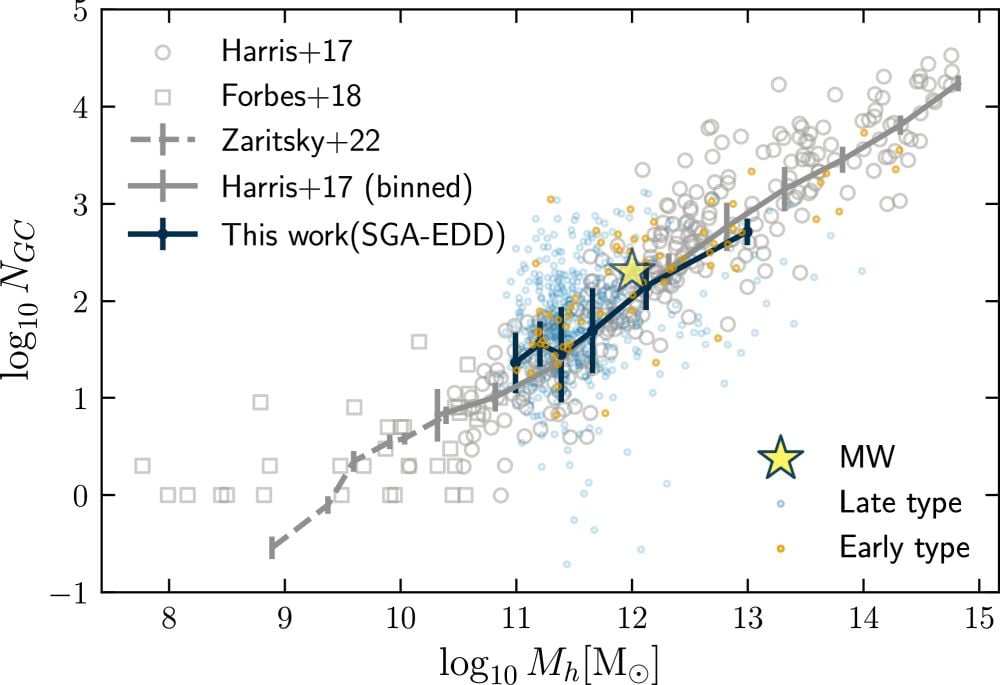 This figure from previous research shows how the number of globular clusters (y-axis) correlates with galaxy mass (x-axis). Each orange or blue circle represents the number of GCs in an individual galaxy. Image Credit: Minh Ngoc Le and Andrew P. Cooper 2025 ApJ 978 33
If both of these ways of measuring mass agree, and both are high, that means that the UDG has an overmassive halo compared to its number of stars. That supports the first UDG formation scenario: it's a failed regular galaxy that quenched early.
If the different measurements both agree, but they're low, that supports the second UDG formation scenario: it's a puffed up dwarf inside a normal sized dwarf dark matter halo.
There's another wrinkle. If the dynamical mass is low, but the GC-count mass is high, then the formation of GC was unusually inefficient for some other, environmental reason.
NEXUS@SHARP is just a concept at this point, and the paper just makes the case for building it. If it's built, the results could go a long way to a better understanding of dark matter and Lambda-CDM. Understanding Lambda-CDM is an ongoing effort, and it's being tackled from different directions with different facilities. While Lambda-CDM is still the best match for lots of data about dark matter and dark energy, it doesn't fit everything.
If built, NEXUS@SHARP can chip away at some of the uncertainty around Ultra-Diffuse Galaxies and their dark matter halos, and can help either confirm or contradict Lambda-CDM.
"By enabling the systematic spectroscopic survey of GCs in low-surface-brightness systems, NEXUS@SHARP will act as a definitive tool for constraining the formation channels of the most elusive galaxy populations in the local universe," the authors conclude.

