 Universe Today
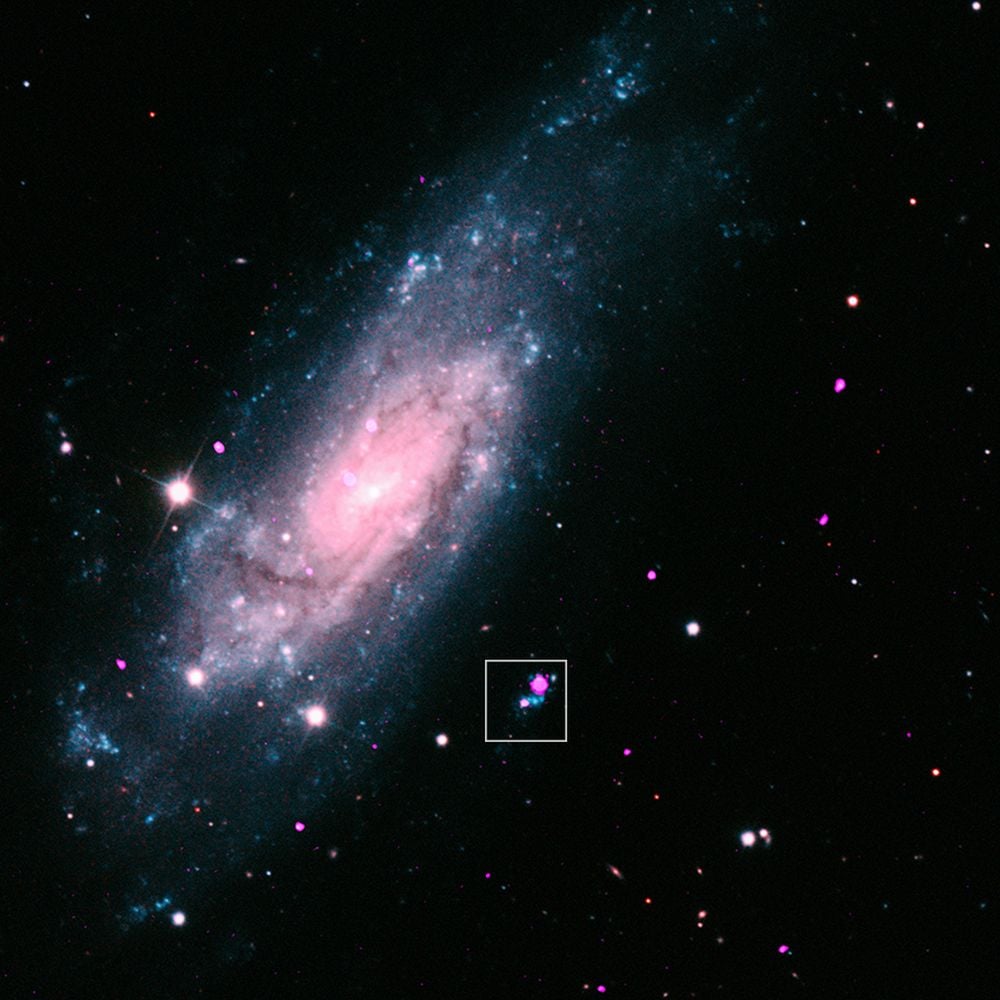
When is an apparent supernova not really a supernova at all? That's a tough question to answer, especially since no supernovae have been observed in the Milky Way in the telescope era. The ones that astronomers see are mostly many millions of light years away in distant galaxies.
SN 1987A was the closest modern supernova, but it exploded in the Large Magellanic Cloud, which is still more than 160,000 light years away. And that was before the Hubble launched, and studying its aftermath was difficult. Now we have automated supernova surveys that scan the sky for exploding stars. One such survey detected what seemed to be a supernovae in 2016, in a distant galaxy.
Sometimes, a star exhibits variations in brightness before it explodes as supernovae, and that can create confusion around what's actually happening. That describes the object detected in 2016.
That object was a massive star in a distant galaxy that's showing behaviour associated with a typical supernova explosion. Supernovae explosions are the final act of massive stars that reach the end of their lives, and their prodigious energy output can light up the sky. That's what this star does, sort of.
But unlike a supernova with a single explosion, this star has a volatile outburst every 113 days, something that no supernova can repeat. In an effort to understand what's behind these repeated outbursts, astronomers turned to one of NASA's workhorse space telescopes, the Chandra X-ray Observatory. Chandra's exceptional angular resolution sets it apart from other x-ray observatories, and it can pick out faint sources in detail at great distances.
The volatile star, named AT 2016blu, has about 33 solar masses and is in the spiral galaxy NGC 4559, around 30 million light years away. AT stands for astronomical transient, and blu is a sequential suffix that tells us the star was the 1,685th transient reported in the year 2016. AT 2016blu is also called a luminous blue variable (LBV), and was first discovered in 2012 by an automated supernova search.
LBVs are rare, and as noted above, exhibit powerful variations in both their brightness and their spectra. Their variability is usually considered to be unpredictable, but in this case, it's periodic.
New research in The Astrophysical Journal has an explanation for AT 2016blu. It's titled "AT 2016blu: Accretion-powered Outbursts in a Luminous Blue Variable and Compact Object Binary," and the lead author is Mojgan Aghakhanloo, a Virginia Institute of Theoretical Astronomy Origins Fellow at the University of Virginia in Charlottesville.
"We present the first X-ray detection of the supernova (SN) impostor AT 2016blu in NGC 4559," the authors write.
Astronomers are calling AT 2016blu a 'supernova impostor' because LBVs are often detected in supernova searches. "Supernova (SN) impostors are transient events associated with massive stars that are often initially discovered in SN surveys," the authors explain. "However, because their outbursts are less energetic and less luminous than true SNe, and because the star is expected to survive, they are subsequently classified as SN impostors."
Unlike a supernove, AT 2016blu appears to have a nearby companion that triggers the outbursts.
"AT 2016blu exhibited 27 detected quasiperiodic (∼113 day) outbursts between 2012 and 2026 June, presumably triggered by periastron passages in an eccentric binary system in which the primary is a ≳33 M⊙ luminous blue variable (LBV)," the authors explain.
Chandra had observed AT 2016blu by accident in 2001-2002, but that was before its first documented outburst. Those observations were actually aimed at another nearby ultraluminous X-ray source (ULX), NGC 4559 X7. XMM-Newton, an ESA x-ray observatory, also observed AT 2016blu four times while looking at NGC 4559 X7. So there's a collection of happenstance observations of the region.
“For 15 years, astronomers have been watching this star get really bright and then dim again on a regular basis,” said lead author Aghakhanloo. “Until we were able to get Chandra data at the right time, we couldn’t figure out what was making this happen.”
Overall, astronomers observed 27 outbursts of optical light from the supernova impostor between 2012 and 2026. That's one burst about every 113 days, something no supernova can do, since they're destroyed in their explosive outbursts.
“This star’s behavior was confusing at first because it kept acting like a supernova, but clearly it’s not because it keeps surviving these outbursts about three times a year,” said co-author Núria Torres-Albà, also of the University of Virginia. “To understand the cause of these eruptions, we realized we needed X-ray data that was timed so that we’d observe the star when it was in an outburst.”
Once it was known to exhibit outbursts, the researchers watched it in optical light leading up to its next predicted outburst. Then they used Chandra to observe it in x-rays, since it's the only x-ray telescope powerful enough to discern AT 2016blu from the other nearby x-ray source, ULX NGC 4559 X7, which is much brighter than the supernova impostor. "We monitored the source’s visual-wavelength variability around its predicted outburst time and triggered a Chandra Target of Opportunity (ToO) program in 2026 March, obtaining observations with detections over five closely spaced epochs," the authors write.
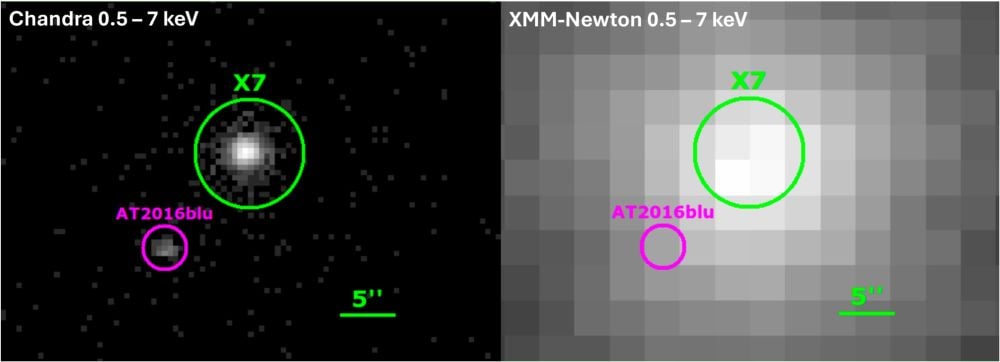 The left panel shows a stacked Chandra image of all five target-of-opportunity observations taken during the 2026 March optical outburst of AT 2016blu, in a span of 4 days. The right panel is an XMM-Newton image of the same sky region. XMM-Newton is not as powerful as Chandra, and cannot resolve the two sources. The image is dominated by ULX NGC 4559 X7, much brighter than AT 2016blu. Image Credit: Mojgan Aghakhanloo et al 2026 ApJ 1011 252
“We suspected that the bright repeating flashes at optical wavelengths might actually be powered by periodic blasts of high-energy X-rays,” said co-author Nathan Smith of the University of Arizona in Tucson. “The dense gas surrounding the system is heated by the X-rays and then glows in the optical. So, we needed to plan the Chandra X-ray observations carefully to be simultaneous with an optical outburst.”
Chandra's x-ray data from its 2026 outburst shows that AT 2016blu is 100 times brighter in x-rays than in its data from 2001 to 2002. This is best explained by a binary companion. "These outbursts are most likely triggered by periastron encounters in an eccentric binary system in which the primary is an LBV," the authors write. The secondary is almost certainly a neutron star or a black hole. As they orbit each other, the LBV ejects material that finds its way to the secondary. The material orbits the secondary at very high speeds in an accretion ring, and that heats it up until it emits x-rays.
Based on the x-ray luminosity, the researchers estimate that about 2.7% of Earth's mass is transferred during each outburst.
As is often the case, the researchers had to rule out a potential background source, and for that they relied on Chandra, too. "The alternative to a genuine counterpart to AT 2016blu would be a background quasar with a coincident position," the researchers explain. "This quasar, furthermore, would have brightened at a time coincident with our observations, and thus the AT 2016blu outburst."
No background source was detected.
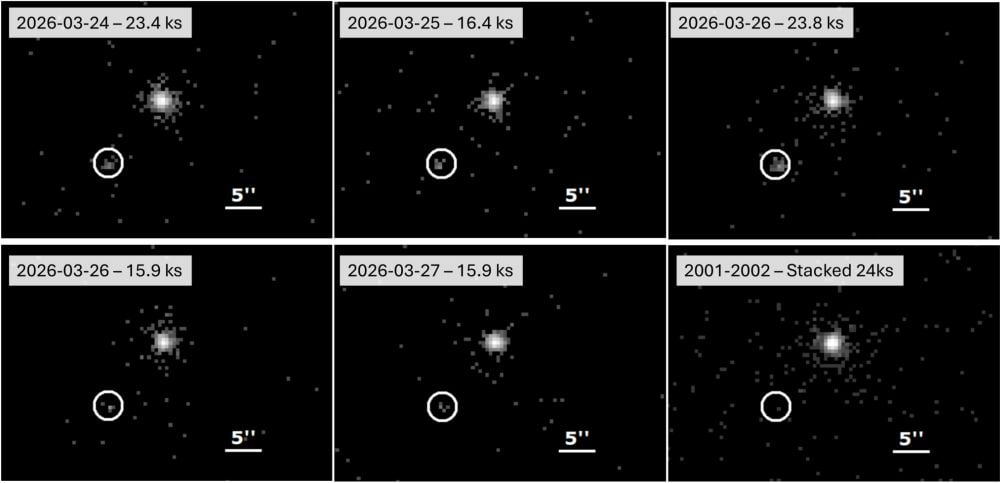 These panels are all Chandra images. The first five are from Chandra's observations of AT 2016blu during the ToO campaign, and it's clearly visible during its outbursts. The sixth panel is a stacked image of the region outside of an outburst, clearly showing no background quasar. "No source is detected in the stacked archival images prior to the first observed optical outburst of AT 2016blu, when it was a stable system," the researchers explain. Image Credit: Mojgan Aghakhanloo et al 2026 ApJ 1011 252
"AT 2016blu represents the first observationally known LBV system with a compact companion," the authors write. "Previously studied LBVs either lack X-ray detections or show luminosities consistent with wind–wind collisions in massive-star binaries."
Its discovery could shed light on other, similar transient phenomena. Many stars show changes in brightness before they explode as supernovae, and maybe some of them are similar to AT 2016bu. "The discovery of an LBV–compact-object binary undergoing accretion-powered outbursts also connects AT 2016blu to a growing class of models in which massive star–compact object binaries explain a variety of pre-SN transient phenomena," the authors explain.
The next step, as is often the case in observations of new types of astrophysical objects, is to find more of them.
"Expanding the sample of such systems is therefore essential to better understand the evolutionary pathways and physical mechanisms connecting SN impostors, LBVs, and interacting SNe," the researchers conclude.