Universe Today
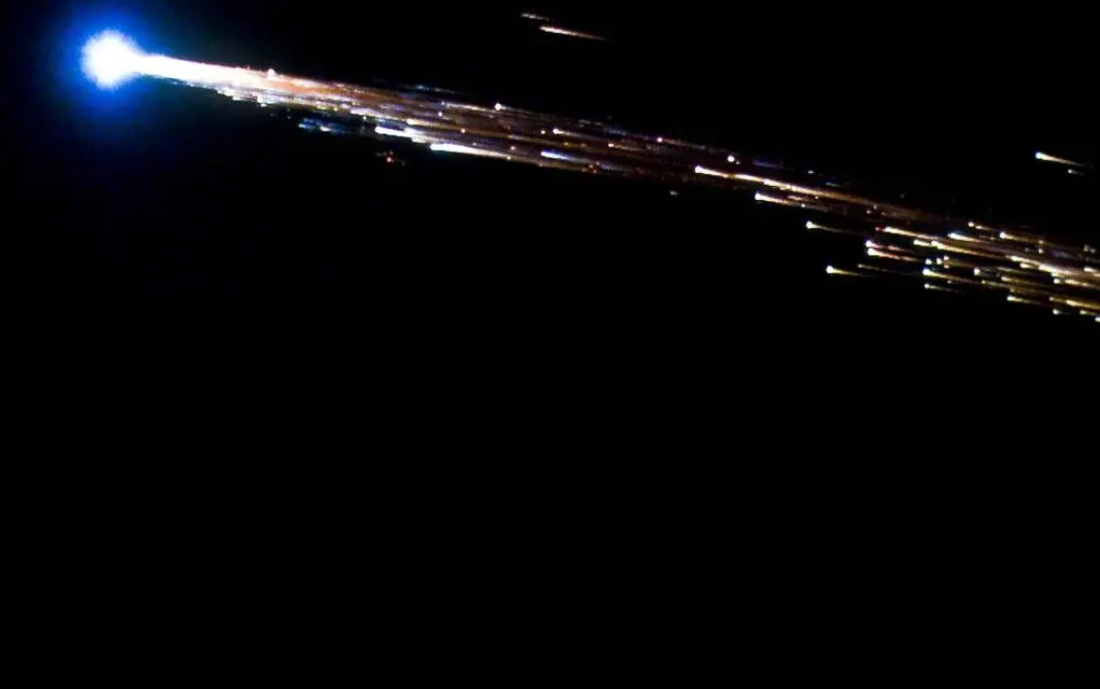
New research spanning several solar cycles shows the impact of space weather on space junk and the Earth orbital environment.
It’s getting crowded up there. Over the past few years, the advent of SpaceX’s Starlink and other players in the mega-satellite constellation game are adding an exponential load of satellites and orbital debris to the low Earth orbit environment. But all that goes up, must eventually come down. Now, a new study looks at solar activity over time as a predictor for how reentries trend.
The study out of the Vikram Sarabhai Space Centre and the Indian Institute of Space Science and Technology was recently published in the journal of Frontiers in Astronomy and Space Sciences.
It’s been known for a while that the reentry rates go up near solar cycle maximum, as the energized outer atmosphere puffs out in response to enhanced space weather, and satellites in low Earth orbit experience increased drag. This new study, however, was novel in that it followed debris objects over a long span of time.
“While the influence of solar activity on satellite drag is well recognized, a systematic investigation into its long-term impact on the orbital decay of space debris remains lacking,” notes researchers in the study. “The rapid expansion of the space sector and the corresponding growth in space debris population have made it increasingly important to understand the long-term drivers of orbital decay.”
Specifically, the study looked at the orbits of 17 objects over the span of nearly 40 years, covering the solar cycles 22, 23, 24, and the start of 25. The Sun goes through an 11-year cycle from one maximum to the next, a peak at which more flares erupt, and more sunspots are seen crossing the solar disk. The study digs way back into the satellite catalog, with the oldest object being Explorer 7 with a low catalog number of 22 (!)
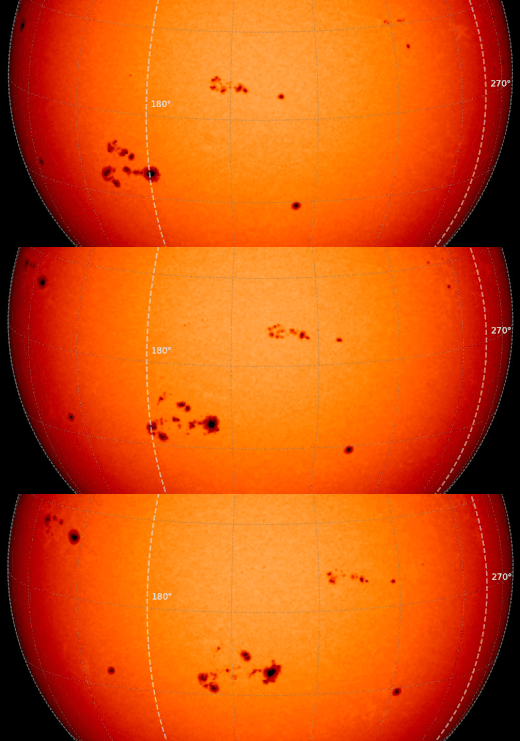 A large sunspot group lurking on the solar farside in the first half of May 2026. Credit: ESA/Solar Orbiter.
The information from the study will go a ways towards understanding how orbital decay operates over long spans of time. Debris was ideal for looking at natural processes, as opposed to operational satellites which typically use active station-keeping to combat reentry.
The initial 95 objects selected for the study come from the Space-Track catalog, NORAD’s clearing house for satellite analysis.
A major trend identified in the study was the role that Extreme Ultraviolet (EUV) emissions play in accelerating orbital decay. When sunspot numbers cross a key two-thirds threshold, EUV spikes, triggering a transition boundary past which space junk experiences more drag. At most, the study found that overall geomagnetic activity only plays a secondary role.
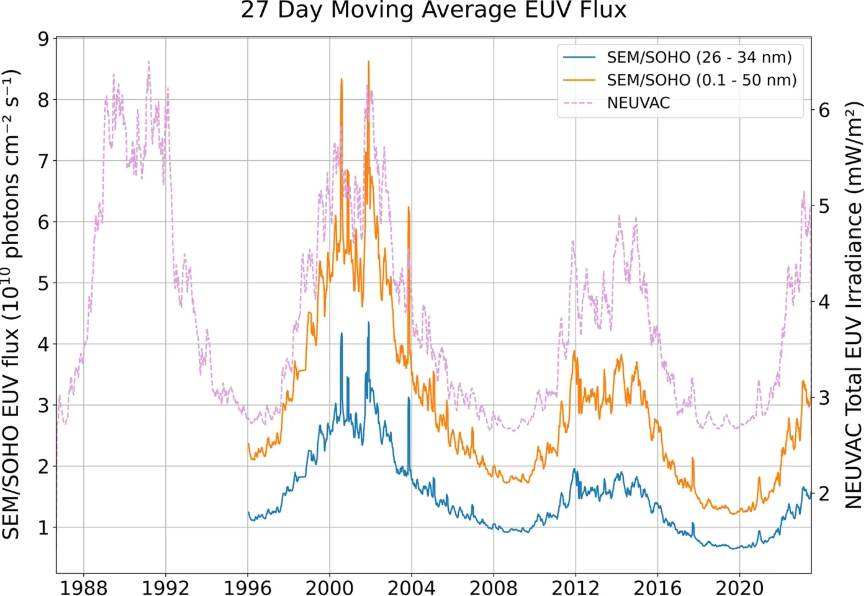 The variation of the solar EUV flux over recent solar cycles. Credit: Frontiers in Astronomy and Space Sciences.
Two objects followed in the study in high inclination polar orbits seemed immune to the impacts of peak EUV flux, suggesting either limitations to the study, or regions where the effect is minimized.
Sunspot numbers and EUV flux data gathered by the joint NASA/ESA SOHO mission correlate with the impacts seen in the study. SOHO has been on station and making solar observations since 1996.
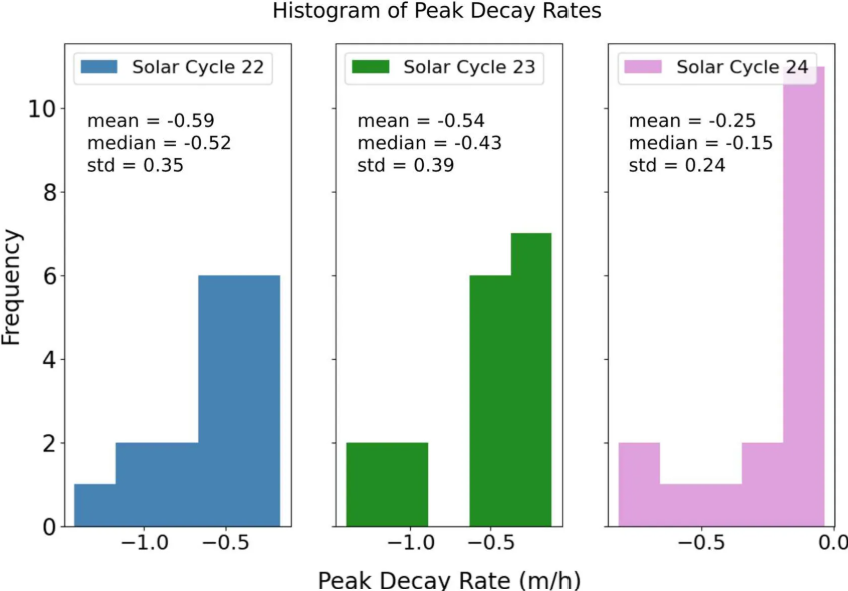 The spike in decay rates seen over the peak of the past three solar cycles. Credit: Frontiers in Astronomy and Space Sciences.
This information could be of key operational value, and assist planners and help to identify times when decay rates could be at their peak. Crewed stations such as the ISS and Tiangong must conduct routine maneuvers to avoid space debris.
SpaceX’s Starlink made an amazing 50,000+ collision avoidance maneuvers in the first half of 2024, just to maintain the company's mega-satellite constellation. Space weather could wreak havoc in LEO in very short order. Two events, the collision of Iridium 33 and Kosmos 2251 in 2009, and the Russian ASAT anti-satellite missile test in 2021 added to the debris load in LEO.
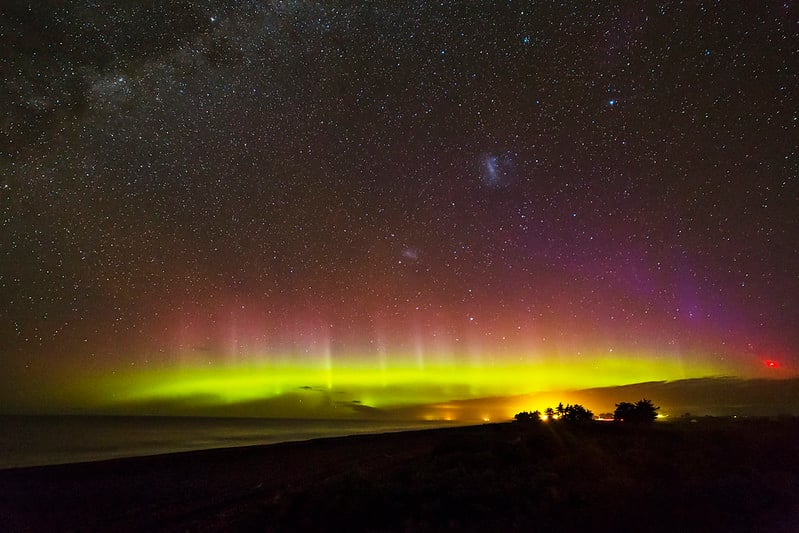 Space weather-triggered southern aurora from 2017. Credit: Paul Stewart.
The next ‘star’ you see at dusk may in fact be space junk, as we build a strange new artificial sky overhead. The irony is, I'm currently writing about Starlink's impact while working in remote rural Virginia and enjoying a Starlink connection. Now more than ever, it's crucial that we understand how space weather impacts the local Earth environment, as we put more and more satellites in low Earth orbit.