Universe Today
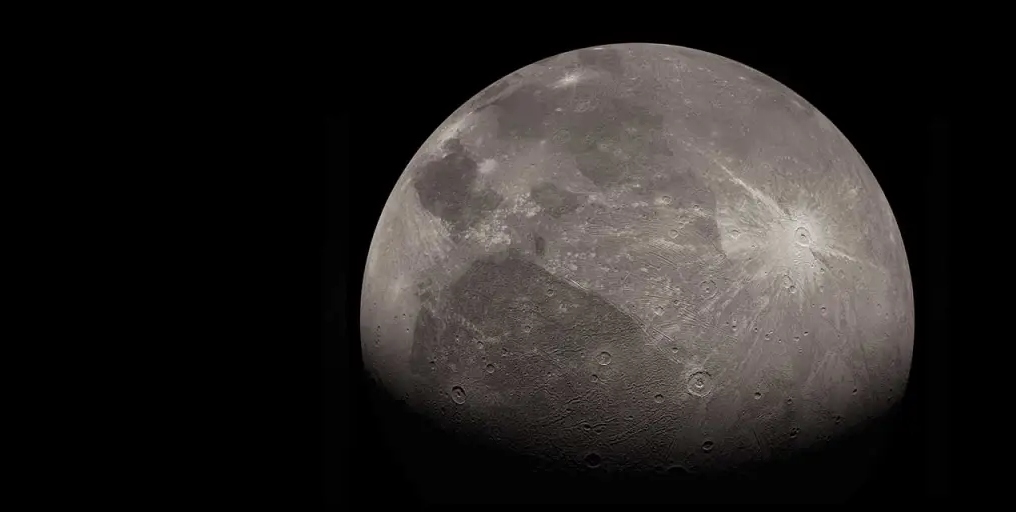
Ganymede, Jupiter's largest moon, is also the Solar System's largest satellite, even larger than the planet Mercury. It is also the only celestial body aside from Earth (and the gas giants) to have an intrinsic magnetic field. As if this didn't make the icy body interesting enough, scientists also predict that it has a massive interior ocean with more water than all of Earth's oceans combined. At present, the European Space Agency's (ESA) Jupiter Icy Moons Explorer (JUICE) is in transit to Ganymede to explore it for signs of habitability.
In anticipation of its arrival, an international team led by Dr. Anezina Solomonidou of the Hellenic Space Center (HSC) has identified some of the most promising cryovolcanic regions on Ganymede. She was joined by researchers from Greece, France, Italy, Germany, the U.S., Czechia, the ESA, and NASA's Jet Propulsion Laboratory (JPL). The study, titled “Potential Cryovolcanic Regions on Ganymede: A Priority Target for JUICE”, has been accepted for publication in the Planetary Science Journal.
Similar to volcanoes on Earth, cryovolcanoes are the result of material inside a celestial body being pushed up through the surface. But in the case of "Ocean Worlds" like Ganymede, so-named because of their interior oceans, the material in question is water and volatile materials being pushed through surface ice. In addition, this activity is driven by geological activity in the interior, which is the result of tidal flexing caused by interactions between these satellites and the gas giants they orbit.
These regions represent important targets for future observations by missions such as JUICE and NASA's Europa Clipper spacecraft. By investigating water from the interior, scientists hope to find evidence of organic processes beneath the surface, which could also indicate life (or "biosignatures"). Ever since the Voyager probes passed through the Jupiter system, scientists have speculated that some of its largest moons - Europa, Ganymede, and Callisto - have oceans capable of supporting life. Said Dr. Solomonidou in an HSC press release.
Ganymede is one of the most fascinating worlds in the Solar System. Understanding possible cryovolcanic activity can help us better understand how ocean worlds evolve and whether they may host conditions suitable for life.
To identify promising cryovolcanoes, the team used reprocessed data from the Near-Infrared Mapping Spectrometer (NIMS) on NASA's Galileo mission, which explored the Jupiter system between 1995 and 2003. This data allowed them to investigate unusual surface depressions and structures that may be linked to cryovolcanism. Among the best candidates for exploration were four paternae, depressions that may have been cryovolcanic vents that deposited material on the surface.
The study also highlights how observations with JUICE's Moons And Jupiter Imaging Spectrometer (MAJIS) imaging spectrometer and the Jovis, Amorum ac Natorum Undique Scrutator (JANUS) will help determine whether these features are the result of cryovolcanic activity. If this proves to be the case, these sites could contain traces of organic molecules and other biosignatures that originated in the interior and are now preserved in the surface ice.
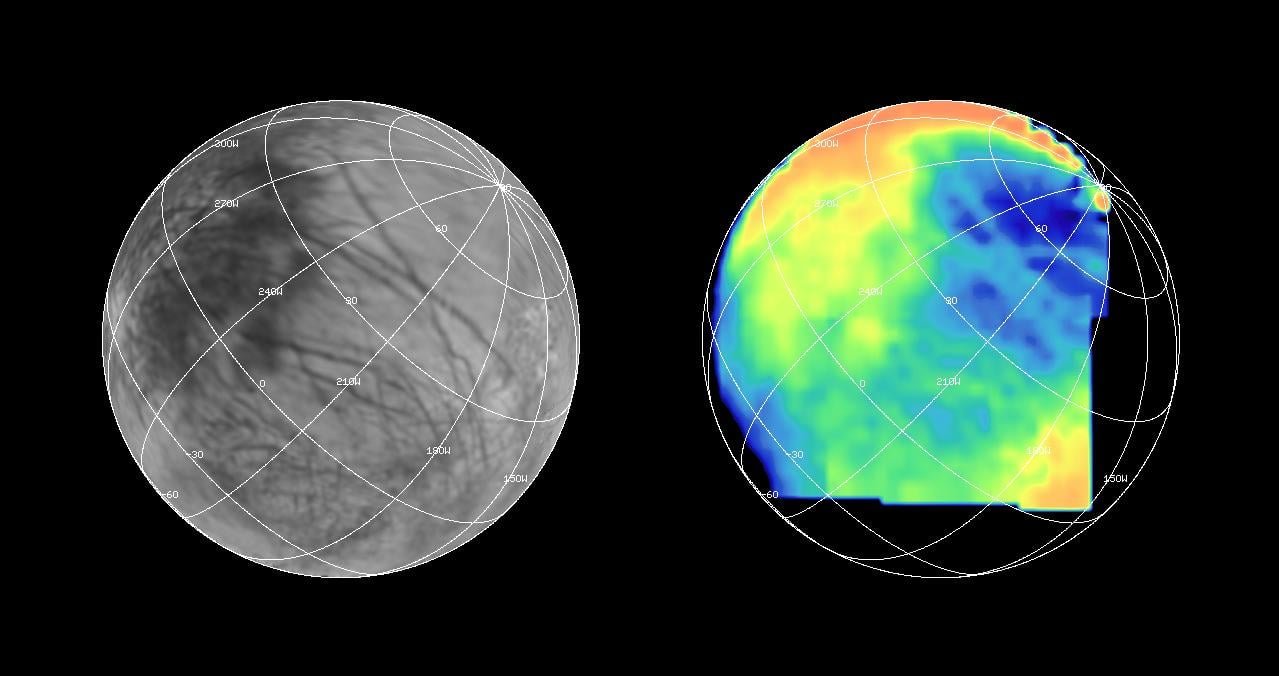 The Near Infrared Mapping Spectrometer (NIMS) on the Galileo spacecraft imaged most of Europa in 1996. Credit: NASA/JPL
In addition to Ganymede, JUICE will explore Callisto and Europa and characterize them with its advanced suite of scientific instruments. These studies, combined with those of the Europa Clipper, are expected to shed light on similar systems throughout the galaxy.
Further Reading: Hellenic Science Center