Universe Today
Supernovae play a central role in the birth of new stars. They provide a rich source of gas and dust to form stellar nurseries, and their explosions can trigger shockwaves that trigger the birth of new stars. But it all depends on where supernovae occur. A supernova that happens within a dense cloud of gas will have a very different effect than one that occurs in a large void. Understanding these effects is a challenge. It is much easier to observe a supernova while it happens rather than long before or after. But a new radio study of the Triangulum Galaxy explores these interactions.
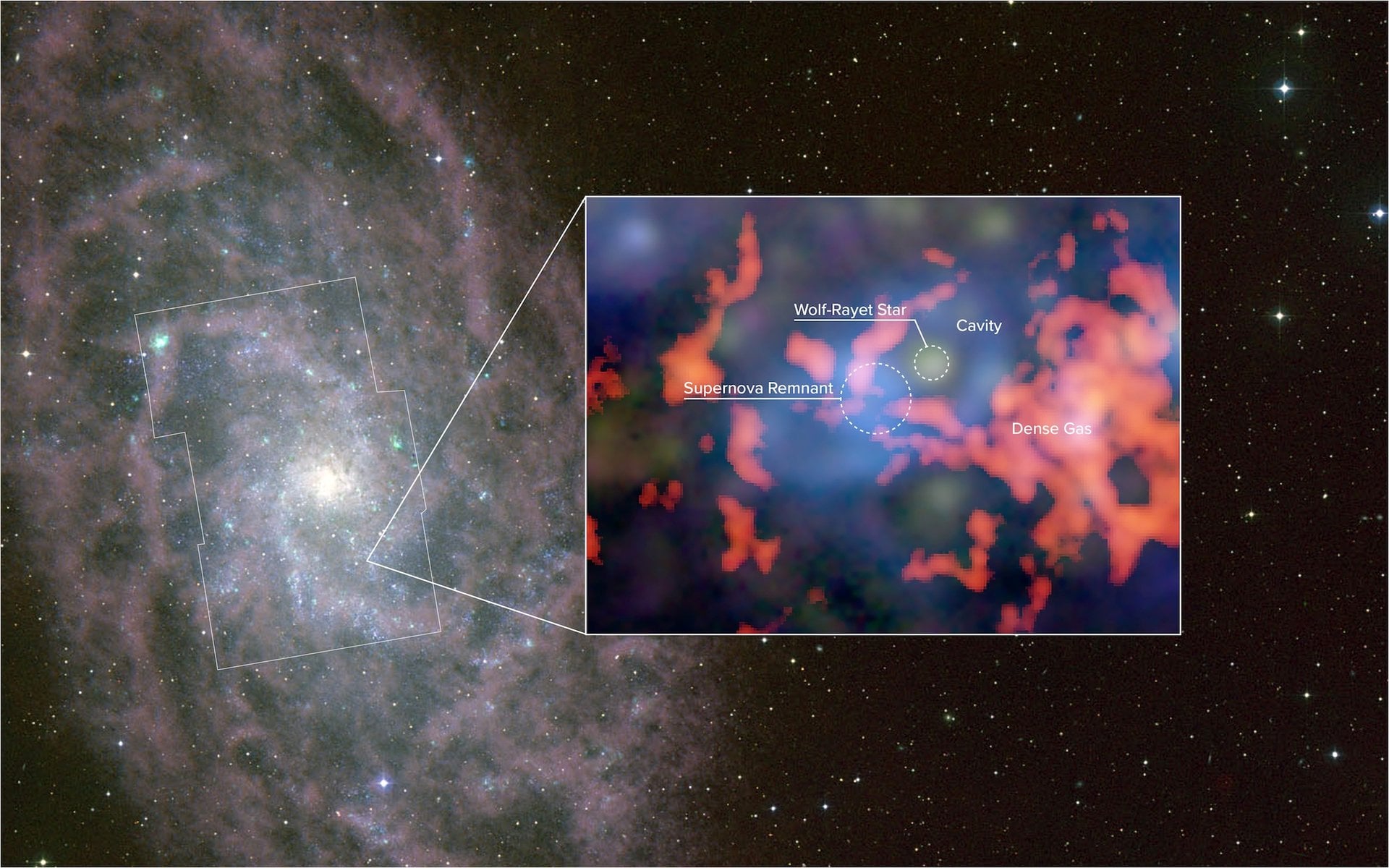
The study is based on data from the Very Large Array (VLA), which looks at distributions of cold neutral hydrogen, and data from the Atacama Large Millimeter/submillimeter Array (ALMA), which looks at cold and warm molecular gas. Taken together, the data allowed the team to create a radio map of a section within Triangulum showing dense and void cloud regions.
The team then compared this map to the locations of three types of objects: red supergiants, Wolf-Rayet stars, and supernova remnants. The remnants, of course, indicate where supernovae have occurred. Red supergiants are dying stars that will become supernovae in the cosmic near future. Wolf-Rayet stars are old stars that cast off their outer layers gradually, though some may trigger shock waves, supernovae, or gamma-ray bursts.
They found that only about a third of red supergiants and supernova remnants are located within higher density regions of molecular hydrogen. The rest are generally found in low-density regions and voids. This suggests that supernova shock waves play a smaller role in triggering star formation than expected. Wolf-Rayet stars are more typically found near dense regions. This makes sense given they are short-lived and have little time to drift away from their origin location. Even within these general patterns, the authors found subtle variations. For example, a Wolf-Rayet star that first appeared to be within a dense region was found to be surrounded by a 10 light-year cavity upon closer examination.
The authors plan to use this study to develop computer simulations of the birth and death of stars within the Andromeda galaxy. They also plan to expand their survey to star-forming regions within other nearby galaxies.
Reference: Sarbadhicary, Sumit K., et al. "Where do stars explode in the ISM?--The distribution of dense gas around massive stars and supernova remnants in M33." arXiv preprint arXiv:2310.17694 (2023).