 Universe Today
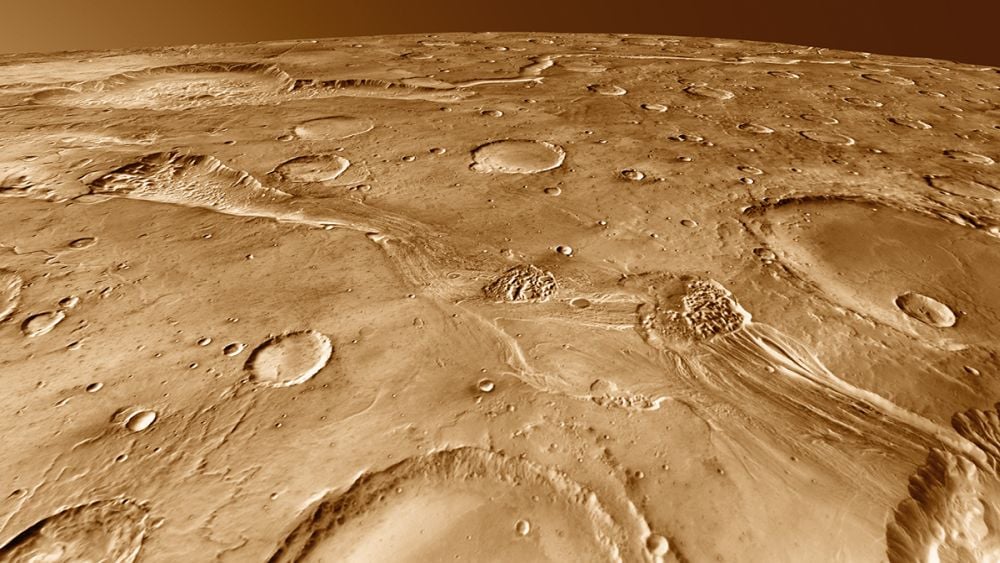
One feature of the Solar System that doesn't require a complex explanation is the cratered surfaces of some of the planets and moons. These surfaces have been pummeled by impacts, and on some bodies, these impacts are defining features. The craters tell the tale of our Solar System's history.
On Earth, at least one massive impact led to an extinction. But when it comes to life, these impacts may both give and take away. While the Chicxulub impact wiped out the dinosaurs, other impacts could potentially spread life from planet to planet.
The idea that life can spread from world to world dates as far back as ancient Greece and the philosopher Anaxagoras. It's called panspermia, and while it's not exactly a mainstream scientific idea, it has endured. The idea has been bolstered somewhat by the growing understanding that life's chemical building blocks are more widespread than we thought.
Now new research into extremophiles shows that at least some of them can survive ejection from Mars due to an asteroid strike. Not only can they survive the extreme high pressure from a direct impact, but they can survive the journey between planets, despite that journey's many hazards. This can happen if they become embedded in debris from the impact.
The research is "Extremophile survives the transient pressures associated with impact-induced ejection from Mars," and it's published in PNAS Nexus. The lead author is Lily Zhao, a graduate student in the Department of Mechanical Engineering at Johns Hopkins University.
"Large-scale impacts are ubiquitous in the solar system, and the likelihood of survival of organisms after an impact event plays a key role in planetary protection, the search for extraterrestrial life, and the assessment of the panspermia hypothesis," the authors write. "Impacts generate very high stresses for short times, resulting in extreme pressures and high rates of loading. Can microorganisms survive such extreme conditions?" the researchers ask.
To find out, they selected an extremophile named Deinococcus radiodurans, which is known to survive the hazardous conditions in space. D. radiodurans has been the subject of much extremophile research. It's the most radiation-resistant lifeform we know of, and can also survive cold, dehydration, vacuum, even acid. It's sometimes called a polyextremophile because of its resistance to these dangers.
In laboratory experiments, the researchers subjected D. radiodurans to extreme pressures for short times, mimicking an impact. Then they measured how much of a sample of the organisms survived, how the survivors repaired damage, and how they reacted to impacts on a molecular level.
"We kept trying to kill it, but it was really hard to kill." - Lily Zhao, Johns Hopkins University
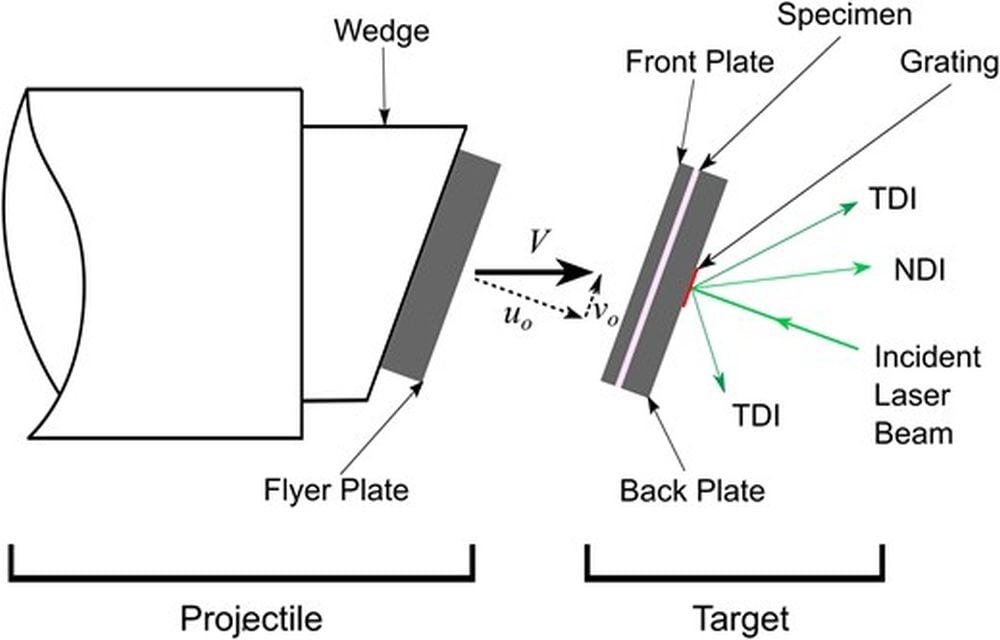 This schematic shows how the laboratory experiment worked. It's called a pressure–shear plate impact experiment, and in it, a projectile with a wedge and a flyer plate impact two steel plates sandwiching a D. Radiodurans sample. This setup keeps the pressure and shear forces equal all across the sample. Laser interferometry and transverse displacement interferometry measure and calculated the stress to the organism as it evolves over time. Image Credit: Zhao et al. 2026. PNASNexus
The RNA of the surviving samples was extracted and studied. It showed that as the pressure increased, so did stress on the organism. But survival was high in some of the experiments.
"We demonstrated that the extremophile D. radiodurans has remarkably high survivability and viability after being subjected to pressures of up to 3 GPa," the authors write. "As the pressure increases, D. radiodurans exhibited indicators of increased biological stress, as determined by the transcriptional analysis of impacted samples."
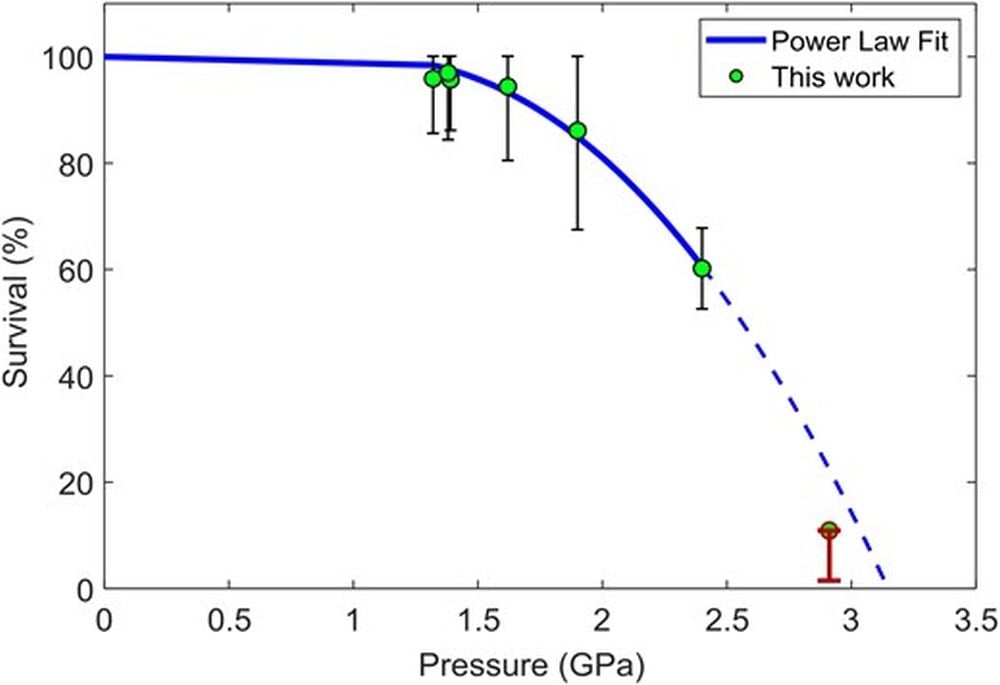 This chart shows how D. radiodurans reacted to impact pressure. Since one GigaPascal (GPa) is about 10,000 times normal Earth surface pressure, some of the extremophile sample endured extreme pressure. The survival rate was ∼95% at 1.4 GPa, 94% at 1.6 GPa, 86% at 1.9 GPa, and 60% at 2.4 GPa. Image Credit: Zhao et al. 2026. PNASNexus
"Our results suggested that microorganisms can survive much more extreme conditions than previously thought, potentially surviving conditions that result in the formation of ejecta that can move across planetary systems," the researchers write.
"Life might actually survive being ejected from one planet and moving to another," said senior author K.T. Ramesh, an engineer who studies how materials behave in extreme conditions. "This is a really big deal that changes the way you think about the question of how life begins and how life began on Earth."
The researchers also studied the samples after impacts to observe any cellular damage. They used Transmission Electron Microscopy (TEM) to compare a non-shocked control sample to samples subjected to 1.4 GPa and 2.4 GPa. They found "structural and morphological changes that result from these transient pressures at the higher pressures."
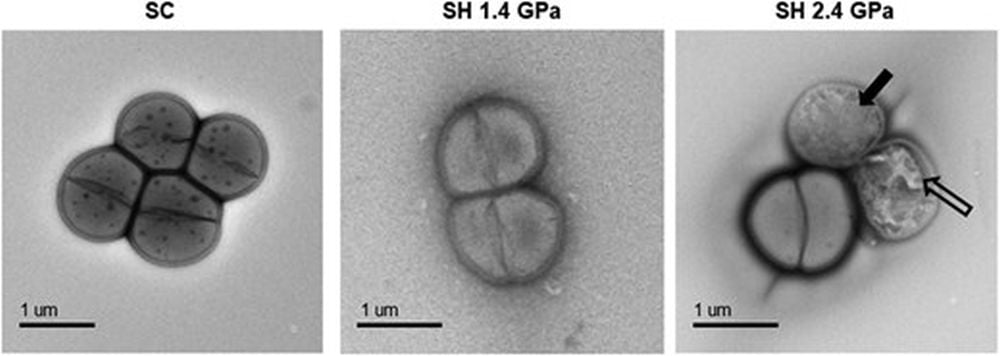 Cells subjected to 1.4 GPa harbor similar morphology and membrane/cell wall structures as the control, according to the authors. But cells subjected to 2.4 GPa show internal damage and cell wall damage. Image Credit: Zhao et al. 2026. PNASNexus
But the main result is that D. radiodurans appears to be able to withstand extremely high, if transient, pressures with minimal effect.
"We demonstrated that the extremophile D. radiodurans has remarkably high survivability and viability after being subjected to pressures of up to 3 GPa. As the pressure increases, D. radiodurans exhibited indicators of increased biological stress, as determined by the transcriptional analysis of impacted samples."
"We expected it to be dead at that first pressure," said lead author Zhao in a press release. "We started shooting it faster and faster. We kept trying to kill it, but it was really hard to kill."
In fact, the laboratory equipment succumbed to the pressure before all the D. radiodurans did.
Impacts on Mars could subject samples to up to 5 GPa, even higher depending on different factors. Still, the fact that D. radiodurans survived up to 3 GPa is good news for panspermia enthusiasts.
"We have shown that it is possible for life to survive large-scale impact and ejection," Zhao said. "What that means is that life can potentially move between planets. Maybe we're Martians!"
But the results apply to more than just panspermia. D. radiodurans ability to survive extreme pressures means there's a pathway where they could survive an inadvertent trip from Earth to Mars, or elsewhere, on one of our rovers or landers.
"We might need to be very careful about which planets we visit," Ramesh said.
"These findings have important implications for our understanding of the extreme limits of life, planetary protection, the design of space missions, and the possibility of the dispersal of life throughout solar systems," the authors conclude.

