Universe Today
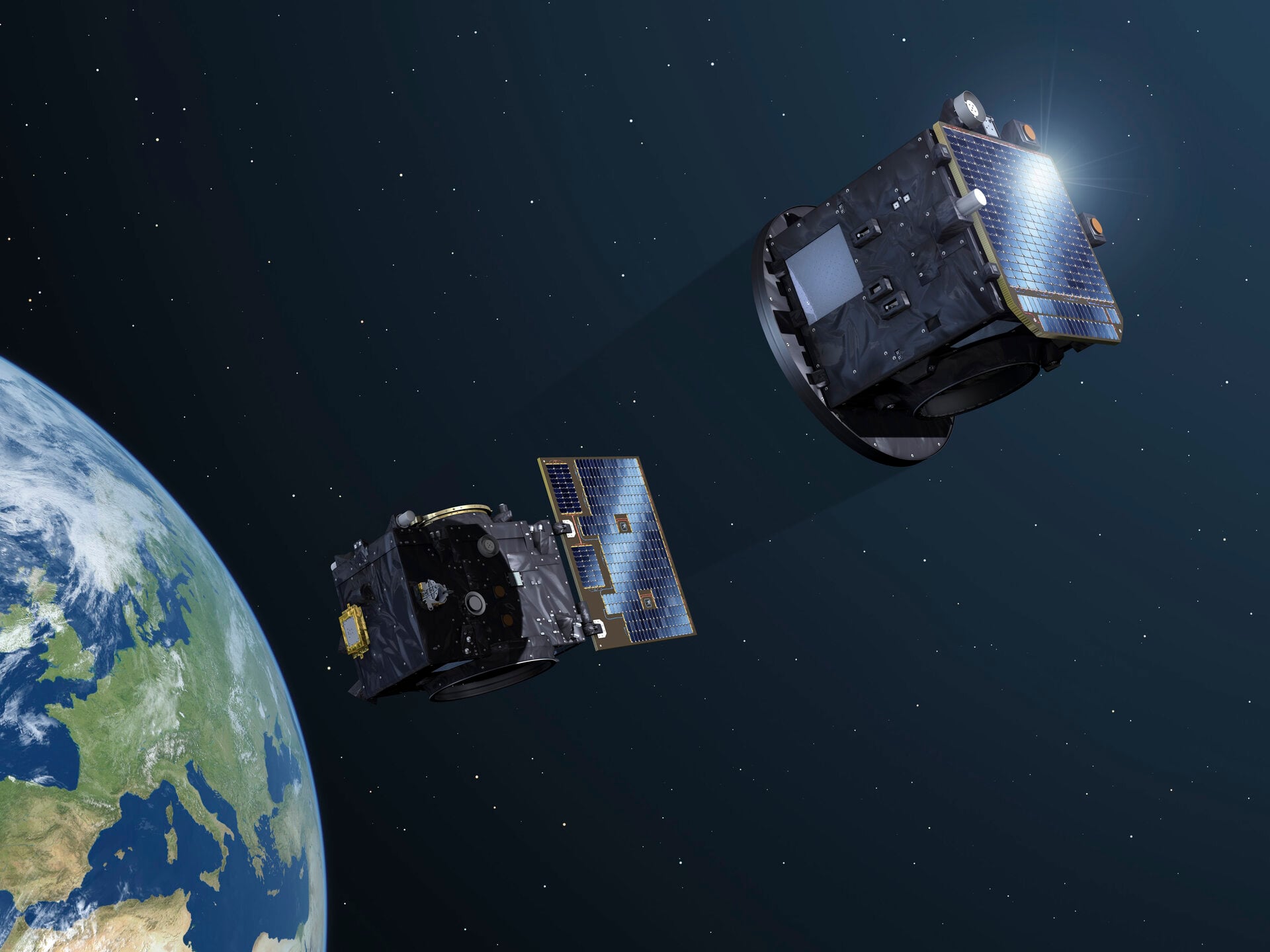
ESA’s flagship Proba-3 mission shows its stuff as an on-demand, eclipse producing machine.
Some really unique science can be done during a total solar eclipse. Totality is the one time we can see the elusive corona of the Sun, the pearly white segment of our host star’s lower atmosphere where space weather activity originates. The trouble is, totality is fleeting. What researchers really need are eclipses on demand. ESA’s innovative Proba-3 mission does just that, by making use of a free-flying occulting disk. Launched in late 2024, we’re now seeing some unique science and images from the observatory.
A recently released image comparison shows us just what the observatory can do. The image shows the elusive inner corona seen as a yellow fringe, versus the active Sun below. Poorly understood, the lower corona is the hottest section of the Sun’s atmosphere, topping out at over a million degrees Celsius. The corona is 200 times hotter than the photosphere surface below. The photosphere is what we see in visible light as the dazzling ‘surface’ of the Sun. The ASPIICS coronagraph image is time synchronized with NASA’s Solar Dynamics (orange) view from its AIA Atmospheric Imaging Assembly (AIA 304).
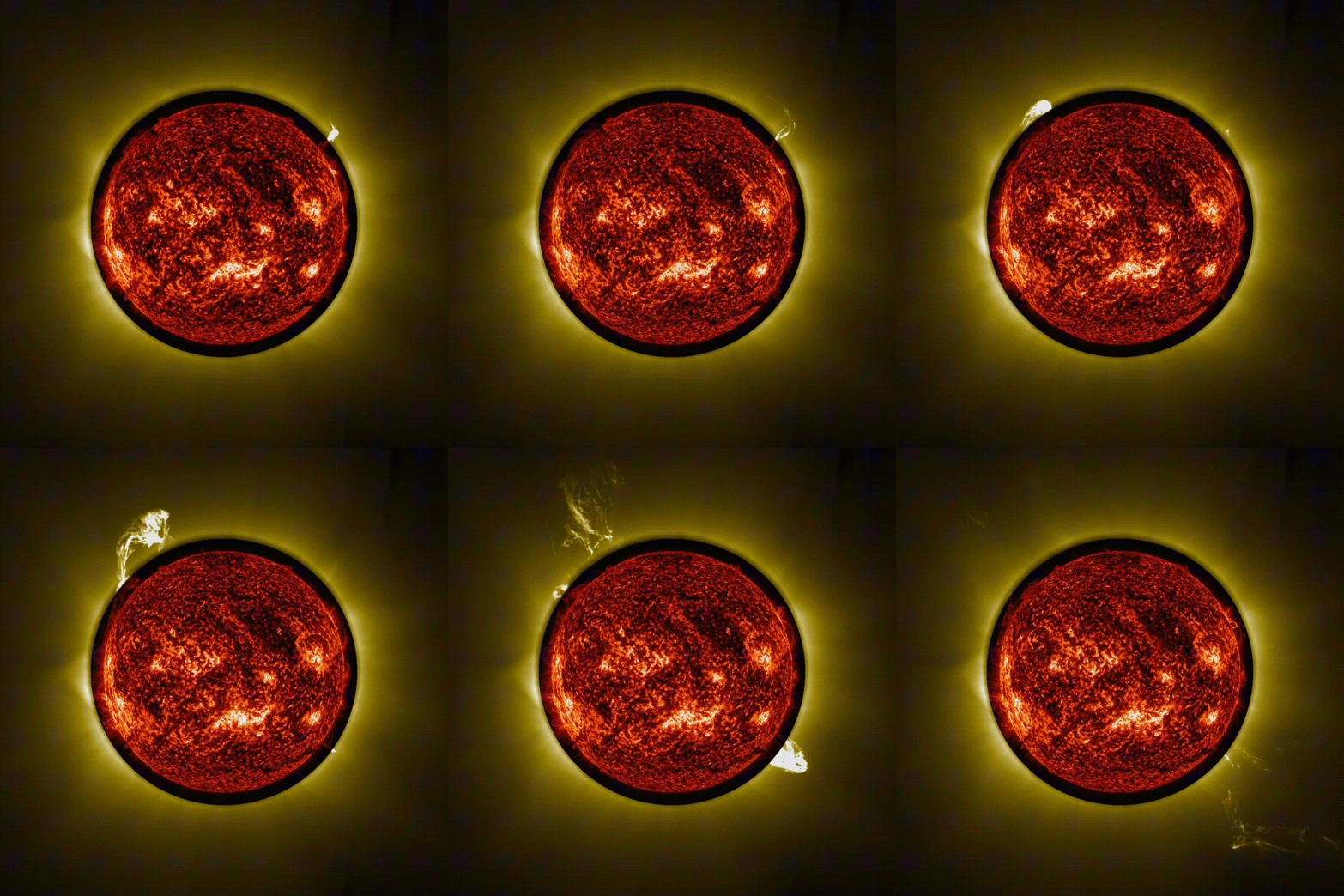 Proba-3's view, versus SDO. Credit: ESA/NASA/SDO.
“The two Proba-3 spacecraft constitute a giant coronagraph called ASPIICS (Association of Spacecraft for Polarimetric and Imaging Investigation of the Corona of the Sun).” Andrei Zhukov (Royal Observatory of Belgium) told Universe Today. “The main scientific objective of ASPIICS is the investigation of the structure and dynamics of the inner solar corona, which is not easily accessible by other means, like imaging in extreme ultraviolet and observations by traditional externally occulted coronagraphs. Namely, the main questions to be investigated include the origin of the variable slow solar wind, and physics of coronal mass ejections (CMEs).”
The animated image sequence shows a five hour span, with an image captured every five minutes centered on September 21st, 2025. The team got lucky with this one, capturing three prominence eruptions in just five hours.
You can see prominences as they form, evolve and grow, right near their source.
The Proba-3 mission is an international endeavor. Proba-3 launched on an ISRO PSLV-XL rocket from Satish Dhawan Space Center in India on December 5th, 2024. In a highly elliptical orbit, Proba-3 takes just under 20 hours to circle the Earth, taking it from a perigee of 600 kilometers to an apogee of 60,530 kilometers out. This unique path allows for it to complete the science segment of its orbit when it's farthest from Earth. Proba-3 has a two year nominal mission.
The science and purpose behind the Proba-3 mission gets at the heart of understanding and solving what’s known as the ‘coronal heating problem.’
“The early images taken by the Proba-3/ASPIICS coronagraph demonstrate first of all that the formation flying concept for observations of solar corona does work,” says Zhukov. “Proba-3 created around 50 artificial total solar eclipses with the duration of up to 5.5 hours. The ASPIICS images show numerous dynamic phenomena in the corona. These include small-scale phenomena like loops and jets, and large-scale phenomena like streamers, prominences, and coronal mass ejections. It is a bit early to speak about first science results, as the science team is currently working on the preparation of first peer-reviewed publications.”
Proba-3 works in concert with other missions following solar activity through the ongoing Solar Cycle 25, including NASA’s Solar Dynamics Observatory, PUNCH, the Parker Solar Probe and ESA’s Solar Observer (SolO) mission.
Producing eclipses in space presents key technical challenges for the mission. Flying 150 meters apart, the mission’s twin spacecraft must fly with a precision of mere millimeters to make the system work.
“The technical challenges were essentially the required formation flying position accuracy, and also the level of autonomy of the spacecraft,” Damien Galano, (ESA-Proba 3 Project Manager) told Universe Today. “The telescope’s optical aperture, which is 50 millimeters wide, needs to be precisely centered within the shadow cast by the occulter at 150 meters. Light behaves as a wave, and the shadow is not pitch black, especially close to its inner edge. In order to avoid collecting too much sunlight in the telescope, a requirement of 5 millimeters was devised for the maximum position error between the center of the telescope and the shadow’s center."
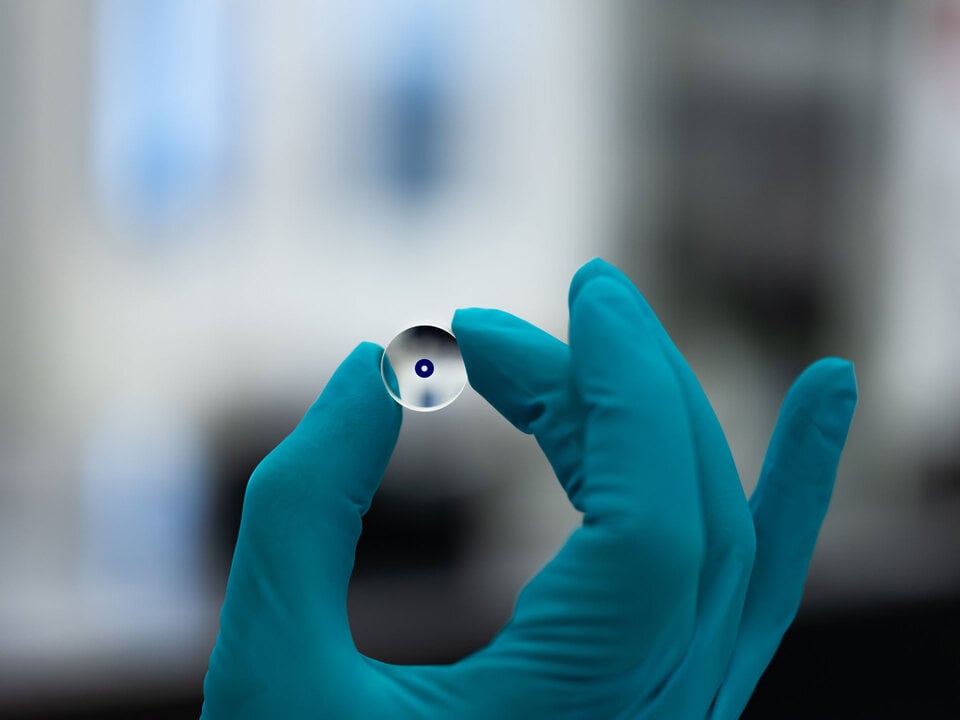 A lens from the Proba-3 ASPIICS optical system, etched with its own diffraction coronagraph (the black circle in the center). Credit: ESA/Remedia.
Amazingly, the team actually achieved an on-orbit accuracy better than a millimeter. “This feat was accomplished through the development of specialized on-board sensors so the spacecraft can know their relative position with exquisite accuracy, and correct any deviation,” says Galano. “The deviation(s) are due to any forces that apply differently on each spacecraft. For instance, the gravity pull from the Earth, different as each spacecraft is not exactly at the same altitude, or the force caused by the sun particles – the solar wind – which hit the spacecraft.”
Another challenge for the mission is the autonomous ability for the spacecraft to break and reacquire formation flying on their own. “The formation breaking is needed when the spacecraft come closer to the Earth in their cyclic rotation around it, where the gravity pull is too high for the formation to be maintained,” says Galano. “This autonomy is enabled by complex and robust on-board software and algorithms.”
Coronagraphs in Space
The idea of using a coronagraph to study the solar atmosphere is an old one. It’s difficult to do in practice on the Earth, due to how our pesky atmosphere scatters light. The final mission of the Apollo program the Apollo-Soyuz Test Project attempted to use the Apollo Command/Service module as an occulting disk in 1975, with less than spectacular results.
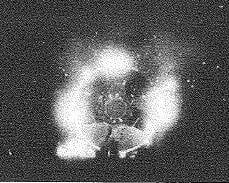 An Apollo 'Command Module Eclipse' as seen from Soyuz. Credit: NASA/Roscosmos.
Proba-3 marks the first successful use of a dedicated, free-flying coronagraph to observe the Sun in space.
“Following the intense period after the launch, when all the on-board systems and equipment had to be activated and validated, the Proba-3 team will continue to operate and monitor the health of the spacecraft in a more routine manner to acquire more science data,” says Galano. “This will last for about two and half years, until the on-board consumables, particularly the nitrogen reserve for the propulsion system, are depleted.”
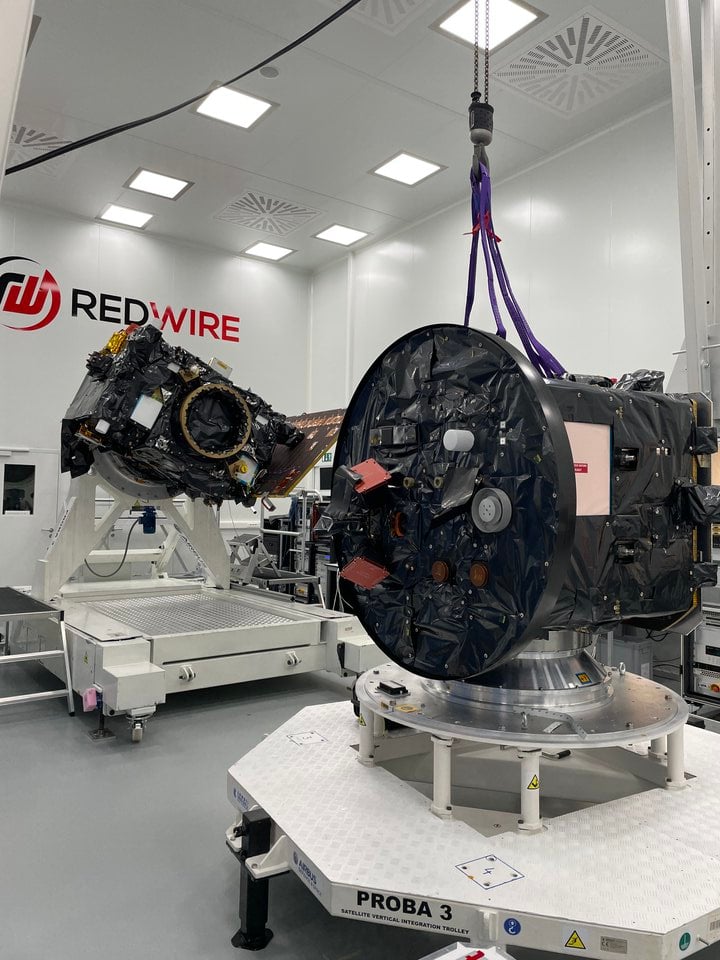 The two Proba-3 spacecraft in the lab on Earth. Credit: ESA/Redwire Space.
The team also occasionally commands the spacecraft to perform additional maneuvers for technical purposes, such as bringing the two spacecraft closer together safely. “We have already successfully executed such maneuvers, with the spacecraft coming as close as 30 meters from each other,” says Galano.
Other missions which plan to incorporate a coronagraph-style occulting disk include the Nancy Grace Roman space telescope, the Habitable Worlds Observatory mission, and NASA’s proposed New Worlds mission, which would feature a free-flying occulter known as Starshade. These will be primarily used to image exoplanets near their host stars directly.
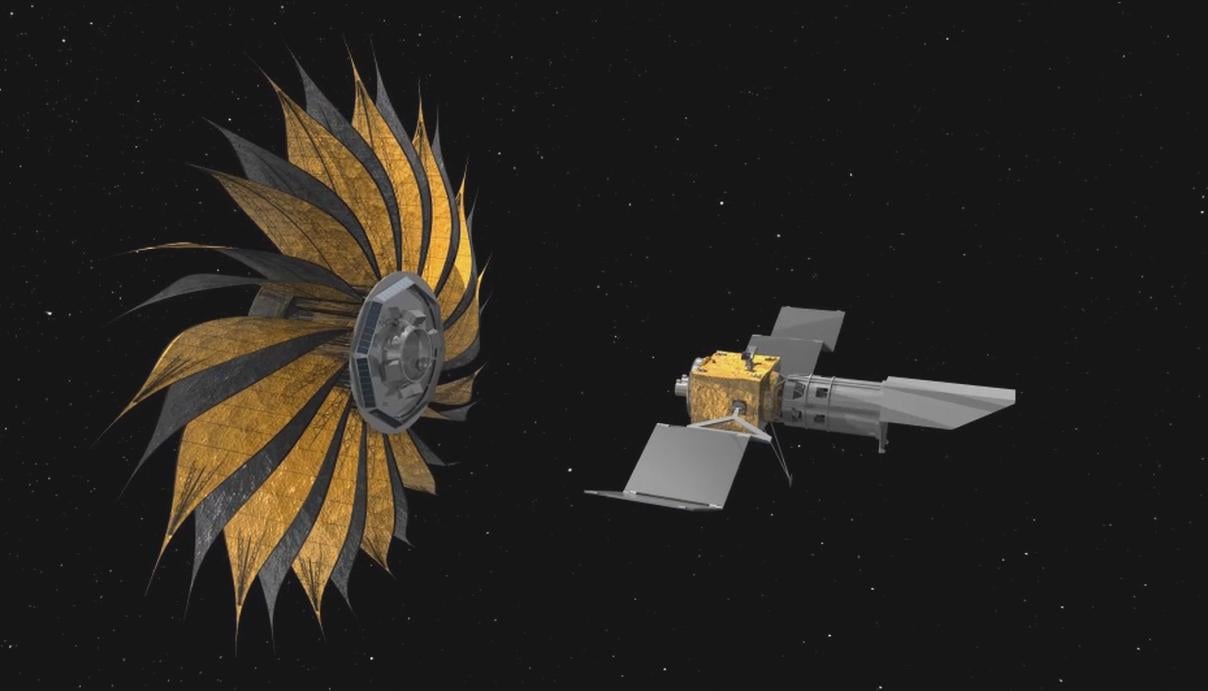 An artist's impression of Starshade in space. Credit: NASA.
Lucky eclipse chasers will have a chance to see the solar corona in person on August 2nd of this year, when the Moon’s shadow sweeps across Iceland, the North Atlantic and Spain. I’d like to see a synchronized view of the solar corona during the upcoming total solar eclipse, from space courtesy of Proba-3, and from the ground taken during the brief totality phase.
Expect more great views of the corona, courtesy of Proba-3 and its on-demand artificial eclipses.