Universe Today
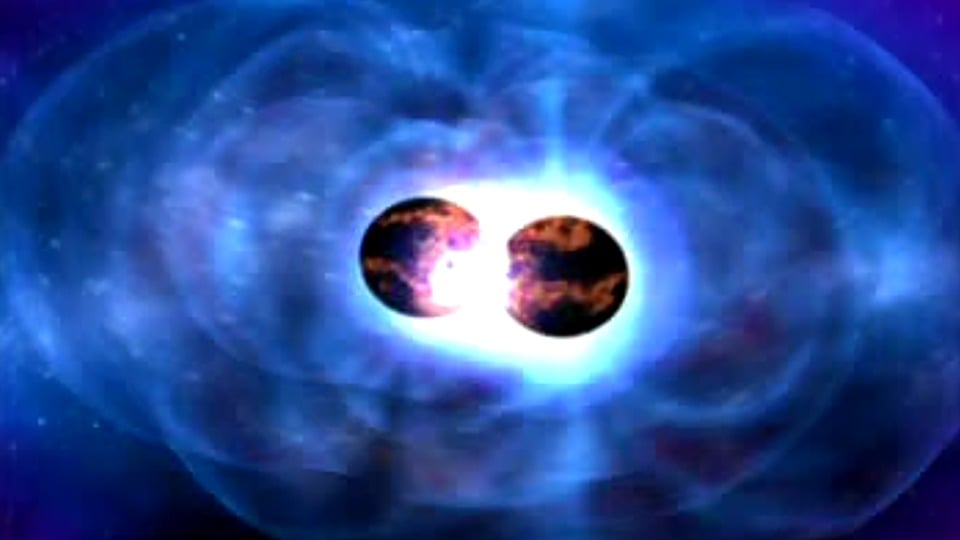
A small lump of rock pulled up from the Pacific Ocean seafloor in 1976 is giving scientists new clues about an ancient cosmic event. More than a hundred million years ago, two neutron stars collided. The resulting energetic kilonova sent a rain of long-lived elements, such as isotopes of plutonium, through space. Eventually, this stellar "debris" settled onto Earth. Some sank to the bottom of the ocean and got incorporated into a chunk of ferromanganese rock. Hidden inside were a few hundred atoms of plutonium radioisotopes. They provide the strongest clues about what created them in the merger and how long ago it happened.
The plutonium is in the form of Pu-244, which has a half-life of 81.3 million years. That helped a team of scientists from the Helmholtz-Zentrum Dresden-Rossendorf institution in Germany and researchers at Australia's Nuclear Science and Technology Organisation (ANSTO), put the epoch of the explosion a near 100 million years ago. They also found that the sample lacked another element related to the collision: curium 247. It has a half-life of 16 million years.
“The absence of the curium radioisotope Cm-247, which was also produced in the explosion, tells us it happened a very long time ago," said ANSTO's Dr. Michael Hotchkis. "But not more than about 1 billion years ago; otherwise the Pu-244 would also be undetectable."
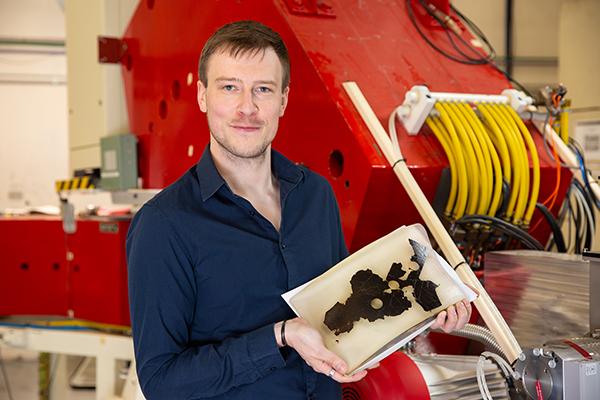 Research team member Dominic Koll holds a sample of the rocky crust recovered from the Pacific Ocean. Courtesy ANSTO.
Drilling Cores Reveal Elements from a Kilonova
To get to the hidden PU-244 and figure out the age of the neutron star merger debris, the science team drilled out three cores in the rock. Then they began a careful chemical analysis. The cores were dated using the beryllium isotope Be-10, which has a half-life of 1.5 million years. They also found traces of the iron isotope Fe-60 in one core. Earth's crust grows so slowly that each core, measuring up to 3 cm, spanned more than ten million years.
The remaining crust was imaged with computed x-ray tomography and encased in resin. This allowed the scientists to cut thin layers that each corresponded to ~1 million years of growth. Then, each sample was divided up and processed to extract the plutonium. During this analysis, the team also found traces of material from known supernova events that occurred 2 and 7 million years ago. They also found some curium, but not the specific isotope that would have been created in the neutron star collision, according to Hotchkis. "The only possible explanation is that the cosmic explosion responsible for the plutonium happened so long ago that the curium has already decayed away to practically nothing,” he said.
Making Elements
We all know that elements such as helium, carbon, nitrogen, oxygen — all the way up to iron — are made inside stars, a process called stellar nucleosynthesis. The Sun, for example, is fusing hydrogen in its core to make helium. In a few billion years, it will start to fuse helium to make carbon, and then continues on to make carbon and oxygen. When the Sun begins the transition to become a white dwarf, it will release all the elements to space. In stars much more massive than the Sun, the process is more complex, but basically, it continues up to the creation of iron. Since it takes more energy to make iron and anything heavier, the process stops, the core collapses and the star explodes all its elements to space. Elements such as gold, platinum, uranium, nickel, and zinc get created in such events.
About half the heaviest elements are made in colossal events such as neutron star collisions that result in kilonova events. That process is called the "r-process" and includes such elements as thorium and uranium, and transuranics, such as plutonium and curium. Theories of r-process nucleosynthesis suggest that both Cm-247 and Pu-244 are produced simultaneously, in roughly equal proportions in such an event. Since the curium decays more rapidly than the plutonium, that puts a lower bound on the age of the neutron star merger, while the Pu-244 helps define the upper bound.
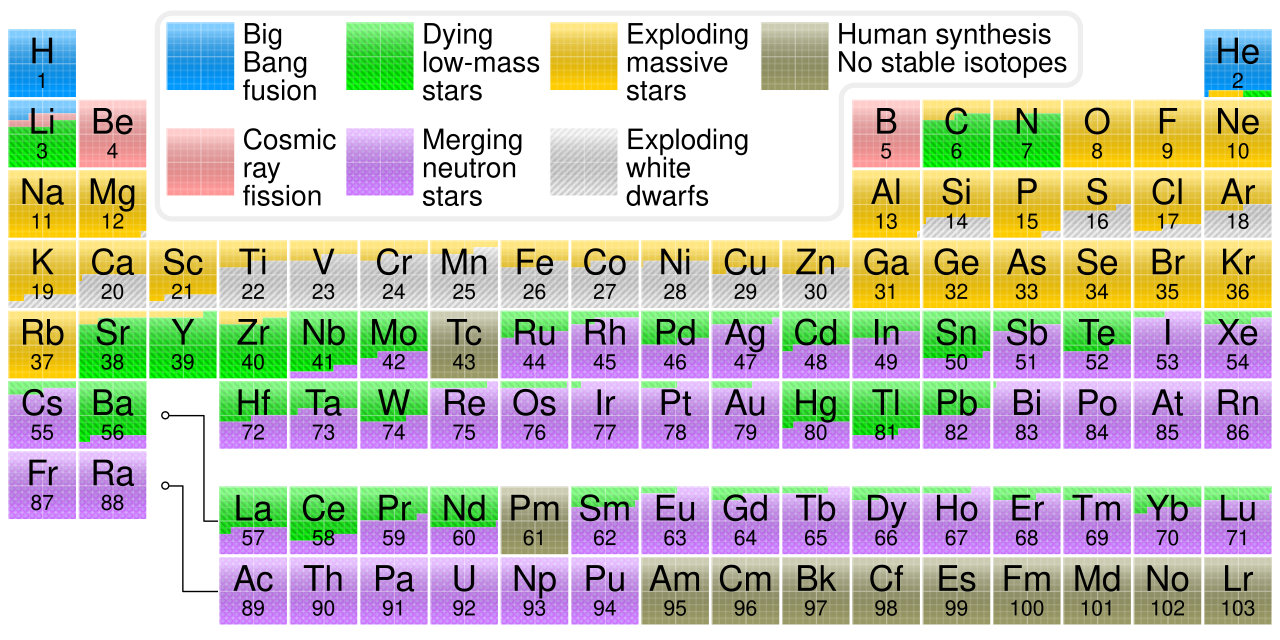 The periodic table of the elements with the origin of each element highlighted. Elements heavier than iron are created in supernovae, while some are created only in neutron star mergers. Courtesy Cmglee. CC BY-SA 3.0
Exploring the R-process Dust on Earth and Beyond
The detailed study of these isotopes, plus others found in the ocean-bottom rock sample, show the debris from cosmic events can arrive at Earth in pulses. Some are linked to nearby supernova explosions. However, the tiny sample of Pu-244 existed throughout all layers of the rock slices. That means the plutonium very likely came from the neutron-star merger/kilonova. It has been showing up at Earth as a continuous flux throughout the 100 million years since the event.
The research team is looking for other samples to bolster the neutron-star merger discovery using radioisotope samples. There should be more pieces of ancient crust on Earth that contain the products of the r-process that occurred. The dust from that long-ago event could well have settled onto the Moon and other worlds. The Apollo rocks could be fair game for study, and future missions could provide another way to access dust from the ancient past.
Space-based missions such as the Chandra X-ray Observatory, James Webb Space Telescope, and others have seen neutron star mergers in various wavelengths. So, scientists knew they took place. However, this "chemical analysis" of debris from such events offers a big step forward in dating the events and observing the results of r-process nucleosynthesis.
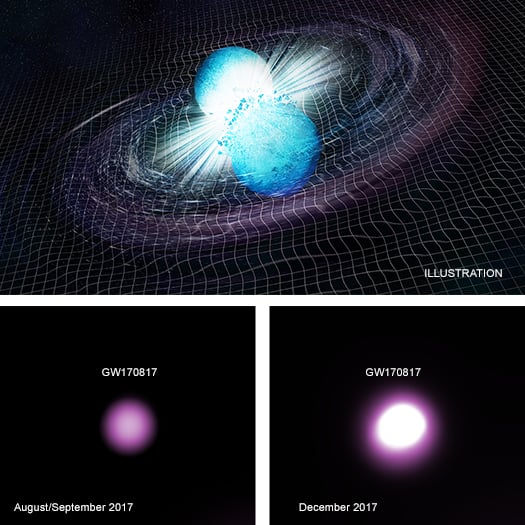 An artist's view of a neutron star merger, accompanied by two views taken by the Chandra X-ray Observatory. This type of event results in extremely high-energy conditions conducive to the creation of some of the heavier elements such as plutonium.