 Universe Today
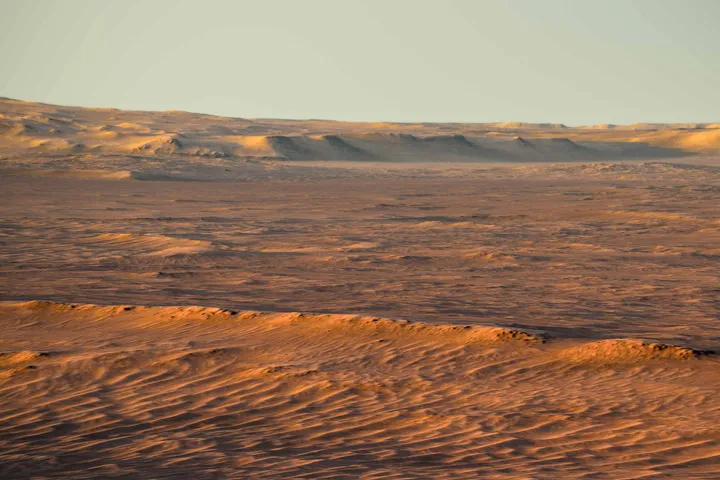
When the rover now named Perseverance landed in Jezero crater in early 2021, scientists already knew they had picked an interesting place to scope out. From space, they could see what looked like a bathtub ring around the crater, indicating there could once have been water there. But there was some debate about what exactly that meant, and it’s taken almost five years to settle it. A new paper from PhD student Alex Jones at Imperial College London and his co-authors has definitively settled the debate on the source of that feature - part of it was once a beach.
Admittedly, there is some nuance to that finding. The particular feature they looked at was something called the Margin Unit - a band of olivine- and carbonate-rich rocks ringing the inner edge of the crater. The paper actually splits this into two different sub-segments, the Western Margin Unit (WMU) and the Eastern Margin Unit (EMU).
The WMU is located close to the crater rim, and is made up of a type of igneous rock. Most likely it was formed when lava actively ran through the crater. It’s largely structureless, and is made up primarily of olivine that has been transformed into carbonate and silica. Most likely that was caused by carbon-dioxide rich fluids (probably water) reacting with the rock itself.
NASA video describing Perseverance’s exploration of Jezero Crater. Credit - NASA Jet Propulsion Laboratory YouTube ChannelThat carbon dioxide rich water potentially could have been caused by hydrothermal vents, which makes this area particularly interesting for astrobiology, since hydrothermal vents are one of the places theorized to have been the formation place of the first life forms. That’s not to say the same process happened on Mars, but it seems the WMU is as good a place as any to take a look for it.
But perhaps more interestingly, the EMU looks a lot more like - to put it bluntly - a beach. This feature is farther down the crater rim, but shows signs of cross-stratification. That means there are layers at an off-set angle from the main bed, indicating they were deposited there by some sort of liquid flow. There were also surfaces that had clearly been eroded, and sandstone grains that were rounded in shape, indicating they had been subjected to wave motion.
All of this indicates that the EMU is a “high-energy lacustrine shore zone” that formed when Jezero crater was filled with water. Which is amazing for a variety of reasons, but perhaps most importantly is the clear indication of waves.
Fraser discusses the original plans for the Mars Sample Return mission.For waves to form, the water must not be frozen, which has been a point of contention in the Mars climatology community. It appears that at least for a period of time, the water on the surface of Jezero crater was not frozen. But what’s more, waves in a lake need wind, and Mars’ current sparse atmosphere wouldn't provide enough oomph to form them. That implies that, again at least for a time, Mars had an atmosphere thick enough to cause waves.
Which makes the case for an astrobiological search of these areas all the more pressing. The minerals found in these areas (carbonates and silica) can capture bacteria living in the sand or water and preserve them as microscopic fossils. Theoretically, even billions of years later, we would still be able to see them, if they exist.
There’s one particular sample the paper mentions called Comet Geyser, which Perseverance took in the WMU. According to NASA, this sample has the highest potential for finding preserved signs of ancient life of any taken during Perseverance's mission.
NASA Video describing Comet Geyser - perhaps the most interesting of the Mars Samples from an astrobiological perspective. Credit - NASA Jet Propulsion Laboratory YouTube ChannelHowever, recent news has put a damper on those hopes. The Mars Sample Return mission, which was originally intended to go to Mars and get those samples back to Earth, has officially been cancelled by NASA. It happened so recently that a press release supporting the release of the paper still mentions it as a possible future for some of the samples. But Congress cut the program due to cost overruns in the last few weeks. So, at least for now, those samples must remain in their dried up former lake, awaiting the day when someone or something will come pick them up.
Maybe the cause will be taken up by a rich individual - like the recent announcement that Eric Schmidt is privately supporting a flagship-class telescope mission. So, if any billionaires happen to be interested, there’s a tiny cylinder of rock sitting on Mars that might tell us whether we are alone in the universe or not. That sounds like a worthwhile legacy project.
Learn More:
ICL - New clues to Mars’s habitability in discovery of ancient beach
A. J. Jones et al. - Stratigraphy of Carbonate-Bearing Rocks at the Margin of Jezero Crater, Mars: Evidence for Shoreline Processes?
UT - NASA's Mars Sample Return Is Dead, Paving The Way For China

