 Universe Today
Neutron stars are the remnants of supernova explosions. They're known for their extreme density, and it's often said and written that a teaspoon of neutron star weighs as much as the combined weight of all of Earth's approximately 8 billion human beings. The only thing denser than a neutron star is a black hole.
Born from such calamity, it's not surprising that neutron stars have other extreme properties too. They're known for their extraordinarily powerful magnetic fields, generated by the same collapse that generates their extreme density. Researchers are exploring a link between these magnetic fields and what happens to neutron stars when they merge.
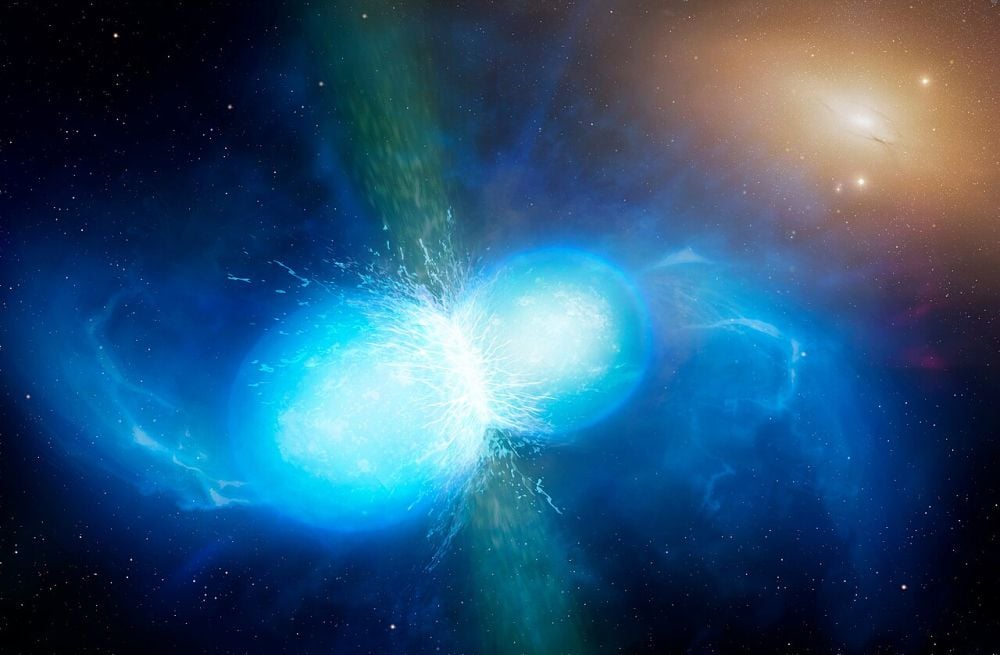
Given their powerful properties, it's no surprise that when two neutron stars (NS) merge, extremely powerful physics are involvde. A neutron star merger is a cataclysmic event that builds up over hundreds of millions of years, though the merger—the final act—lasts only milliseconds. When a pair of neutron stars spiral toward each other and eventually merge, it triggers a kilonova explosion and releases a short gamma-ray burst (GRB), the most energetic type of event in the Universe. The end result of the merger is either a more massive NS or a black hole. In an effort to understand these extraordinary events, a gamma-ray detector like NASA's Fermi satellite has to detect a GRB. Then astrophysicists take the data from that detection, gather any other observations like gravitational waves, and piece together what happened.
Despite everything researchers have learned about neutron stars, their insides are still mysterious. It's the realm of theory over observation. But when a pair of neutron stars is about to merge, their churning, interacting magnetic fields could be a window into their mysterious interiors.
Research published in The Astrophysical Journal simulated the final few orbits of a pair of inspiralling, merging neutron stars to see what high-energy signals the orbits generated. It's titled "Magnetosphere Evolution and Precursor-driven Electromagnetic Signals in Merging Binary Neutron Stars." The lead author is Dimitrios Skiathas, a graduate student at the University of Patras in Greece. Skiathas is conducting research at NASA's Goddard Space Flight Center.
“Just before neutron stars crash, the highly magnetized, plasma-filled regions around them, called magnetospheres, start to interact strongly. We studied the last several orbits before the merger, when the entwined magnetic fields undergo rapid and dramatic changes, and modeled potentially observable high-energy signals,” said lead author Skiathas in a press release.
The researchers used supercomputer simulations to investigate the magnetosphere interactions, and what electromagnetic signals might be emitted. "Our simulations fully follow a representative inspiral motion, capturing the intricate magnetospheric dynamics and their impact on EM outflows," the researchers explain in their paper.
The researchers used NASA's Pleiades supercomputer to simulate the merger of two NS with 1.4 solar masses each. The primary goal was to watch the pair's magnetic fields. Neutron stars rotate very rapidly, dozens of times per second. When they merge, this creates a turbulent electromagnetic chaos. Skiathas and his fellow researchers focused on the final 7.7 milliseconds of the inspiral, right before the merger itself.
“In our simulations, the magnetosphere behaves like a magnetic circuit that continually rewires itself as the stars orbit. Field lines connect, break, and reconnect while currents surge through plasma moving at nearly the speed of light, and the rapidly varying fields can accelerate particles,” said co-author Constantinos Kalapotharakos at NASA Goddard. “Following that nonlinear evolution at high resolution is exactly why we need a supercomputer!”
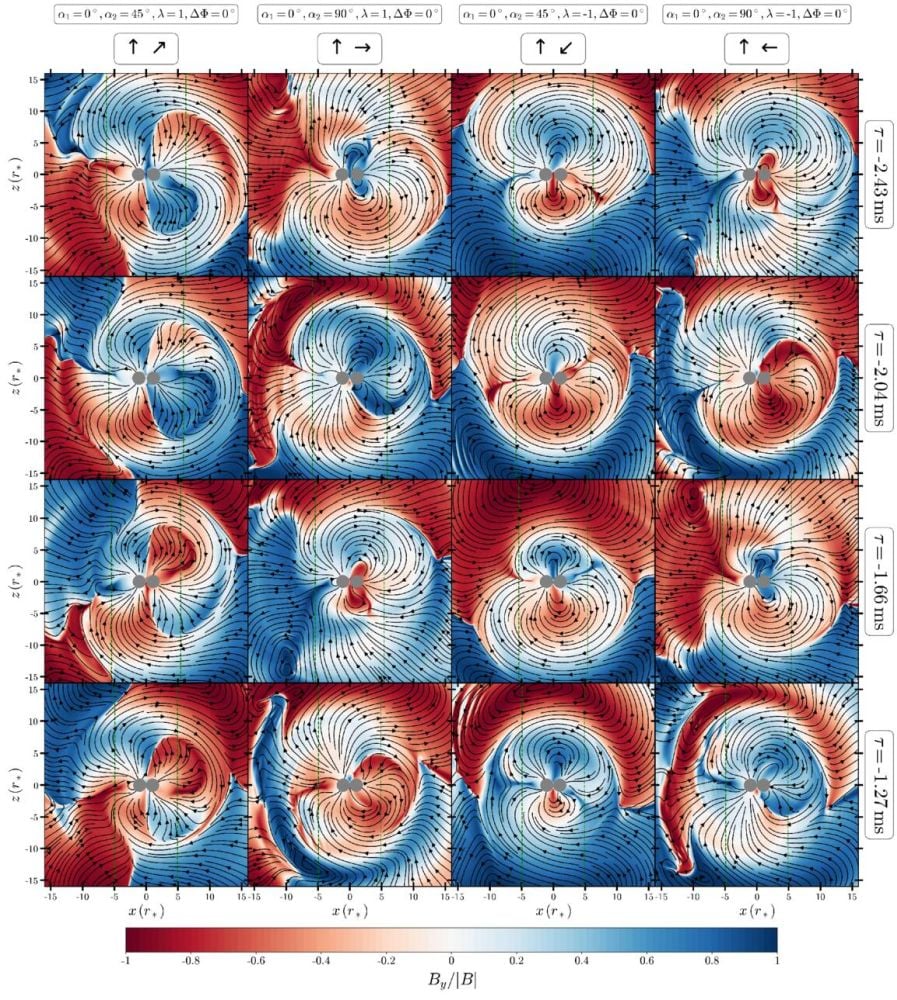 Explaining everything in this figure would mean plunging deeply into a rabbit hole, but it's basically showing how different alignments of the pair of neutron stars affects the magnetic fields. Above each column is a box with two arrows, illustrating different alignment configurations simulated in the work. Each row represents a different time in the merger, as indicated in a box on the right of each row. The complicated entwined magnetic fields are clear to see. Image Credit: D. Skiathas et al. 2025. ApJ
The questions is, what electromagnetic signals did all of this chaotic, energetic activity send?
The simulations show that the powerful forces involved can eventually produce photons that reach TeV–PeV energies in the last ∼ms when the magnetic fields are at their strongest. Those are extreme gamma-ray energies, which would imply that gamma-ray observatories could detect them. But the simulations also show that these high-energy photons are unlikely to escape, while less energetic photons can.
Strange things happen in the chaos that surrounds merging NS. Fast-moving electrons can emit powerful gamma-rays through what's called curvature radiation. This happens when electrons reach relativistic speeds and follow curved magnetic fields. The resulting gamma-ray photons can then interact with the magnetic field and change into a pair of particles: a positron and an electron.
This means that these extremely energetic gamma-rays can't escape and be detected.
"However, our analysis of single photon magnetic pair production suggests that these photons are unlikely to escape, with the MeV band emerging as a promising observational window for precursor high-energy emission," the researchers explain in their paper. That means that some lower-energy gamma-rays and some x-rays could be detected during the build-up to the merger. The ability to sense these signals depends somewhat on the observer.
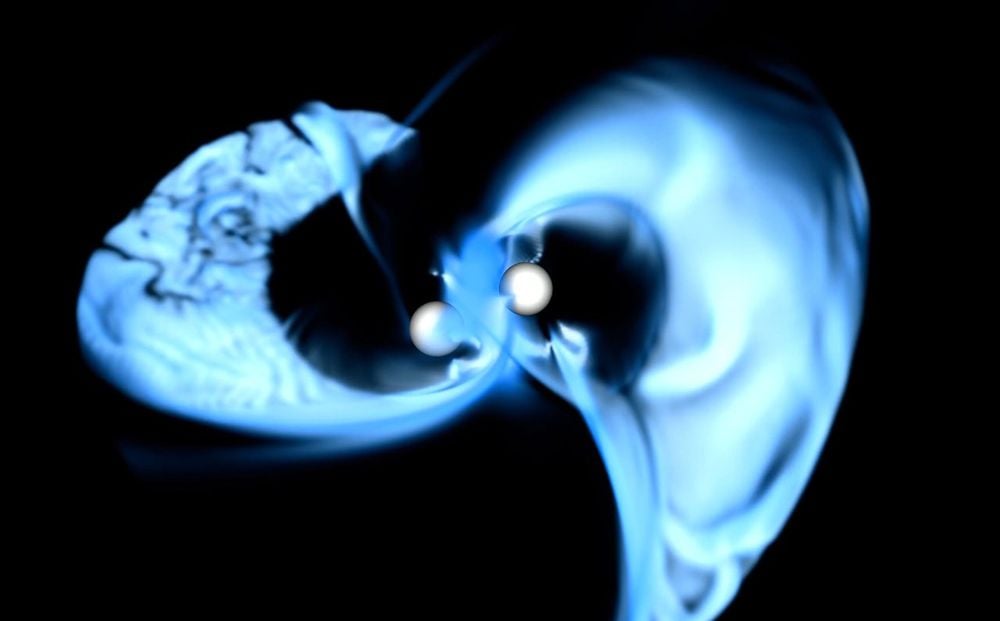 This screenshot from the simulations shows a pair of neutron stars as they merge. The brighter colours are where the highest-energy emissions originate. Some of these gamma-ray photons are trillions of times more energetic than optical light, but according to the research, none of them can escape. The curved magnetic fields convert the photons to a pair particles: a positron and an electron. However, less energetic gamma-ray photons and x-ray photons can be detected. Image Credit: NASA’s Goddard Space Flight Center/D. Skiathas et al. 2025
“Our work shows that the light emitted by these systems varies greatly in brightness and is not distributed evenly, so a far-away observer’s perspective on the merger matters a great deal,” said co-author Zorawar Wadiasingh, from the University of Maryland and NASA's Goddard Space Flight Center. “The signals also get much stronger as the stars get closer and closer in a way that depends on the relative magnetic orientations of the neutron stars.”
The simulations revealed more than just what signals we can hunt for in the cosmos. They also revealed more details of how the complex magnetic fields behave in a NS merger. These fields exert force on the surface of the stars, though that force is weaker than gravity. But these forces could affect the other signals that we detect from NS mergers: gravitational waves.
“Such behavior could be imprinted on gravitational wave signals that would be detectable in next-generation facilities. One value of studies like this is to help us figure out what future observatories might be able to see and should be looking for in both gravitational waves and light,” said Goddard’s Demosthenes Kazanas.
Overall, this work "uncovers a rich phenomenology with significant physical consequences, many of which are explored here for the first time," the authors write. "These results suggest that the premerger magnetospheric state plays a crucial role in shaping the overall evolution of EM luminosity," they conclude.

