 Universe Today
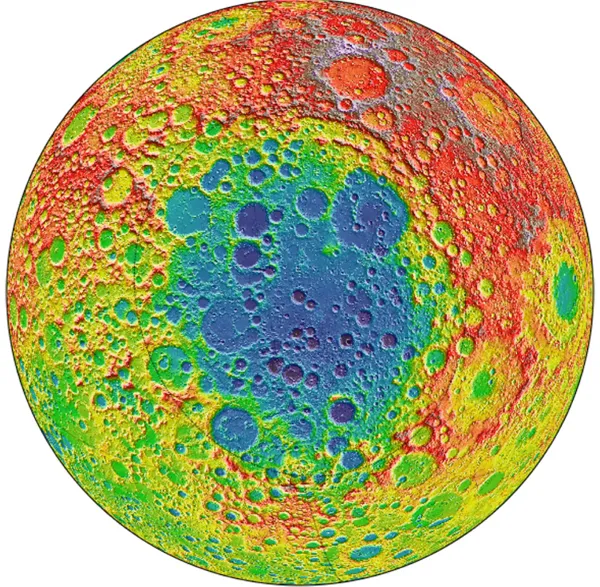
Results are coming out from the samples returned by China’s Chang’e-6 sample return mission to the far side of the Moon. They offer our first close-up look at the geology and history of the far side, and a recent paper published in Science Advances from researchers at the Chinese Academy of Sciences has very interesting insights about the impact history of the Moon itself, and even some for the solar system at large.
Lunar samples tell the history of where they’re collected, and so far, we’ve only ever directly taken samples from the “near” side of the Moon that constantly faces us. Those samples have been analyzed ad nauseum, and we think we have a pretty good understanding of the formational history of the near side of the Moon. But we have essentially no close-up data about the far side.
That’s in part because of the difficulty of managing missions that go there. The Moon itself blocks communications with Earth, so any mission to the far side requires a relay satellite to send messages between the rover or lander and its operators back on Earth. China’s space agency decided to take on that challenge, and became the first organization to successfully land on the far side of the Moon with its Chang’e-4 mission. A follow up mission, Chang’e-6, in 2024 served as the first sample return mission from the lunar far side.
Video of Chang’e-6 blasting off with its far-side samples.Scientists have been diligently working on analyzing the returned samples, and have begun to release papers describing them. This particular paper, which was officially released in February, has three interesting insights. First is that the ages for the craters on either side of the Moon seem similar. Second is that some of those estimates need to be adjusted by a few hundred million years. And third, and perhaps most intriguingly, it seems like the Late Heavy Bombardment didn’t happen.
The first result is relatively self-explanatory. Scientists have long believed that there was no significant difference in the impact rate on the far side vs the near side. Logically there shouldn’t be, since both halves of the Moon are exposed to all parts of the sky over a given period. But they’ve never been able to prove it since no one had ever collected a sample from the far side. This paper serves as that evidence.
However, they did note a bit of a discrepancy in what’s called the Chronology Function. This mathematical tool allows scientists to estimate the age of any lunar surface by counting its craters. Before this sample return mission, all of the data points to “calibrate” the calculation were based on samples from the near side. With the additional insight of the data from the far side samples, the researchers suggest there’s about a 340 million year shift for some of the dates attributed to certain parts of the Moon. Interesting, but less than a 10% variation in the more than 4 billion year old history of the Moon.
Fraser talks about the Chang’e-6 mission.That history included a massive impact early in the Moon’s history that created what is now known as the South-Pole Aitken (SPA) Basin. This feature, which included Chang’e-6’s landing location in the much smaller Apollo Basin, was believed to have been created by a massive impact early in the Moon’s history. Some of the samples collected by the mission include a mineral called norite, which, in contrast to the basalt that makes up the majority of the Apollo Basin, is thought to be a result of the original impact that created the SPA Basin.
To test the age of this material, the researchers used a dating technique called lead-lead dating. Like the more familiar carbon dating, which measures the ratio of carbon isotopes, this one measures the decay of two separate types of uranium isotopes into two separate types of lead isotopes. Since their half-lives are different, this makes it possible to double-check the aging of a single sample.
Results show the age of the SPA Basin to be approximately 4.25 billion years old. That flies in the face of a long-standing theory that both the Earth and the Moon suffered from a period called the Late Heavy Bombardment around 3.9 billion years ago. According to that theory, gravitational movements of the outer planets forced a ton of asteroids into the inner solar system at the time, causing massive repeated impacts on our own planet as well as the Moon. Those impacts would cause a significant amount of craters, and cause the dates of many of the craters on the Moon to be around that age.
Fraser discusses what’s on the far side of the Moon.Much of the data from near-side sample recovery missions supported that, with many of them being dated to 3.9 billion years. But the SPA Basin, which is arguably the oldest structure on the Moon, is 4.25 billion years old - well before the theorized start of the LHB. According to the paper, the spike in 3.9 billion year old craters might have been caused by a particularly violent event, known as the Imbrium impact, that spread its debris all over the near side, causing multiple 3.9 billion year old craters.
Graphing the distribution of other crater’s ages, though, makes it look like the impact frequency has a slow and steady decline that more aligns with the newly formed planet and moon clearing out its nearby solar system neighborhood rather than suffering from a chaotic spike in impacts at that particular time period. So this paper might actually have an impact on our general understanding of how the solar system evolved rather than just providing dates to certain parts of the Moon. Sometimes science works in interesting ways like that - at the very least we can now say we better understand the history of the far side of the Moon. Hopefully there will be plenty more papers on these unique lunar samples forthcoming soon.
Learn More:
Z. Yue et al. - Lunar chronology model with the Chang’e-6 farside samples and implications for the early impact history
UT - Analysis of Chang'e-6 Samples Addresses Mysteries About the Far Side of the Moon.
UT - China's Chang'e-6 Probe Drops Off Samples From Moon's Far Side
UT - New Research Says the "Dark Side" of the Moon is Also the Cold Side

