 Universe Today
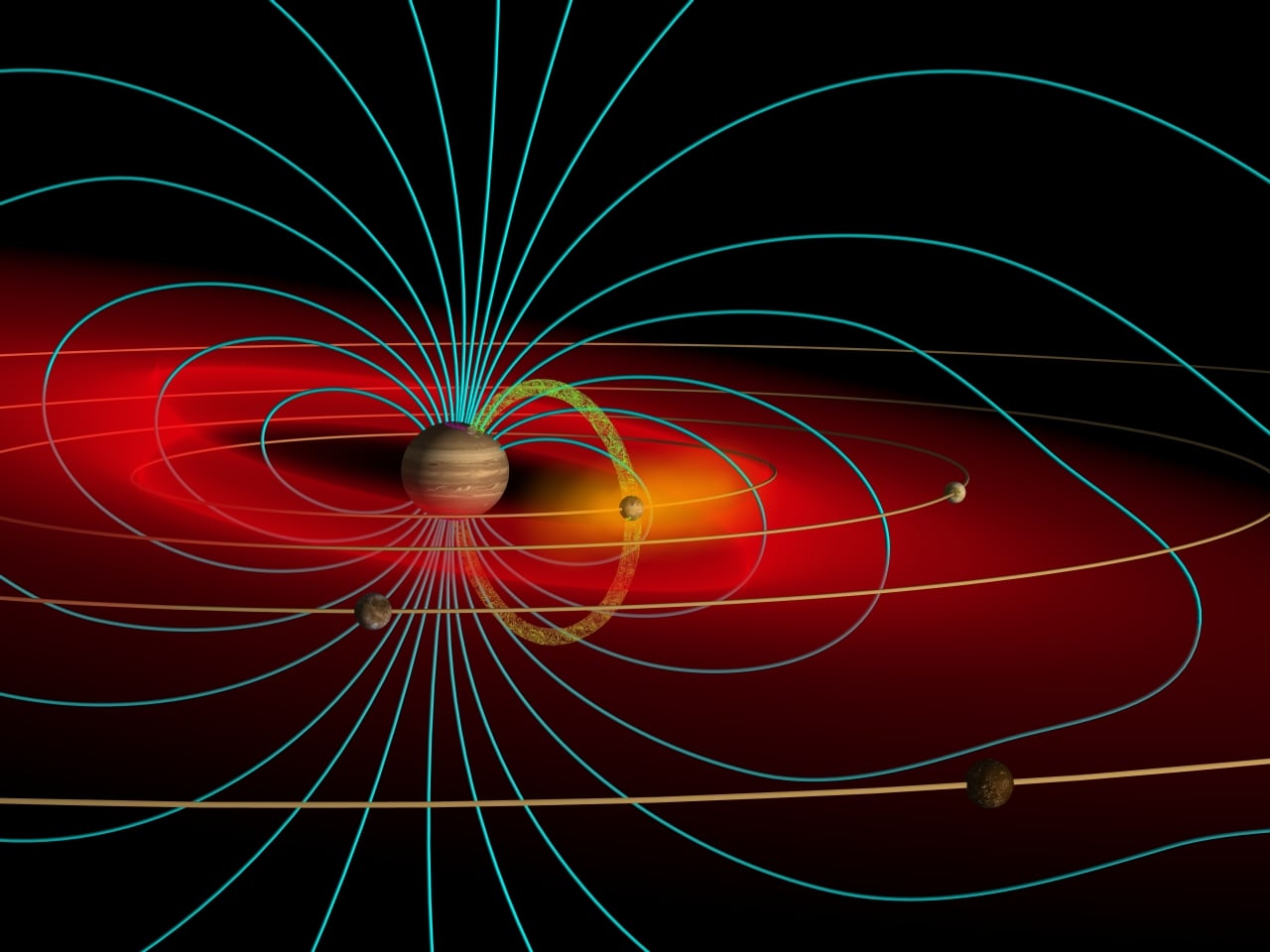
Jupiter is the largest planet in the Solar System and has a planetary magnetosphere to match! Since 2016, NASA's Juno probe has studied this massive planet to better understand its magnetosphere and its famous interaction with Io, its volcanic, innermost moon. Of particular interest is the ring-shaped magnetodisk, driven by the planet's rapid rotation and Io's volcanic material. Until recently, scientists pictured this feature as a smooth disk that rises and falls with Jupiter's rotation.
However, an international team led by researchers from Shandong University is changing that view based on new Juno probe data. As part of their study, which appeared in the journal Science China Earth Sciences, they analyzed Jupiter's magnetic field and energetic particle activity during multiple events in the Jovian magnetodisk. Their results show that Jupiter's magnetodisk crumples into a wave-like structure during active periods.
Normally, the Juno spacecraft crosses the magnetodisk's current sheet twice per rotation (every 9.9 hours). Instead, Juno crossed the current sheet repeatedly during magnetodisk reconnection events and detected the same clear magnetic signature (along with bursts of energized electrons and ions) almost every time. The team's analysis of the current sheet's orientation showed that it doesn't simply rise and fall, but moves like a wave with ripples lasting several minutes to over an hour.
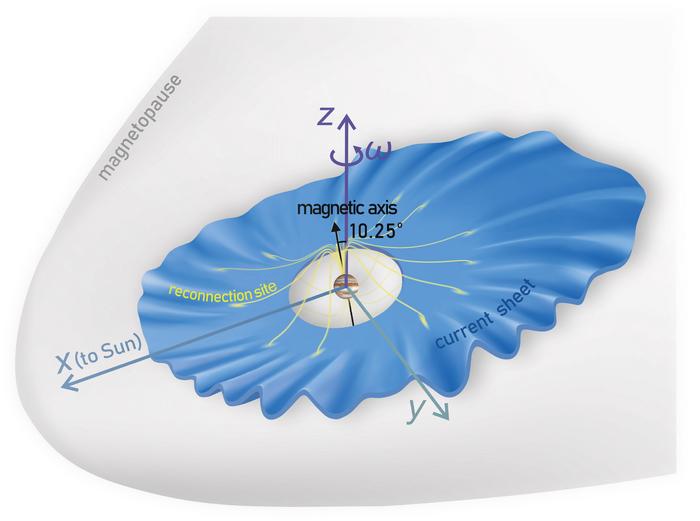 Illustration of Jupiter's magnetodisk current sheet (blue surface), deformed into a rippling structure by numerous small-scale magnetic reconnection sites (yellow speckles). Credit ©: Science China Press
As the research team concluded in their paper, the magnetodisk has numerous small reconnection sites spanning about 100 degrees of longitude. They further concluded that these sites continually break the disk's magnetic field lines and push the current sheet away from its equilibrium position. Since Jupiter's magnetodisk rotates so quickly, the entire sheet is carried around with the planet. This differs significantly from what scientists have observed in Earth's magnetotail.
On Earth, the kink wave moves away from a reconnection site, whereas Jupiter's reconnection signatures point to a rotating, rippled current sheet. Their findings have significant implications, including the possibility that the sheet could affect the acceleration and transportation of Io's volcanic particles. Based on this new data, these particles could complicate the link between the planet's ionosphere and magnetodisk.
In short, their analysis shows that the Jovian magnetodisk is not a simple rotating sheet, but a highly structured, dynamic environment. The Juno probe is currently operating on an extended mission, which is scheduled to last until September 2028. The probe continues to fulfill science objectives that build on the findings of NASA's Galileo probe, the only other spacecraft focused exclusively on exploring Jupiter.
Further Reading: Science China Press (via EurekaAlert!), Science China Earth Sciences