 Universe Today
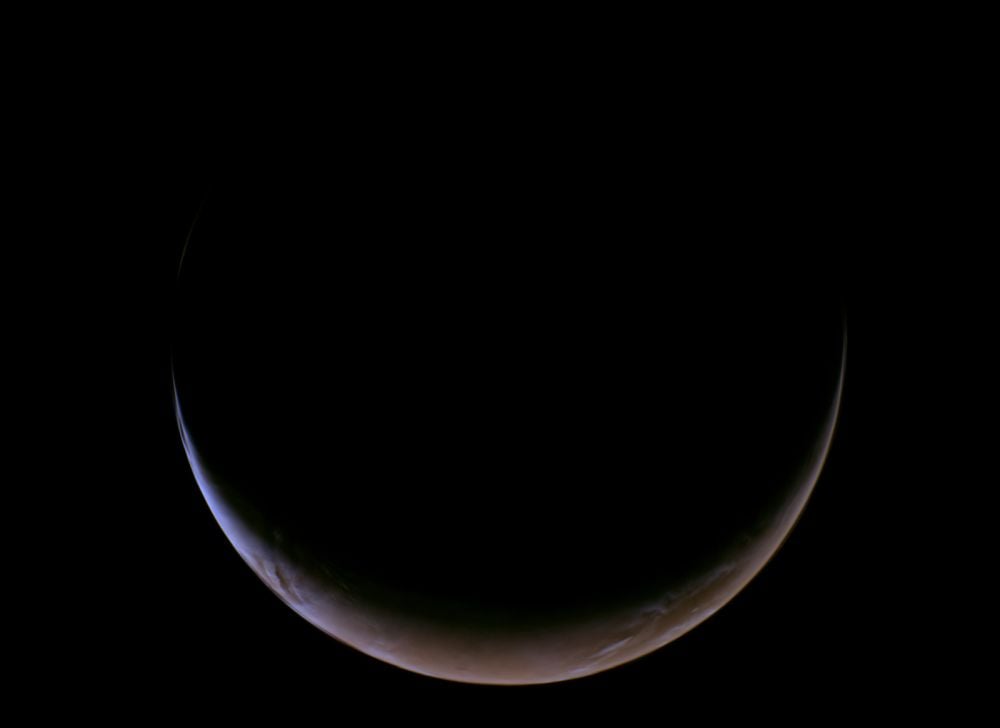
NASA's Psyche mission is on its way to a unique target: the metal-rich asteroid 16 Pysche. The mission will try to answer questions that only 16 Psyche can answer. The asteroid is thought to be the core of a planetesimal that had its outer layers removed in a collision. The mission will be able to confirm that, if true, and then use its visit to study planetary cores in general. Studying Psyche will reveal things about Earth's core, mission scientists hope.
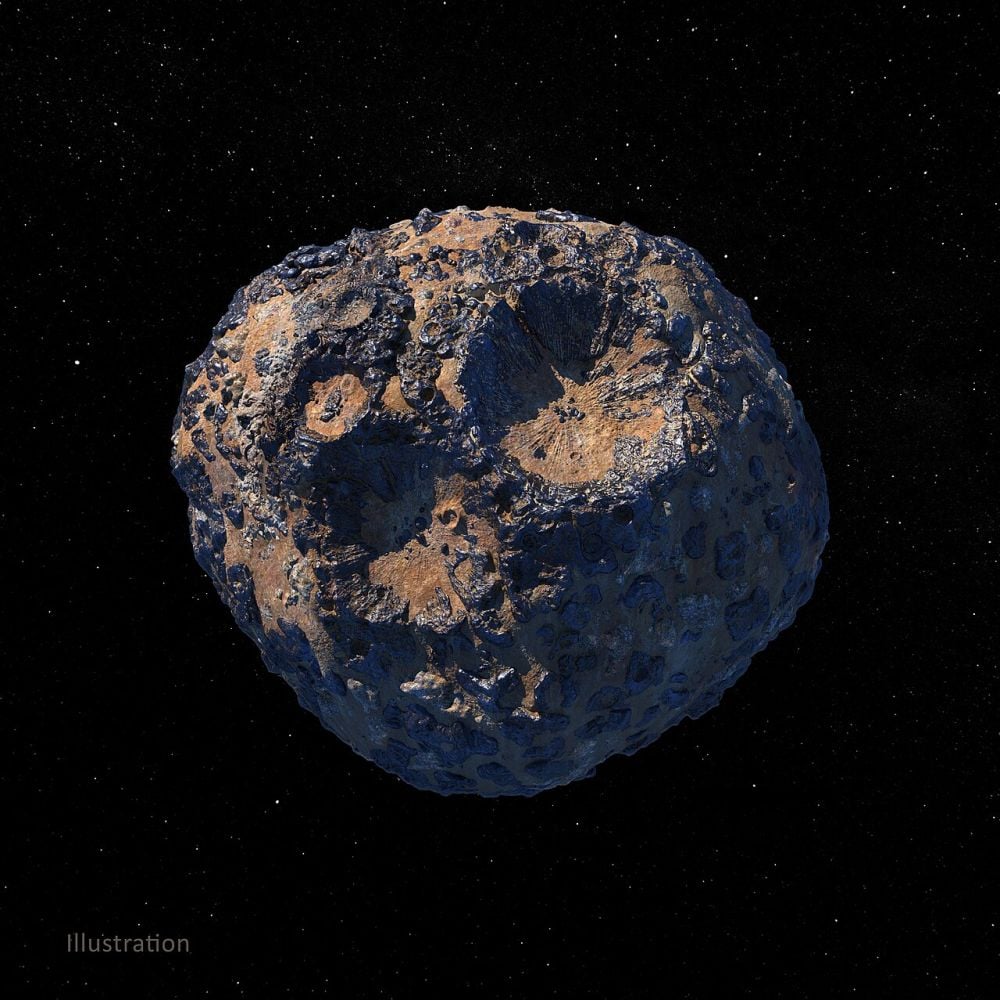 NASA commissioned this artist's illustration of 16 Psyche to highlight asteroid's metal-rich nature. The 226 km asteroid is expected to be rich in iron and nickel, but only the mission to the asteroid can tell us for sure. Image Credit: NASA/JPL-Caltech/ASU
But before it can do that, it had to visit Mars ever-so-briefly.
Psyche completed its planned flyby of Mars on May 15th and is now on its way to 16 Psyche. The spacecraft captured some new images of the planet as it flew past. We're accustomed to images of Mars, but Psyche's images are a bit different due to its approach. Psyche approached Mars from a high phase angle, meaning it looked like a thin crescent as the spacecraft approached.
The flyby was designed to give Psyche a boost without using onboard propellant. It was also used to alter the spacecraft's course, and it's now heading directly for its metal-rich target. NASA uses its Deep Space Network (DSN) to monitor Psyche and other interplanetary craft, and NASA personnel analyzed those signals to determine that the spacecraft was on course.
“Although we were confident in our calculations and flight plan, monitoring the DSN’s Doppler signal in real time during the flyby was still exciting,” said Don Han, Psyche’s navigation lead at NASA’s Jet Propulsion Laboratory. “We’ve confirmed that Mars gave the spacecraft a 1,000 mile‑per‑hour boost and shifted its orbital plane by about 1 degree relative to the Sun. We are now on course for arrival at the asteroid Psyche in summer 2029.”
Psyche also captured images of a nearly-full Mars. One of those shows the planet's southern polar region and its mostly water-ice cap. To the north is the Valles Marineris region.
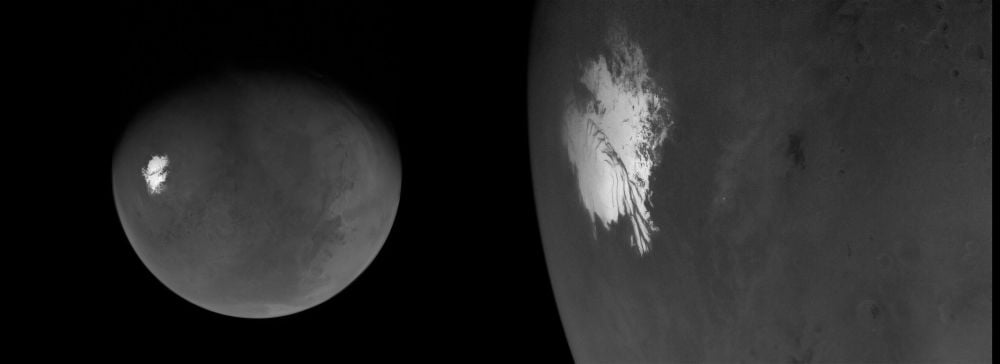 Psyche captured these images of Mars showing the southern polar cap and the Valles Marineris region to the north. Image Credits: NASA/JPL-Caltech/ASU
Psyche approached Mars from its night-time side and departed from its day-time side. As it passed into daytime, it captured a rapid series of images of the Martian surface. One shows craters in the Syrtis Major region and wind-blown streaks of dust.
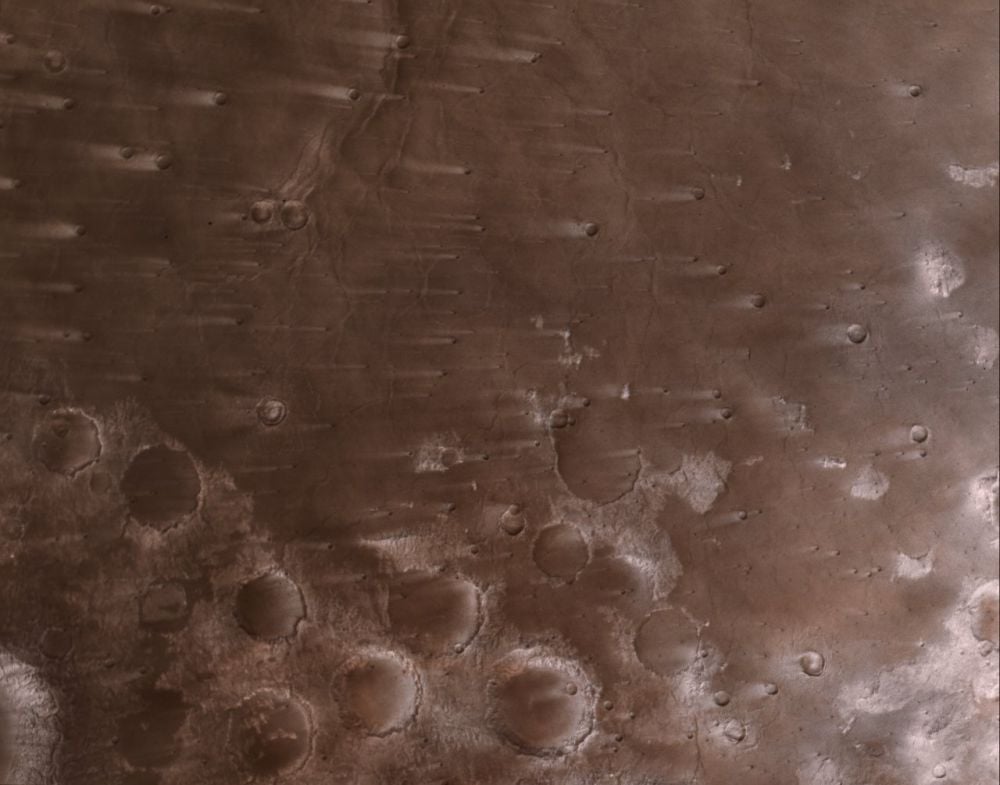 Psyche captured this image of craters and wind-blown dust streak in Syrtis Major with its multispectral imager. The large craters in the center bottom average about 50 km in diameter. Image Credit: NASA/JPL-Caltech/ASU
It also captured images of Huygens Crater, a 450 km+ impact crater and fifth-largest crater on Mars, located in the Southern Highlands.
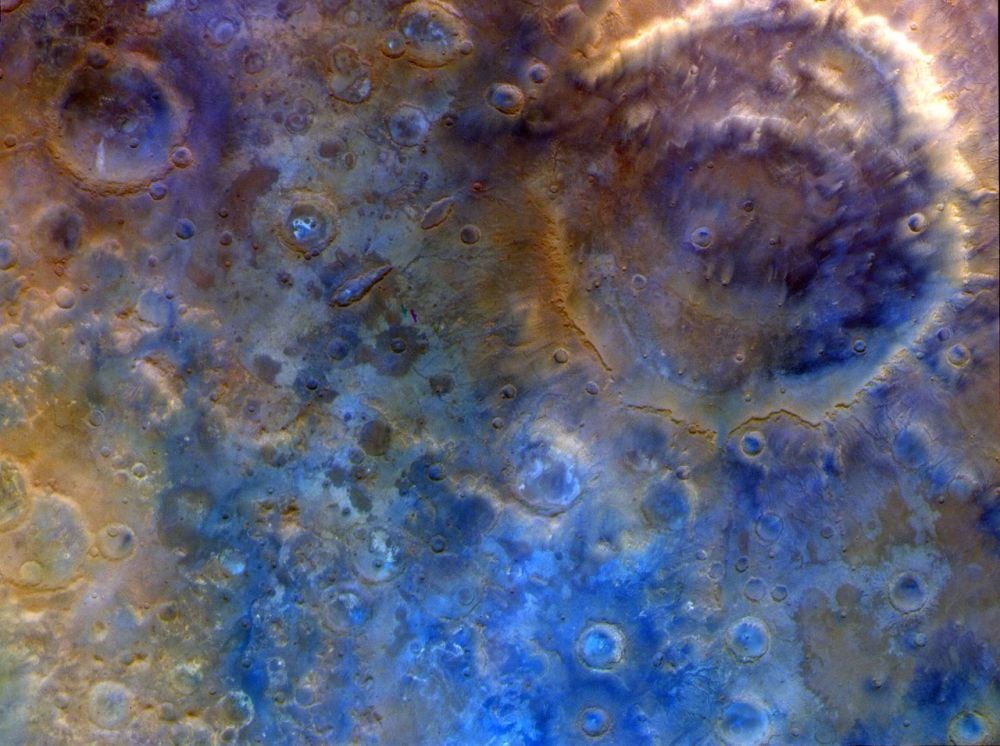 This false-colour image of Mars was also captured with the spacecraft's multispectral imager. It shows the fifth-largest impact crater on Mars, Huygens crater. It's about 467 km in diameter and is almost four billion years old. Image Credit: NASA/JPL-Caltech/ASU
“We’ve captured thousands of images of the approach to Mars and of the planet’s surface and atmosphere at close approach," said Jim Bell, the Psyche imager instrument lead at Arizona State University (ASU) in Tempe. "This dataset provides unique and important opportunities for us to calibrate and characterize the performance of the cameras, as well as test the early versions of our image processing tools being developed for use at the asteroid Psyche. As the spacecraft continues its journey after the flyby, we’ll continue calibration imaging of Mars for the rest of the month as it recedes into the distance.”
Beyond images and gravity-assist maneuvers, flybys like these are also used to test and calibrate a spacecraft's science instruments. Psyche powered up all of its instruments during the flyby and used it as practice for its eventual rendezvous with 16 Psyche. Psyche carries three instruments aimed at studying the asteroid: a multispectral imager, a gamma-ray and neutron spectrometer, and a magnetometer. Psyche will also test a new communication system called Deep Space Optical Communications. DSOC is a laser space communication system that, if proven effective and reliable, could speed up spacecraft communication with Earth by as much as 100 times.
Mars is in Psyche's rear-view mirror now, and the next destination is 16 Psyche. The spacecraft will begin its approach sequence to the asteroid in May 2029 and enter into orbit in late July 2029. It will orbit the asteroid in five separate orbital configurations, with the closest being only 75 km above the surface. Each orbital configuration will consist of between 56 and 100 individual orbits. That prime mission will last about 26 months, and after that, the spacecraft will be left in the asteroid's orbit.
The primary question regarding the asteroid is if it's an exposed planetesimal core, or if it's primordial, unmelted material from the very early Solar System. The magnetometer will play the leading role in this. If it was a planetary core, it should have a remnant magnetic field, and that field would be "frozen" in the rock. Magnetic minerals would be orientated to the magnetic fields at the time they cooled. If Psyche doesn't find that, then 16 Psyche is almost certainly primordial, unmelted material.
Though the magnetometer could deliver the smoking-gun signal that 16 Psyche is a planetesimal core, the instruments are designed to work together to confirm it. Another exciting possibility is that 16 Psyche is neither a core nor unmelted primordial material. It could be something in between or something completely different.
We'll have to wait a few years to find out.

