 Universe Today
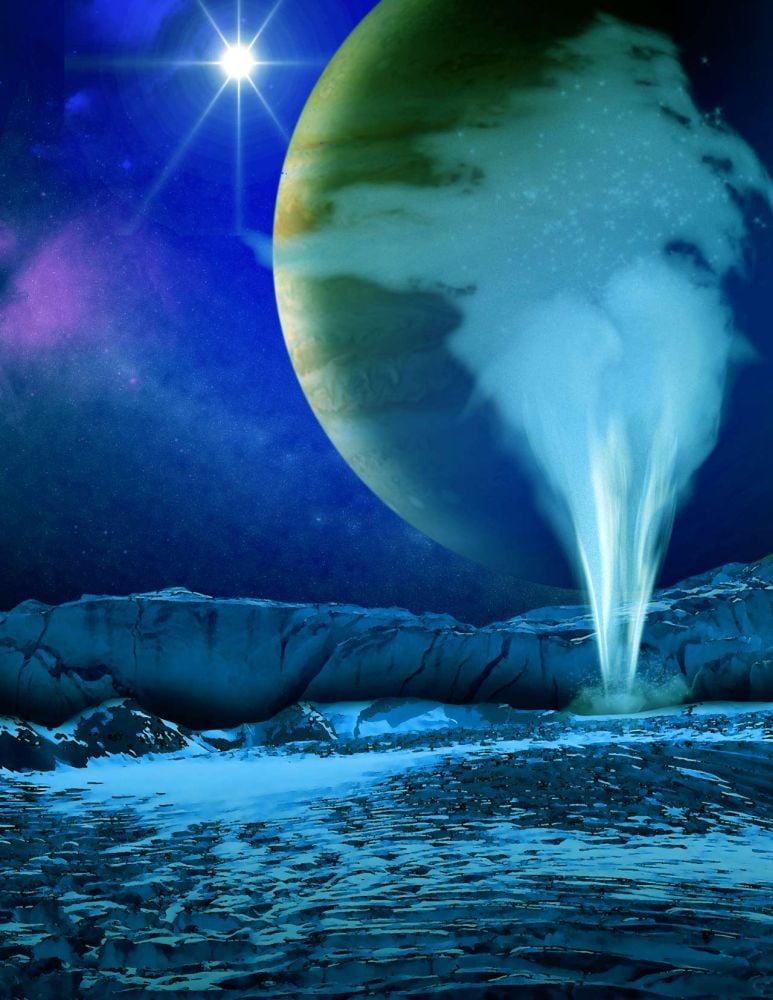
In 2014, a team of researchers presented some exciting results that's shaped our approach to one of the Solar System's icy moons. They published a paper in Science showing that intermittent plumes of water vapour were escaping through Europa's icy shell. The discovery was based on the Hubble Space Telescope's UV observations of the frozen ocean moon. "This emission is consistent with two 200-km-high plumes of water vapor," the authors wrote. "Tidal stresses likely play a role in opening and closing fractures at the surface."
In 2016, a separate group of researchers also detected water vapour plumes at Europa and published their work in The Astrophysical Journal. Their work was also based on Hubble observations. "Out of 10 observations, we found 3 in which plume activity could be implicated," they wrote. But they were also cautious, writing "We consider potential systematic effects that might influence the statistical analysis and create artifacts, and are unable to find any that can definitively explain the features, although there are reasons to be cautious."
As it turns out, that caution was appropriate.
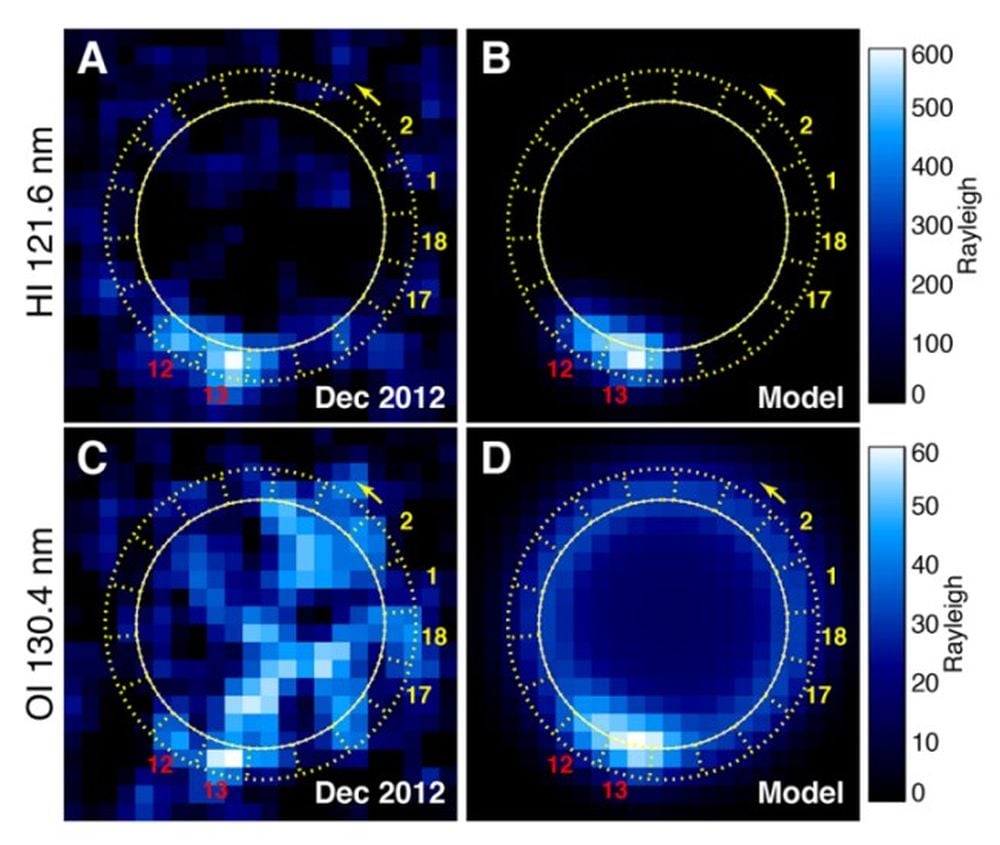 This figure is from the 2014 paper announcing the detection of the water vapour plumes. The red numerals 12 and 13 in each image shows the plume detections in hydrogen and Lyman-alpha (A & B) and in Oxygen I (C & D). Image Credit: Roth et al. 2014. DOI: 10.1126/science.124705
When published in 2014, the discovery was a game-changer for studying the ocean moon. If water from the moon's ocean, which is buried under a sheet of ice that up to 30 km thick, was being emitted into space, that provided a way for a spacecraft to study the ocean without confronting the thick, icy shell that covers it. NASA's Europa Clipper is on its way to the moon, and it will reach the Jovian system and perform flybys of Europa starting in 2031. The Clipper is specifically equipped to study these plumes, if they're real.
But it's looking increasingly like the plumes are not really there. New research led by Dr. Lorenz Roth, the same researcher who led the initial 2014 paper, is casting doubt on the Hubble's detection of water vapour plumes at Europa. The new research is titled "Europa’s Lyman-α emissions from HST/STIS observations," and it's published in Astronomy and Astrophysics. Roth is from the KTH Royal Institute of Technology in Sweden.
This research examines 14 years of Hubble observations of Europa with its Space Telescope Imaging Spectrograph (STIS). "We analyzed the complete dataset of the STIS observations obtained when Europa was sunlit and not transiting Jupiter," the authors write.
The original detection of the plumes was based on hydrogen Lyman-α and oxygen OI emissions detected by the Hubble. Since hydrogen and oxygen make water, the detection and analysis suggested that the plumes were water vapour. "They are consistent with two 200-km-high plumes of water vapor..." the authors wrote in 2014.
But now the researchers are retracting those observations. As it turns out, the positioning and context of Europa in the Hubble images created the initial detection.
"One of the difficulties in interpreting the data back then was determining where to place Europa within its context,” said SwRI’s Dr. Kurt Retherford. Retherford is a co-author of the 2014 paper and the new paper. “The way Hubble works left some uncertainty in terms of placement relative to the center of the image. If Europa’s placement was off even just by a pixel or two, it could affect how the data gets interpreted.”
So instead of Lyman-α and oxygen OI emissions, we have what could be only statistical noise. Instead of water vapour plumes reaching up to 200 km, we have...maybe nothing.
But the authors also point out that they can't be totally sure. What's happened is the confidence level has dropped considerably.
“Our reanalysis took our original 99.9% confidence in the plumes’ existence and reduced it to less than 90% confidence,” said lead author Roth. “That’s simply not enough evidence to support the certainty of claims we made at the time.”
The Hubble's observations actually measured hydrogen in Earth's extended atmosphere, and in Europa's extended atmosphere. In fact, these findings present the initial discovery of Europa's hydrogen exosphere.
"We constructed a model that accounts for all known sources of Lyα emission, including resonantly scattered sunlight from Europa’s H exosphere, the authors write in their paper. To find any H2 aurorae, which indicate the presence of the water vapour plumes, the researchers then subtracted the modeled Lyα emission.
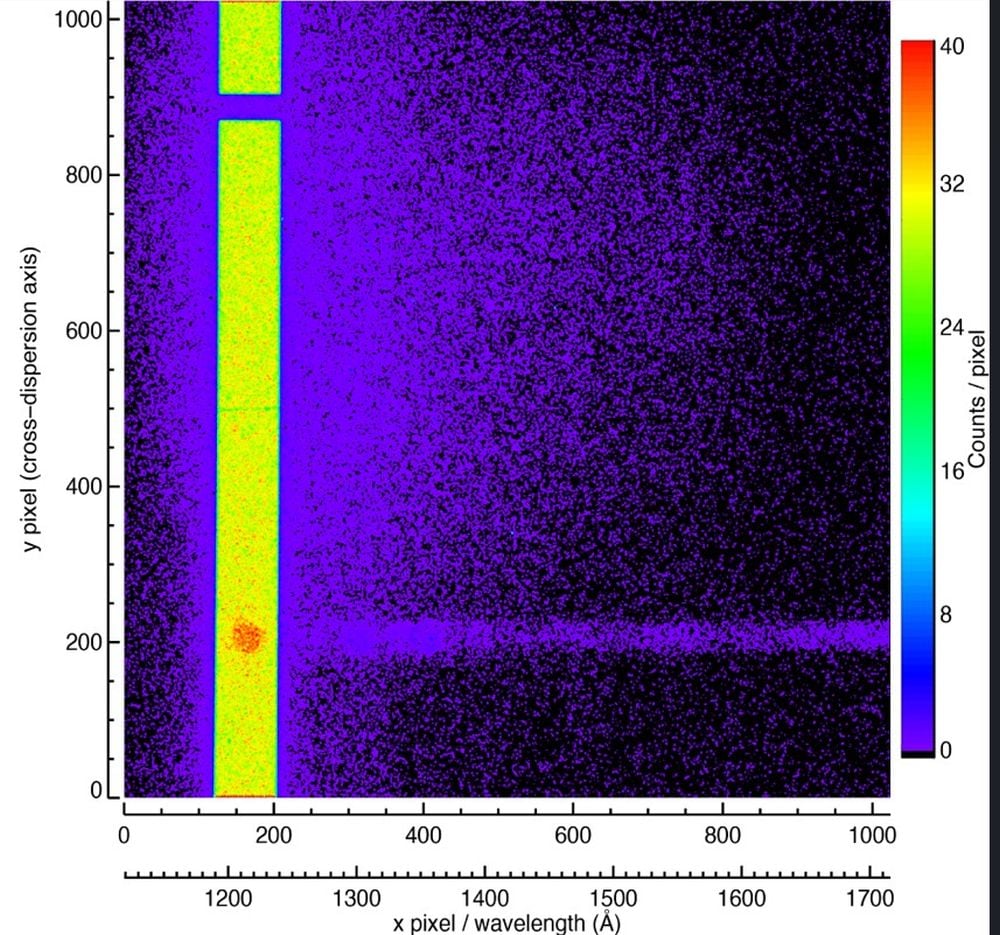 This figure from the research shows the complete STIS detector spectral image from one of the Hubble's "visits" with Europa. The yellow vertical region is where the Lyman-alpha emissions lie. The researchers found that those emissions may not be from water vapour plumes at all, and come from several other sources, including emissions from Earth’s extended H exosphere. Image Credit: Roth et al. 2026. A&A. https://doi.org/10.1051/0004-6361/202659406
"No localized emission enhancements were detected in any of the observations, including the image previously interpreted as evidence of H2O aurora near Europa’s south pole," the authors write. "The discrepancy with earlier results arises primarily from differences in the assumed position of Europa’s disk on the detector."
"The inclusion of an H-exosphere signal in the present analysis also contributes to this difference," the authors write. "When adopting the same disk position as in the previous study and neglecting the H-exosphere signal, the localized emission enhancement was again detected with a similar statistical significance." That pretty much clinches it.
The thing about science is that it acquires new evidence and then alters conclusions to fit the new evidence. That's why it's so effective. It's not about sticking to rigid ideologies, but about challenging conclusions with new, rigorous evidence. At least that's how it's supposed to work, and it did in this case.
“The description of the phenomena just doesn't hold up the same way anymore,” said Retherford. “The new data has made us reconsider the strength of the previous paper’s conclusion regarding water vapor plumes. The recent analysis also provides improved information about the neutral hydrogen atom component of Europa’s escaping atmosphere, originating from its water ice surface.”
The initial discovery of water vapour plumes generated some excitement around habitable ocean moons in our Solar System. Saturn's Enceladus is also an icy ocean moon, and it also emits plumes. The case for its plumes is stronger, and observations show they contain organic, carbon-bearing molecules, as well as other interesting components. If it has a warm, salty, ocean, then it's a prime target in the search for life. If Europa's plumes were real, and it's even closer than Enceladus, then it is also a tantalizing target.
But the lack of plumes doesn't mean there's no ocean. There's still lots of evidence showing that Europa hosts an ocean warmed by tidal heating. It's just that plumes would've made it even more obvious, and more observable.
"We find evidence to support a persistent hydrogen exosphere at Europa, but no evidence of localized water vapor," the researchers conclude.
Everything will become clearer when the Europa Clipper reaches the Jovian system in about 5 years.

