 Universe Today
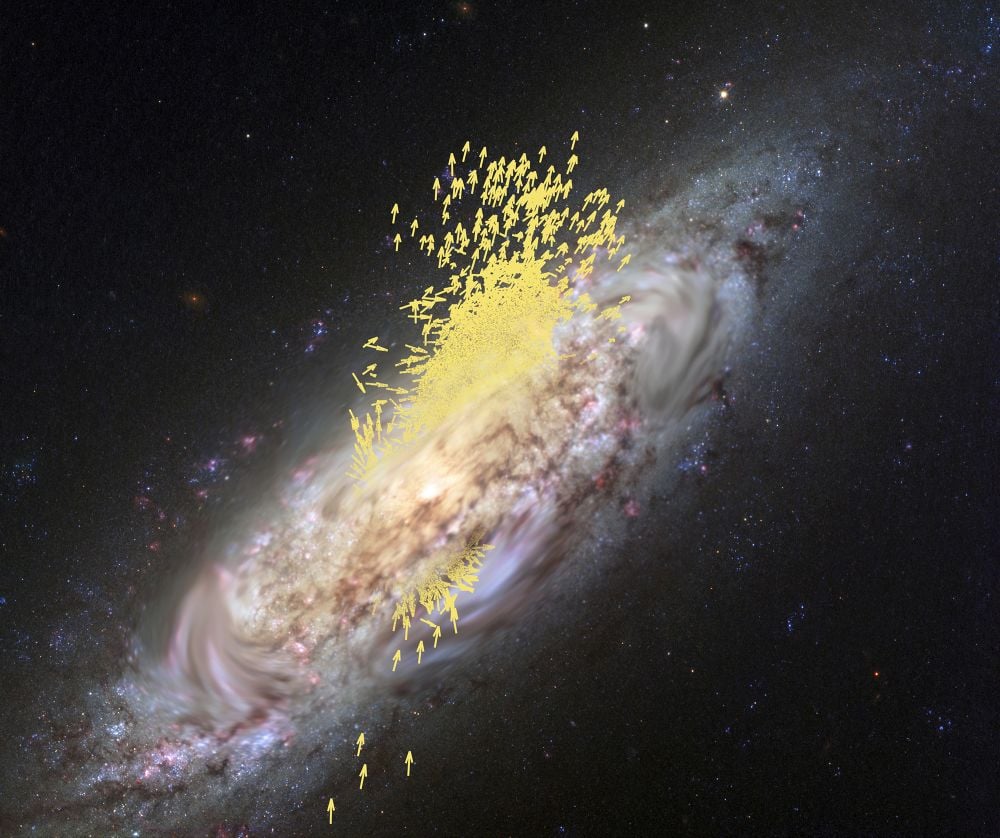
Mergers are a part of a galaxy's life, and the Milky Way is no exception. Without mergers, the Universe wouldn't have the massive galaxies we see in the local, modern Universe. As a spiral galaxy, most of the Milky Way's stars, gas, and dust are in its disk rather than a central bulge.
New research examines how galaxy collisions and mergers can severely disrupt stellar disks, and uses simulations to trace the Milky Way's history.
The research appears in the Monthly Notices of the Royal Astronomical Society. It's title is "Build-up and survival of the disc: from numerical models of galaxy formation to the Milky Way," and the lead author is Matthew Orkney from the Institute of Cosmos Sciences of the University of Barcelona (ICCUB) and the Institute of Space Studies of Catalonia (IEEC).
Angular momentum is a basic property of galaxies. It measures a galaxy's rotational motion and is critical in a galaxy. Angular momentum can be neither created nor destroyed, only transferred. Unless something external, like a merger, changes it, it is essentially fixed. The Milky Way's disk only exists because of the galaxy's angular momentum. It moves at about 220 km/second.
If astronomers can trace the formation of a galaxy's angular momentum, the time that it spun up, they can understand a large part of its history, including its mergers.
"We study the build-up and survival of angular momentum in the stellar disc using a statistical suite of cosmological simulations of Milky Way-mass galaxies," the authors write.
The MW didn't form in isolation. Astronomers have thought for a long time that mergers played a role. Understanding when mergers happened is critical to understanding the MW's history.
When trying to recreate the MW's merger history, astronomers typically turn to measuring stellar kinematics to figure out that history. That's one of the things that the ESA's Gaia mission was good at, and its findings helped shape the current understanding of the MW. One of the mergers that Gaia uncovered is called the Gaia-Sausage-Enceladus (GSE) merger, and it happened between 8 to 11 billion years ago.
But unfortunately, according to the authors, those stellar kinematic measurements aren't enough to trace the MW's history.
"Our results show that stellar kinematics at z=0 rarely recover the true times of disc spin-up, due to the disruptive impact of massive radial merger events," the authors write. (In cosmology, z=0 means the present day.)
Radial mergers are a particular type of merger. They happen when one galaxy plunges directly into the center of another, rather than striking a glancing blow. In what can be called a typical merger, the galaxies may orbit several times before merging, creating the tidal tails seen in images of merging galaxies. Those mergers take longer, and angular momentum is moved around and transferred in complex ways. In a radial merger, the merger plays out faster, and since one galaxy basically plunges into another, it contributes very little angular momentum to the system.
But radial mergers do impart kinetic energy into the galaxy. That energy heats the disk, kicking stars into more eccentric orbits.
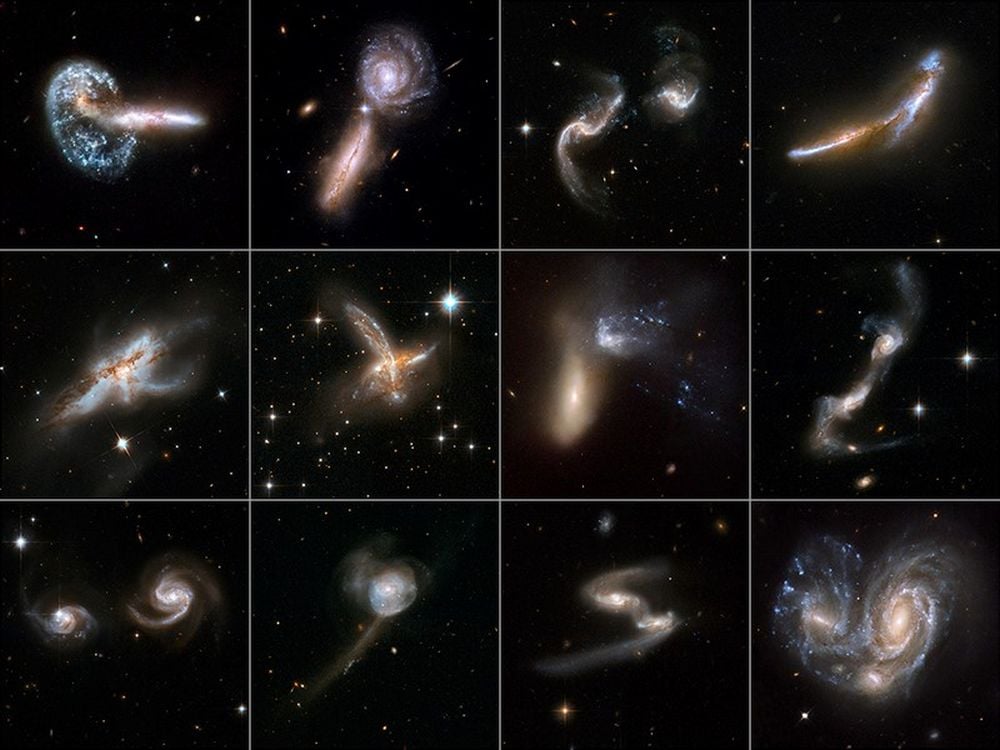 These images of galaxy mergers show the tell-tale streamers of gas and stars that come from mergers. But radial mergers don't create these kinds of tails. Instead, they introduce kinetic energy that scrambles a galaxy's stellar kinematics, making ancient mergers difficult to pinpoint. Image Credit: NASA/ESA/Hubble
The essential problem is that stellar kinematics can't tell us when the MW's disk spun up because of radial mergers and the kinetic energy they impart. There are two ancient populations of stars in the MW, the Aurora, which are proto-disk stars, and the Splash, which are disk stars that were kicked out of the plane of the disk by mergers. Radial mergers make it very difficult to tell which stars are part of which population because of kinetic energy.
In this work, the researchers turned to simulations to try to unravel the MW's merger history. The simulations showed how the MW reacted to the different types of mergers. That let the researchers discover when the MW spun up. So instead of finding a time when the MW's rotation began, it let them determine when the rotation recovered after a merger.
With these simulations, the researchers found that the Gaia-Sausage-Enceladus merger happened about 11 billion years ago, narrowing down the previously established range. This time also aligns with when many star clusters formed in the MW. Since galaxy mergers compress gas and trigger star formation, it all lines up.
“Models of the Gaia–Sausage–Enceladus merger predict that a galactic firework should have followed the impact, raising star formation and fostering the formation of globular clusters. This is the first time this link has been made,” said co-author Chervin Laporte in a press release. Laporte is from the French National Centre for Scientific Research (CNRS).
“This research highlights the important relationship between galactic structure and ancient collisions, which must be understood in unison in order to understand the history of our galaxy,” said lead author Orkney.

