Universe Today
You’re the Lead Botanist on the third human mission to Mars whose primary job involves growing food for the crew throughout the long mission. While you’re very familiar with the infamous “poop potatoes” from the 2015 film The Martian, the greatest minds in science had since devised a more efficient, and less messy, method for growing food on Mars: cyanobacteria.
While this scenario might be plausible in the near future, scientists today are developing the tools for making this scenario a reality. With findings outlined in a recent study published in the Chemical Engineering Journal, a team of scientists from the University of Bremen in Germany have tested growing food using cyanobacteria digestion. Also known as “blue-green algae”, cyanobacteria use photosynthesis to produce energy and are among the oldest life forms on Earth, with fossils dating as far back as 3.5 billion years ago.
For the study, the researchers designed and developed a new fertilizer that can potentially be used with Martian regolith to grow food for long-term human missions to the Red Planet. They accomplished this by having the cyanobacteria consume the Martian regolith simulant, which then converts the cyanobacteria into a nutrient-rich type of fertilizer. To accomplish the most efficient results, the team tested different combinations of variables, including temperature, heating the cyanobacteria before consuming the regolith simulant, and how much cyanobacteria to use, and using the ideal amount of ammonium, which cyanobacteria uses for nitrogen.
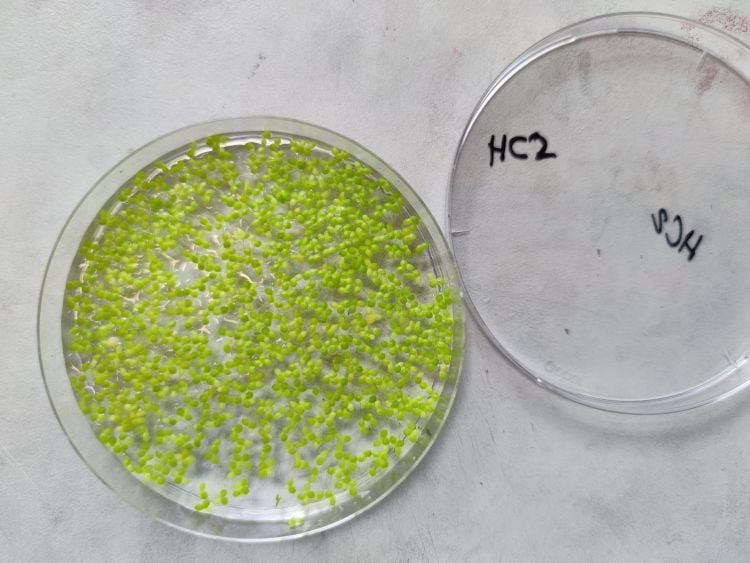
In the end, the researchers found an ideal temperature of 35 degrees Celsius (95 degrees Fahrenheit), one gram of cyanobacteria, and a final ammonium concentration of 5 mM (millimolar) produced a fertilizer that was used to grow 27 grams of duckweed. The researchers note one of the most significant results of the study is using only one gram of cyanobacteria to grow 27 grams of duckweed.
“You can imagine a vegetable garden on Mars that is run entirely from local resources – without bringing soil, fertilizer, or water” said Tiago Ramalho, who is a PhD student in the Department of Environmental Process Engineering at the University of Bremen and lead author of the study. “This self-sufficiency is important to make future Martian settlements as sustainable as possible!”
While several studies referenced in this paper have explored trying to grow plants in cyanobacteria, this study takes a leap into using measurable variables for producing the most viable product. This researchers from this study note the advancements that can come from their work, and while ISRU is only mentioned once early in the study, the study concludes with confidence that long-term exploration on Mars could result from using cyanobacteria for growing plants on Mars.
This study builds on a growing field of research called in situ resource utilization (ISRU), which calls for using available and local resources for survival. This study is an excellent example of using Martian regolith for growing plants, the latter of which would otherwise have to be launched and shipped from Earth, which can be both financially and logistically costly. Another example is water, as scientists are exploring potentially using water ice from the northern latitudes of Mars for a myriad of usages just like how NASA’s Artemis program hopes to use water ice from the south pole of the Moon. Along with growing plants, water can be used for drinking, bathing, fuel, and even oxygen from electrolysis.
As scientists continue to develop new and exciting technologies and methods for living beyond Earth, studies like this also continue to demonstrate the importance of using local and available resources for long-term crew survival on Mars.
How will cyanobacteria help plant growth on Mars in the coming years and decades? Only time will tell, and this is why we science!
As always, keep doing science & keep looking up!