Universe Today
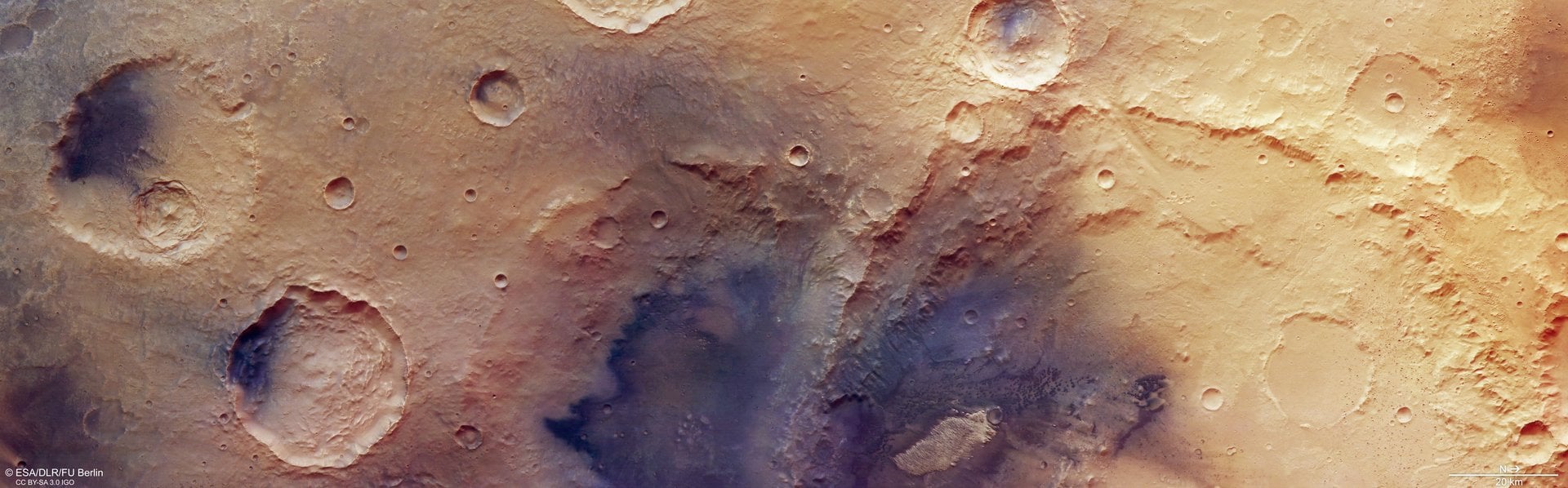
The ESA's Mars Express probe has been surveying Mars from orbit for more than twenty years. The way it has mapped the surface using its High Resolution Stereo Camera (HRSC) has drastically changed the way we see the Red Planet. In a recent article, the ESA shared a series of HRSC images highlighting the heavily cratered region known as Arabia Terra. The study of Martian craters offers insight into Mars' geology, meteorology, and its long and turbulent history. The images were generated from the camera's digital terrain model and the nadir and colour channels.
The image at the top shows the Arabia Terra region, a large plain in the Southern Highlands, heavily pockmarked with craters formed by impactors that struck the planet over time. The features are labelled (if you click on the image) and can be magnified. The volume of craters results from Arabia Terra being one of Mars' oldest geological formations, with estimates ranging from 3.7 to 4.1 billion years old. It was during this time that geologically activity ceased in Mars' interior, causing it to lose its planetary magnetosphere and leading to its atmosphere being slowly stripped away by solar wind.
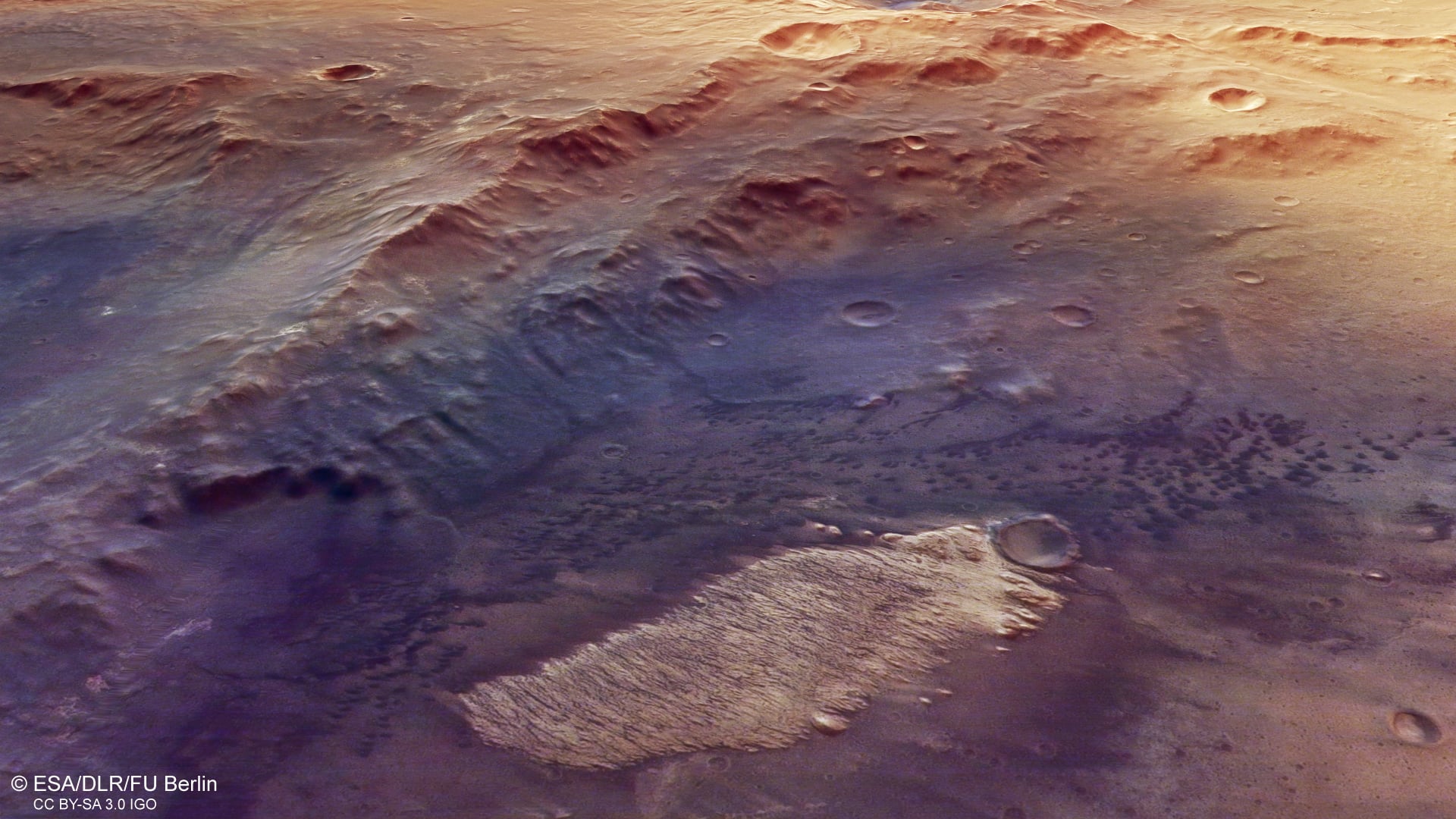 A bird’s-eye view of a region inside Trouvelot Crater, showing the dark, volcanic deposits covering the crater floor and a light-toned mound seen sitting within these deposits. Credit: ESA/DLR/FU Berlin
Similar to how the Moon's airless environment has preserved its craters, Mars' thin atmosphere has kept these craters well-preserved. Some of the craters in the image are filled with dark material, while others are filled with lighter sands and rippling dunes. This suggests that some of this sand was deposited by Martian dust storms, while other material could have been ejected by the impacts themselves. Others still show signs of collapsing crater walls and worn-down rims, also indicative of wind-driven erosion.
To the left of Trouvelot Crater is an older, more eroded basin with a completely collapsed wall almost entirely covered in dark rock. This material has been shaped by wind into the characteristic rippling structures known as "barchan" dunes, which are notable for their crescent-shaped profile. Mars Express has imaged these dunes in multiple locations in the Northern Lowlands and the large volcanic region of Tharsis. The dark material, known as "mafic rock," is mineral-rich and often associated with volcanism here on Earth.
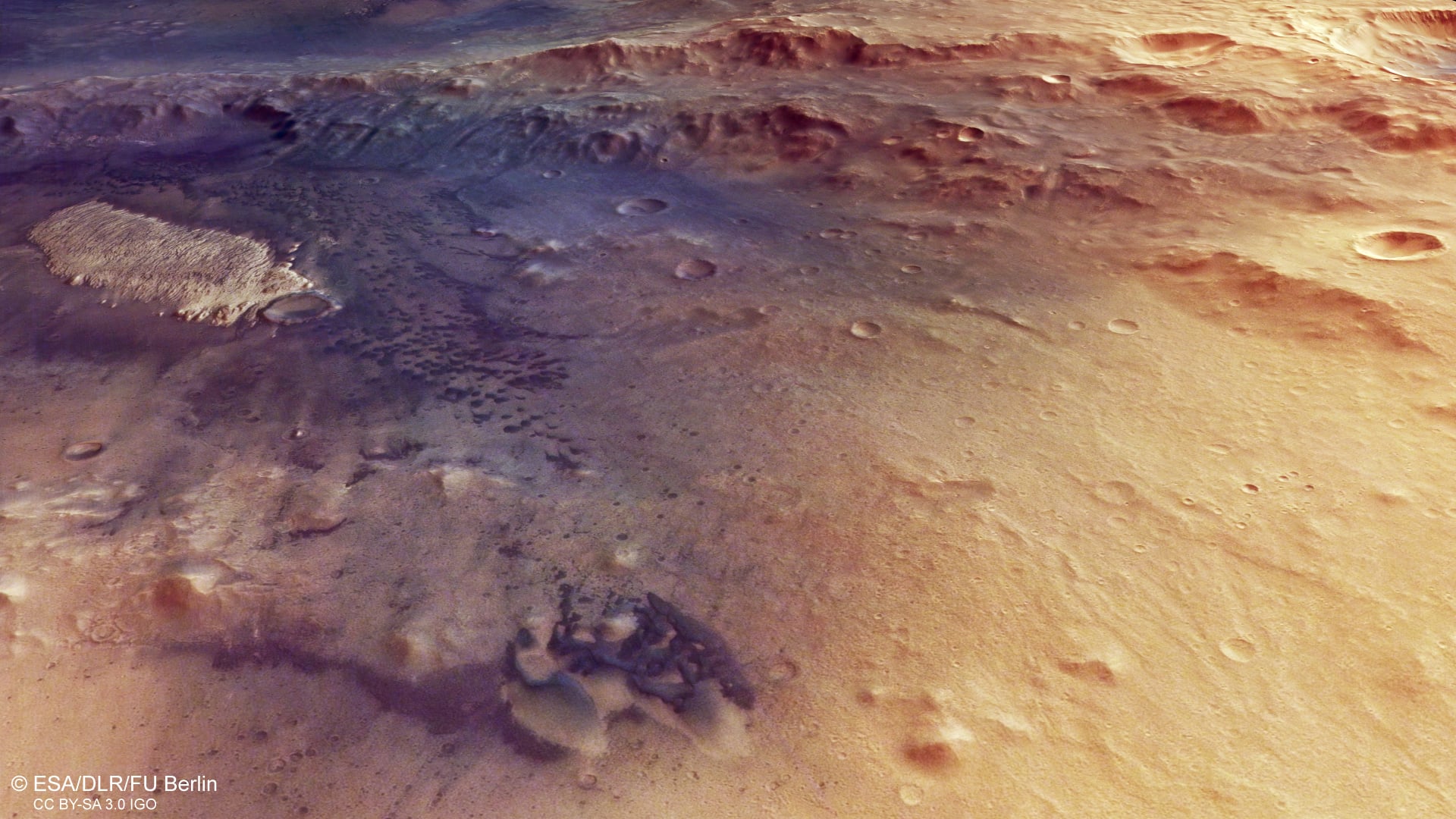 Close-up image showing the light-toned mound at the upper left, standing out amongst the dark rock. Credit: ESA/DLR/FU Berlin
Once again, this is indicative of material ejected by impacts that was blown around by winds and eventually pulled down along the crater walls. The fact that Trouvelot cuts through this crater indicates that it is the younger of the two, and the commonality of craters with dark material suggests that the mechanisms involved are ubiquitous on Mars. Amid the dark material, there is a light-toned mound measuring about 20 km (~12.5 mi) long and covered in ridges and grooves. Such mounds have been observed in other locations, and are indicative that other processes may be at work.
One clue is the minerals observed in these mounds, which suggest they formed in the presence of flowing water. Whether this is the case remains the subject of scientific debate, and there are several ways in which they could have been deposited by water.
Further Reading: ESA