Universe Today
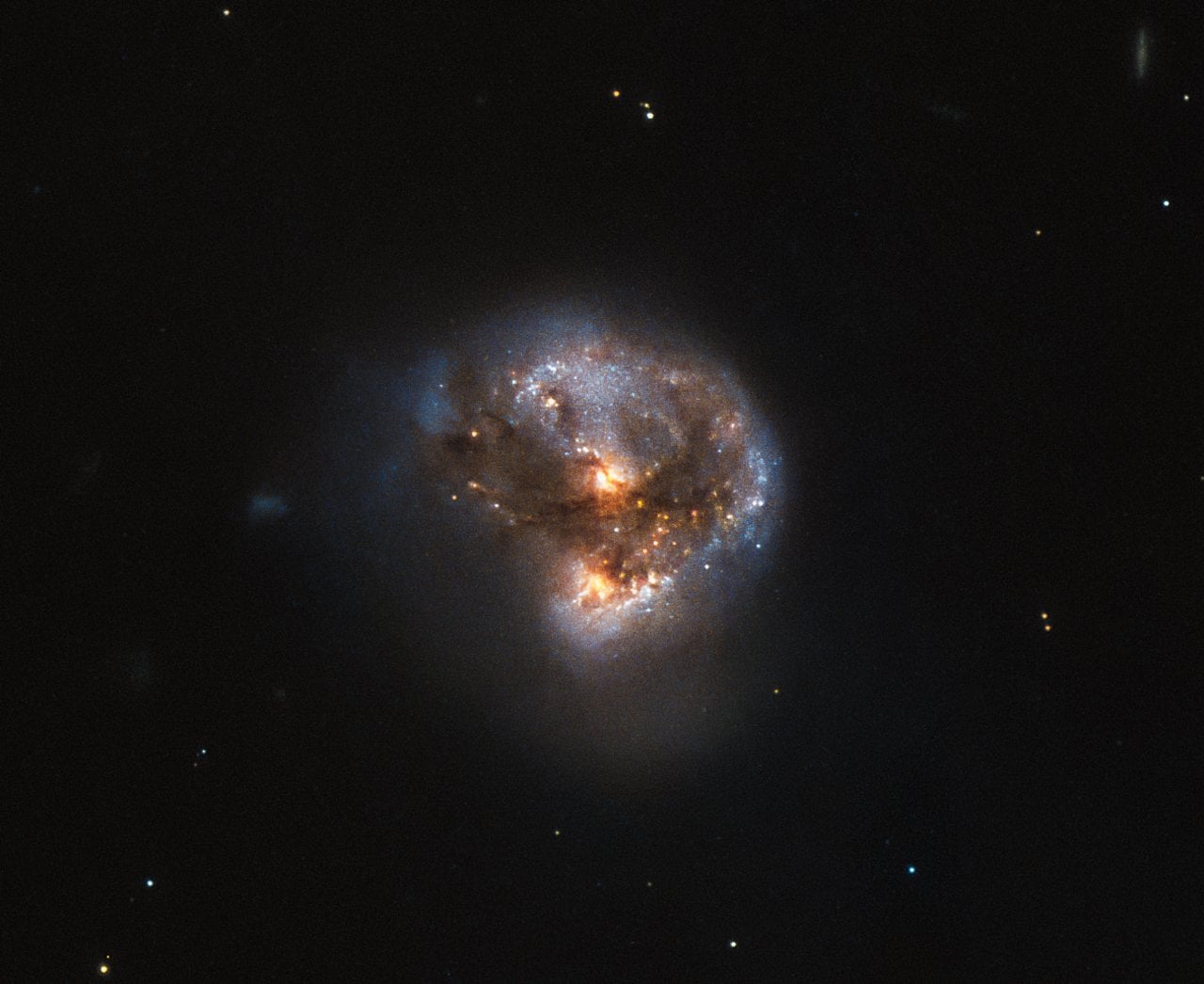
The Universe is full of surprises, including a fascinating type of "space laser" known as Mega-Microwave Amplification by Stimulated Emission of Radiation (megamasers). More specifically, hydroxyl megamasers (OHMs) are extremely bright radio-wavelength emissions produced when gas-rich galaxies collide. This compresses the gas and stimulates large reservoirs of hydroxyl molecules (-OH) to amplify radio emissions. Using the MeerKAT radio telescope in South Africa, astronomers discovered a hydroxyl megamaser located in a violent galactic merger more than 8 billion light-years away.
Whereas previous OHM surveys have been limited to redshift values of z = 0.25 (about 3.5 billion light years), the MeerKAT team pushed the limits of detection to z = 1.027. As the team notes in their study, which was accepted for publication in the Monthly Notices of the Royal Astronomical Society Letters, the detection was due in part to MeerKAT's high sensitivity at centimeter wavelengths and sophisticated algorithms and computing platform. It was further enabled by a massive galaxy in the foreground that amplified the light source - a phenomenon known as gravitational lensing.
Dr. Thato Manamela, a postdoctoral researcher at the University of Pretoria and lead author of the new study, explained in a South African Radio Astronomy Observatory (SARAO) press release:
This system is truly extraordinary. We are seeing the radio equivalent of a laser halfway across the universe. Not only that, during its journey to Earth, the radio waves are further amplified by a perfectly aligned, yet unrelated foreground galaxy. This galaxy acts as a lens, the way a water droplet on a window pane would, because its mass curves the local space-time. So we have a radio laser passing through a cosmic telescope before being detected by the powerful MeerKAT radio telescope – all together enabling a wonderfully serendipitous discovery.
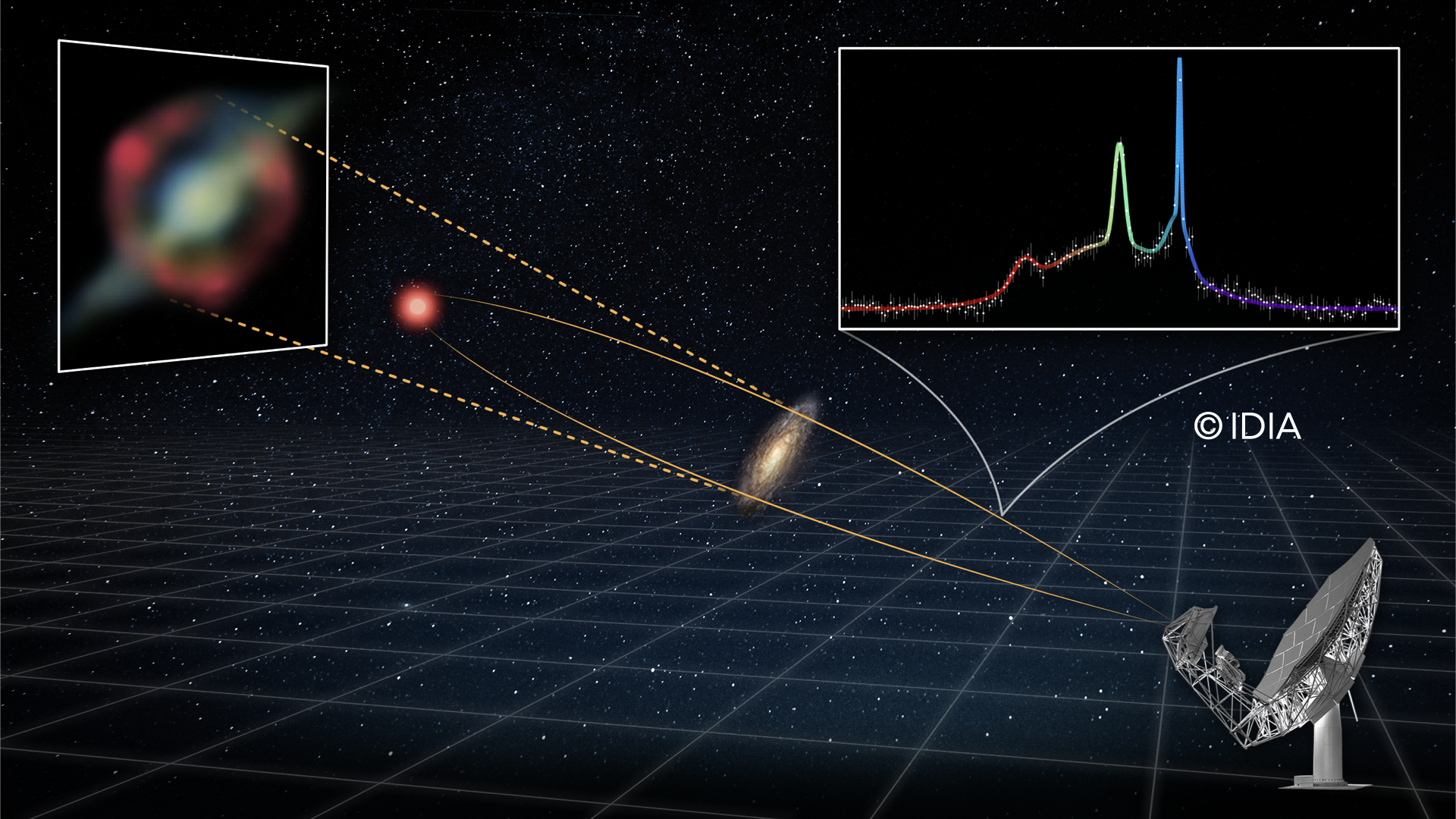 Illustration of the distant galaxy 8 billion light-years away (red), magnified by an unrelated foreground disk galaxy, resulting in a red ring. Credit: Inter-University Institute for Data-Intensive Astronomy (IDIA)
While the physical mechanism behind OHMs is very similar to that used on Earth, megamasers operate at much longer wavelengths (18 cm), placing them in the radio spectrum rather than visible light. When a signature is exceptionally bright, it is termed a megamaser because of the immense energy it emits and its visibility over great cosmic distances. In fact, the laser in this newly-discovered system (HATLAS J142935.3–002836) is so luminous that the MeerKAT team has named it a "gigalaser," which existed when the Universe was 6 billion years old - less than half its current age.
This makes the gigalaser the most distant and energetic example of this phenomenon ever witnessed. "This result is a powerful demonstration of what MeerKAT can do when paired with advanced computational infrastructure, fit-for-purpose data processing pipelines, and highly-trained software support personnel," said co-author Prof Roger Deane, the Director of the Inter-University Institute for Data Intensive Astronomy (IDIA). "This synergistic combination empowers young South African scientists, like Dr. Manamela, to lead cutting-edge science and compete with the best in the world."
In the same dataset, the team also detected a previously unknown neutral atomic hydrogen (Hi) absorption line. These results, and the high signal-to-noise ratio obtained with just 4.7 hours of observation time, highlight the potential of MeerKAT and the future Square Kilometer Array (SKA). This international collaboration includes 16 participating countries and will rely on the combined power of the MeerKAT array and the Murchison Radio-astronomy Observatory (MRO) in Western Australia. As Dr Manamela indicated:
This is just the beginning. We don’t want to find just one system – we want to find hundreds to thousands. Here at the University of Pretoria, we are carrying out systematic surveys of the universe, building the required computational pipelines and algorithms to open this observational frontier ahead of, and ultimately with the Square Kilometre Array.
Further Reading: SARAO, Royal Astronomical Society Letters