Universe Today

After decades of hypothesizing about the origin of life here on Earth, at least one astrobiologist and colleagues are still puzzled by two major conundrums. How simple molecules became complex. And how our own early Earth was able to overcome the Faint Young Sun Paradox and harbor liquid water on its surface.
I strongly believe that life started as soon as energy and nutrients became available to create complex organic molecules out of simpler molecules, Vladimir Airapetian, a senior astrophysicist at NASA Goddard Space Flight Center, told me at the recent Origins 2026 conference in Paris.
Although liquid water at the surface has long been astrobiology’s ‘habitability’ rallying cry, it’s not the only consideration when looking for life.
Over 4 billion years ago, our young Sun was 25% to 27% fainter than today, and under such a faint Sun, Earth should be a frozen ball, but we know that it wasn't, says Airapetian. Standing liquid water was available, he says.
Earth would have been covered with ice, except the equatorial belt.
But the question remains from where did the energy originate to first break apart molecules of nitrogen to form complex organic molecules?
Solar flares may be the answer.
Young stars have super flares accompanied by ejection of billions of tons of coronal mass ejections, that move at a few thousand miles per second and create shock waves in the process.
These coronal mass ejections create highly energetic protons that could have precipitated into the early Earth’s atmosphere. As they do, they start to collide with atmospheric molecular species like nitrogen (N2) and carbon dioxide (CO2) and break them apart.
The second conundrum involves our own Faint Young Sun.
To warm our planet at that time, you have to pump lots of carbon dioxide that would make small ponds the places for the origin of life highly acidic, says Airapetian. But that would make the formation of prebiotic chemistry and life highly improbable and hard to proceed to complexity, he says.
In their models, Airapetian and colleagues used ten percent of experimentally produced nitrous oxide in early earth's atmosphere to show that an equatorial band of our planet could have been warmed to 2 to 3 degrees centigrade. This would suggest a cold start to life. It would also have prevented organic molecules like hydrogen cyanide from evaporating from small lakes; while at the same time promoting further chemical complexity.
If you pump too much carbon dioxide into the atmosphere, it will get absorbed into small little ponds and create very acidic conditions, says Airapetian. But we know that we need alkaline conditions, not acidic conditions for life, he says.
Case in point, the alkaline Boron is very important for stabilization of ribose, a very important molecule for the production of ribonucleic acid (RNA).
Without ribose, you can’t produce stable, informational RNA and DNA molecules, says Airapetian.
An Unsolvable Puzzle?
We may never know exactly how or when life started here on Earth. But over the next two decades, astrobiologists like Airapetian will use a plethora of new ground and space telescopes to look for biosignatures on rocky planets orbiting solar type stars.
Prebiotic chemistry anywhere is going to look very similar, but once it advances, diverges, and becomes more complex, we cannot predict what pathway it will take, says Airapetian.
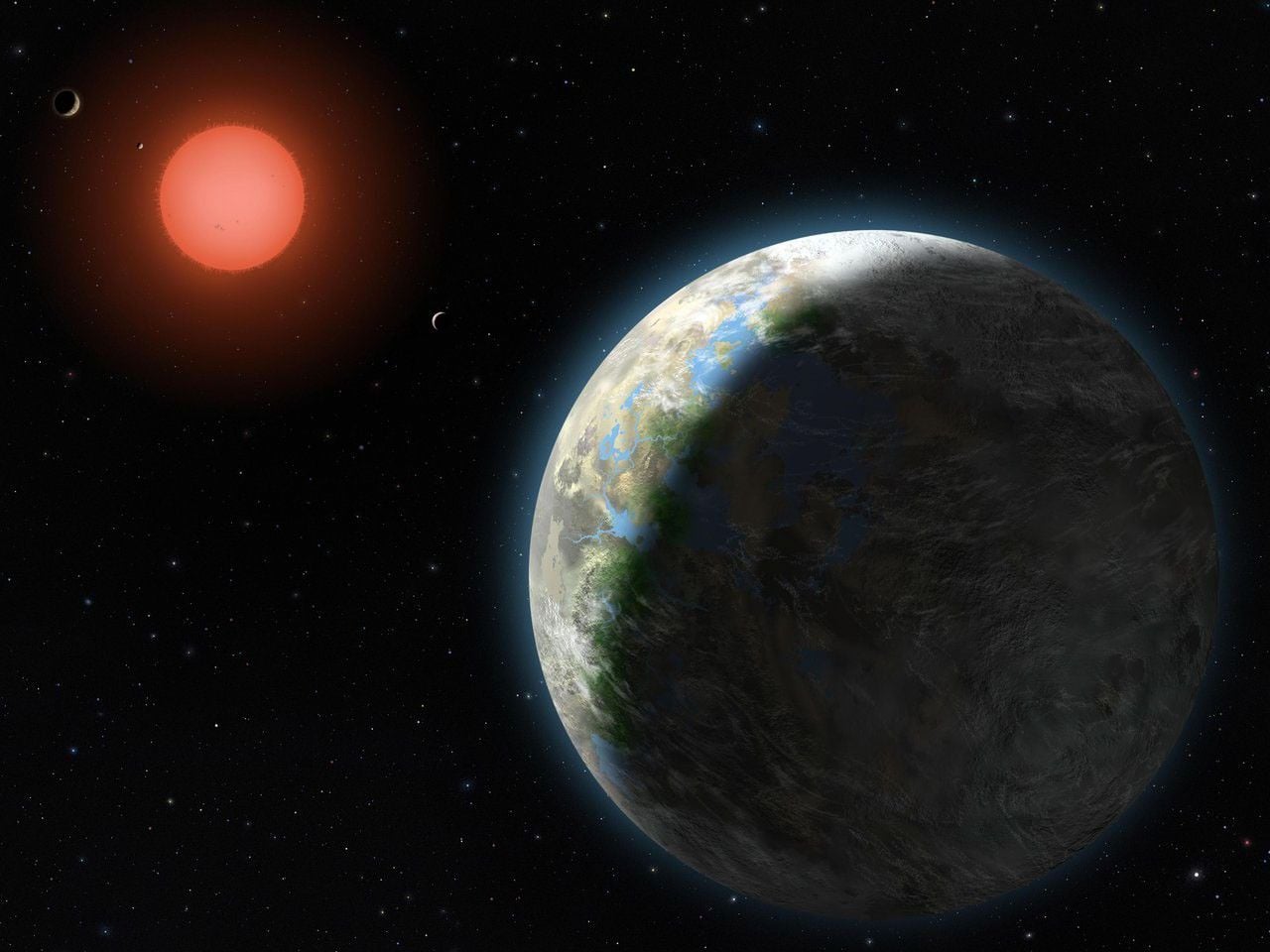 Artist's illustration of an exoearth circling a Red M dwarf star. Credit: NASA/Lynette Cook.
Airapetian is less sanguine about finding life around red M-dwarfs, the most ubiquitous stars in the cosmos. That’s because for a rocky planet to be habitable around any such star requires them to have extremely short orbits.
Such red dwarfs can wreak havoc on an earth type planet’s atmosphere many times over. That’s because red dwarf stars are usually very active; with super flares capable of routinely wiping out any emerging or existing life.
As For Airapetian?
Rather than proof of life, he’s admittedly just as interested, initially at least, in finding prebiotic signatures of life on rocky exoearths. To that end, Airapetian advocates first looking for the spectroscopic traces of nitrous oxide in the atmospheres of these far-flung worlds. That would signal that the planet has atomic nitrogen capable of binding with other chemical species to create complex molecules.
The Bottom Line?
We need to look for the spectroscopic signatures of nitrous oxide, because a nitrogen rich and carbon dioxide rich atmosphere is a basic prerequisite for prebiotic chemistry, says Airapetian.
Source: