Universe Today
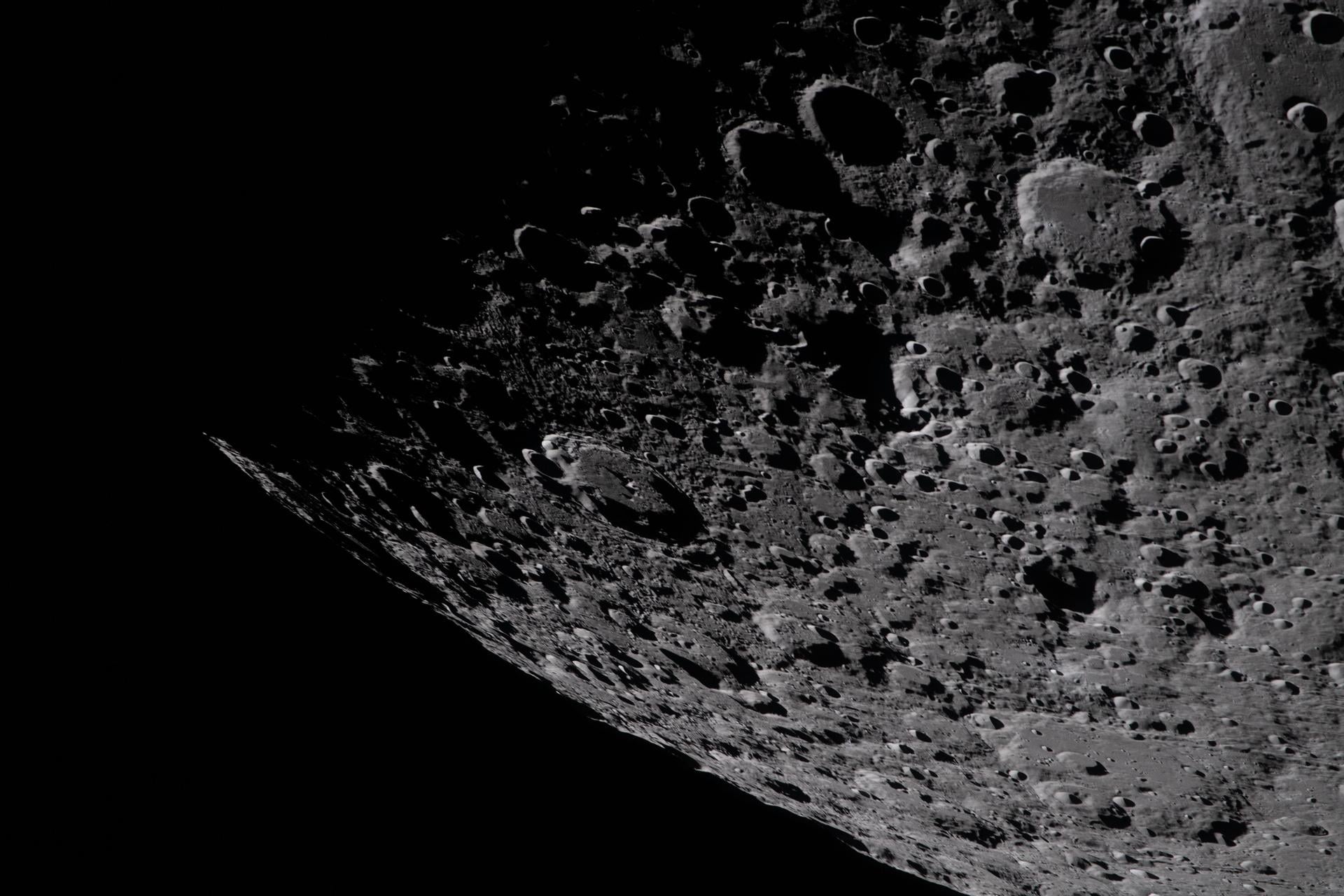
A team of scientists is exploring ways to use dark craters at the lunar poles as sites for ultrastable lasers to aid in surface and near-lunar navigation. The group, led by Physicist Jun Ye, an expert on lasers and precision measurements, were discussing the types of instruments that Artemis astronauts could install and use during their time on the Moon.
According to Ye, some ideas were pretty good, while others were not. “I thought, ‘let me throw out another crazy idea’ — except it turned out to be not so crazy after all,” Ye noted. After working with silicon resonant cavities for years, Ye and his colleagues at both the University of Colorado's Joint Institute for Laboratory Astrophysics (JILA) and the German national metrology institute. along with researchers from NASA's Jet Propulsion Laboratory, know what's needed, particularly for the lasers. They need to be stabilized against motion, which meant an ultrastable silicon cavity housing. It turned out that the lunar polar regions, which are among the coldest and darkest places in the solar system, offered a great environment. “As soon as I understood what the permanently shadowed regions can offer," he explained, "I felt that this would be the most ideal environment for a super-stable laser.”
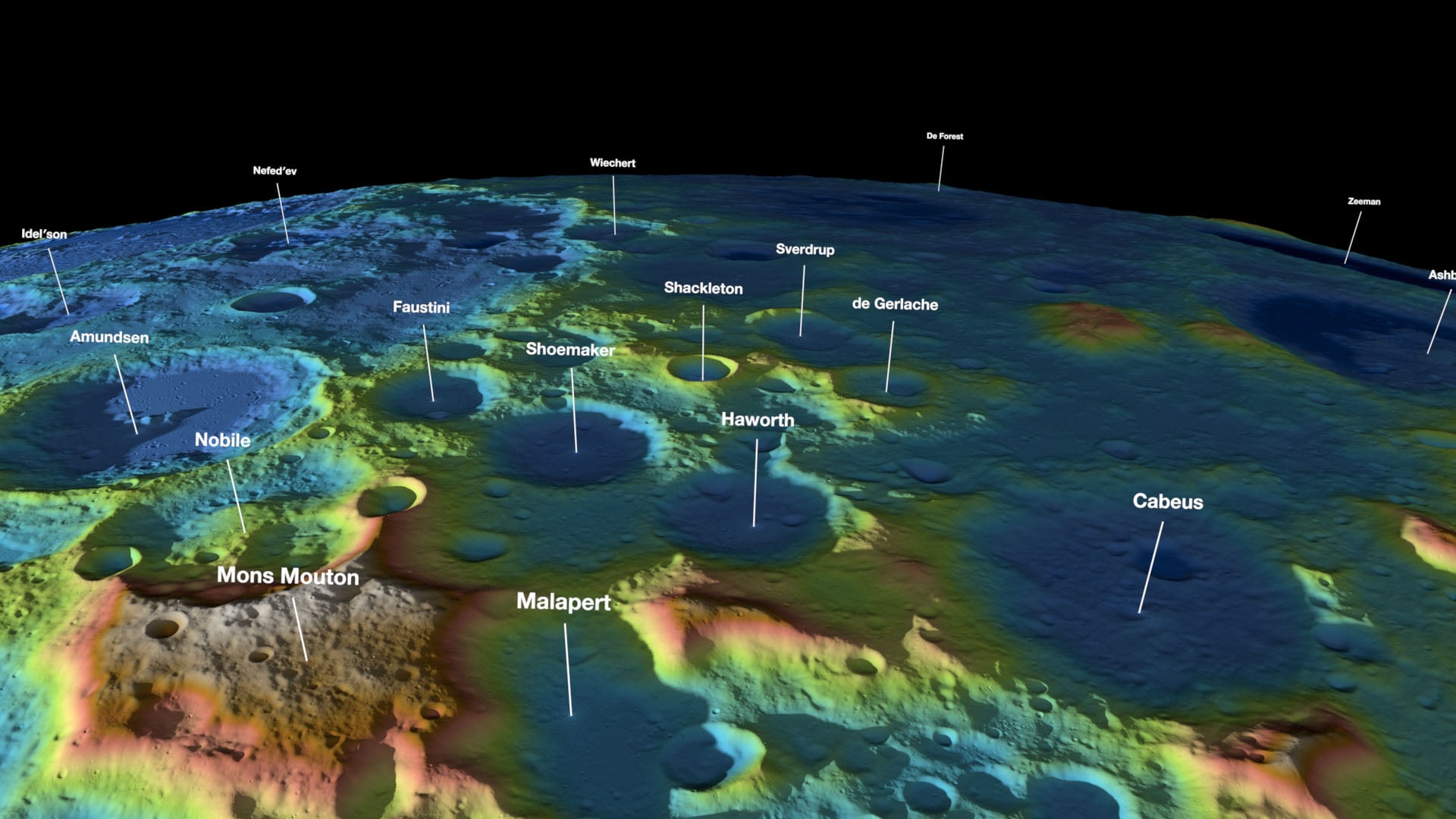 An image of the Moon's South Pole colored by elevation ranging from -8 to 8 km, with labels for 29 craters and the recently named Mons Mouton. The shadowed craters are ideal sites for laser installations. Courtesy NASA's Scientific Visualization Studio
Engineering for Noise and Shakes
Why are the lunar poles the best place for ultrastable laser sites? There are hundreds of craters in these regions that never receive direct sunlight and are always in shadow. Temperatures generally hover about 50 degrees above absolute zero (50 Kelvin), and that drastically reduces the random jitter that could affect the mirrored surfaces needed to reflect laser beams around the Moon. In addition to their shadowed status, each crater have even high vacuum than space, which can help reduce or eliminate vibrations from sound waves and stray particles that could damage the mirrors. Ultimately, radiated heat provides for a much more stable environment.
The key component for such laser installations is a resonant cavity made of a very stable material; in this case, silicon. Such a cavity would only allow specific light frequencies to bounce between mirrors on each end of the block. That's why very high stability is needed. Ye's team has designed a cavity mount to minimize the vibration noise it would experience on the Moon. That includes moonquakes, which could shake the cavity and create fluctuations in laser frequency. They are taking into account a number of scenarios by simulating "shaky" activity here on Earth.
"In our lab, for example we have plenty of seismic noise associated with foot traffic and machinery of a fully occupied building," he said. "Yet our design mitigates such vibration induced noise to a level below the fundamental limit set by the thermal Brownian noise associated with the mirror.
Ye explained that this is something that the team shares with the Laser Interferometer Gravitational-Wave Observatory (LIGO) installations that measure gravitational waves. "On the Moon we expect the lunar seismic noise to be significantly lower than the terrestrial environment, so we are fairly confident that our design will work well on the Moon."
How It Works
Installation would be a multi-step process. The silicon optical cavity for each site that Ye's team has been developing would be fully assembled on Earth and would be small enough to fit inside Artemis. The next step would be to deliver to the lunar surface. Once there, the device's radiation panels would need to unfold. Astronauts would use a remote or mechanically controlled lunar rover to lower the cavity into the crater.
Thanks to the stability of the cavity, the light frequencies from nearby lasers would encounter well-stabilized mirrors within. The distance between the two mirrors determines the frequencies that are allowed to resonate; for a highly stable optical cavity, that distance, and therefore those frequencies, does not vary.
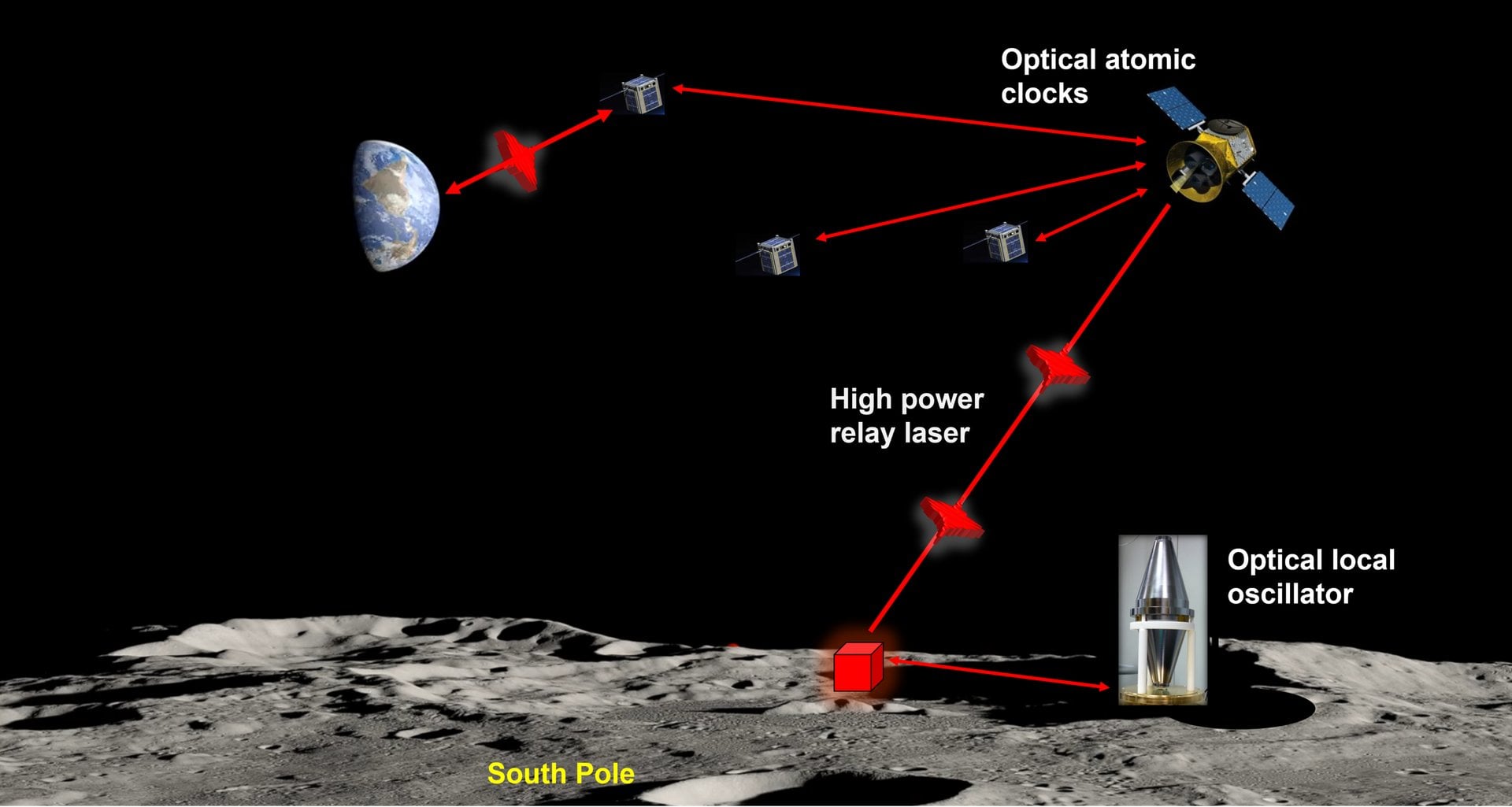 A lunar laser locked to an ultrastable silicon cavity placed inside one of the Moon’s permanently shadowed craters could provide the infrastructure for a lunar time scale, Earth-Moon optical communication, satellite-based space distance measurements and imaging, and a space-based optical atomic clock. Credit: J. Ye/NIST with lunar background image produced by NASA’s Visualization Studio
The stabilized laser could act as a GPS-like signal. Astronauts could use it to guide lunar spacecraft during landing. That's particularly important for missions landing in the dim polar regions. In addition, by tuning its light to the signals of atomic clocks on satellites, a high-stability lunar laser could also form the backbone of the first optical atomic clock on an extraterrestrial surface. This timekeeping signal would rival those from the most precise and accurate optical atomic clocks on Earth, which Ye and colleagues have built in Earth-bound laboratories.
A network of these well-stabilized lunar lasers could measure distances between objects on the Moon with very high precision. That would also enable the network to act as a detector for gravitational waves, just as LIGO does on Earth. Such a network could be ready to test in low-Earth orbit in the next couple of years. Once that testing is complete, the team hopes that they'll be on the lunar surface in the following three to five years, nestled away in the safety of the lunar polar craters.
For More Information
Shooting for the Moon: Ultrastable Lasers in Dark Craters Could Enable Lunar Navigation