Universe Today
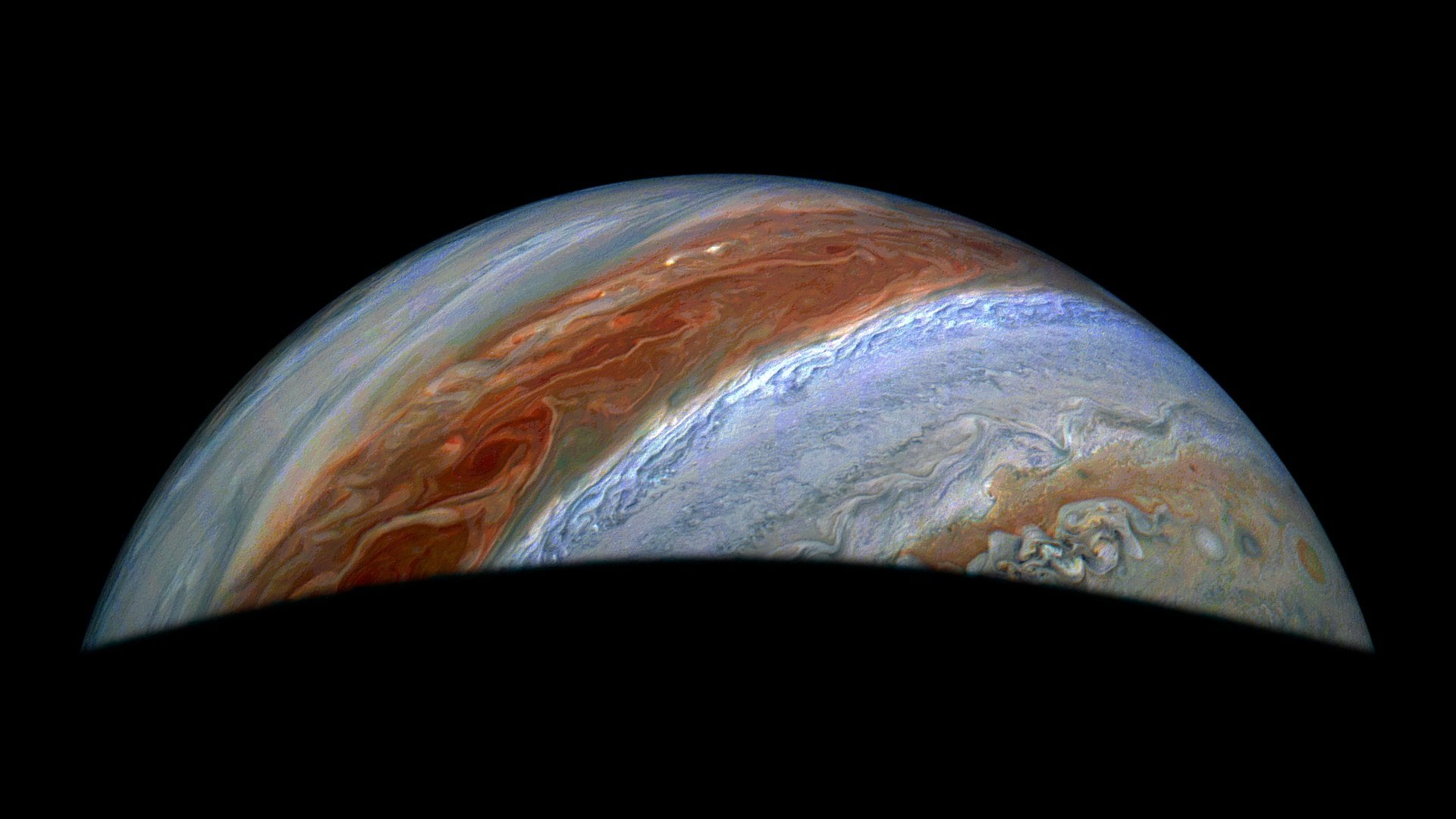
NASA's Juno mission to Jupiter reveals a planet with an interior structure that is much more complex than ever previously thought. At least that’s the latest word from several of Juno’s scientific team members who were on hand at a press conference at the European Geosciences Union’s 2026 General Assembly last week in Vienna.
Now on its 83rd orbit around the giant planet and its many moons, the Juno team described the solar-powered spacecraft’s health as excellent.
Launched in 2011, Juno arrived at Jupiter in 2016 with science goals intended to shed light on the planet’s formation and evolution. The idea was to measure the gas giant’s interior, its atmosphere, its polar magnetosphere, as well as both its magnetic field and gravity field.
And to those ends, it has made great progress. At present, Juno is making its way towards Jupiter’s North Pole in a region that’s hardly been explored due to the gas giant’s powerful radiation belts.
Because Jupiter is not a perfect sphere, it has torqued our orbit around, Steven Levin, Juno’s project scientist at NASA JPL in Pasadena, told me in Vienna. So now instead of being down near the equator, the closest approach is way up near the planet’s North Pole, Levin told me.
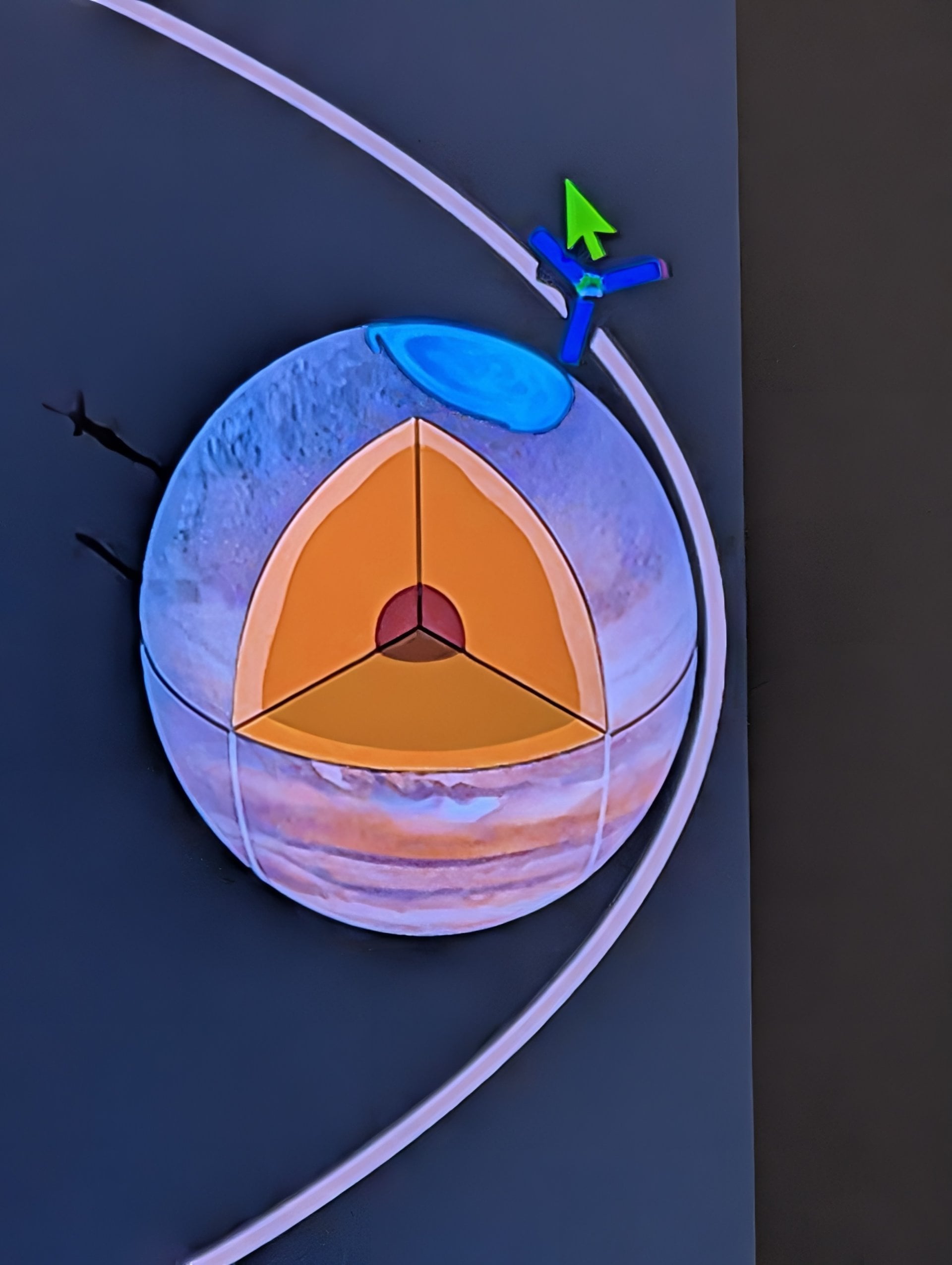 A smartphone image of a graphic of the spacecraft making its way towards Jupiter's North Pole used during the NASA Juno team's press conference. Credit: Bruce Dorminey
Thus, on every orbit at the moment, the spacecraft is scanning the planet almost from pole to pole.
The data that we got from these 83 orbits is so precise that to do the calculations, we need to model Jupiter like an onion with many, many layers, Yohai Kaspi, a Juno co-investigator at the Weizmann Institute of Science in Israel, told me in Vienna.
Jupiter has long been viewed as a swirling maelstrom of colorful jet streams with a giant red spot that has long captivated amateur astronomers and planetary scientists alike. But only in the last two decades have theorists finally begun to have a better scientific understanding of our gas giant planet, which is so full of hydrogen and helium that if it were 13 times larger, it would begin deuterium burning in its core. And thus, it would resemble a failed brown dwarf star rather than the kingpin of our outer solar system.
One of the mission’s main drivers was to try and resolve the debate over how gas giant planets like Jupiter actually form.
As first proposed in 1951 by the Dutch-American astronomer Gerard Kuiper, Jupiter may have formed from a cloud of molecular gas in a process known as ‘gravitational disk instability,’ as noted in my 2001 book “Distant Wanderers: The Search for Planets beyond the Solar System.” The idea is that giant protoplanets would independently contract into spherical bodies from large clumps of gas and dust in a process not unlike the way our own Sun collapsed from clouds of molecular gas and dust, I wrote in my book.
In conventional planet forming accretion theory, once Jupiter had enough initial mass in the form of a rock and ice core at least ten times the mass of Earth, it began accreting hydrogen gas, I wrote in “Distant Wanderers.” This eventually compressed molecular hydrogen into liquid hydrogen, and then finally metallic hydrogen, I wrote.
But Juno has turned conventional planet formation theory on its head. The team can't say for sure whether there is a compact core, something less than six Earth masses.
They have concluded that either there's no solid core or if there is a core, it’s likely made of heavy elements, something further down the periodic table than hydrogen and helium.
We can't see with our naked eye, but we can see with Juno’s microwave radiometer, which has six different channels at six different depths, says Kaspi. From that we have learned that Jupiter is complex and the atmosphere is not well mixed, he says. At 7000 km deep, molecular hydrogen and helium become so dense and ionized they become metallic, says Kaspi.
The spacecraft could still have a lengthy future.
Even so, NASA refuses to venture a guess as to how many more orbits of Jupiter Juno might be able to make. The mission has already far exceeded its nominal mission of 32 orbits. The good news is that for the moment, the mission continues to be funded and the spacecraft remains healthy enough to continue returning great data.
The Bottom Line?
Jupiter has a very large, diffuse, dilute core, Scott Bolton, Juno’s principal investigator at the Southwest Research Institute in San Antonio, told me in Vienna. We think that there may be a small, compact core in Jupiter’s very center, and we're using machine learning and AI to resolve those results, Bolton told me. But it’s still hard to come up with a model that actually works to build a Jupiter the way we see it, he says.
Planetary theorists still debate whether what is known as a true Jupiter --- a gas giant planet that orbits its parent star at roughly five Earth-Eun distances (astronomical units) --- wasn’t somehow needed to create an orderly inner solar system. That is, an inner solar system where our own habitable Earth was able to evolve the kind of intelligent life that allows us to ponder such issues.
As for how Juno will reshape our understanding of our solar system’s largest planet?
As humans, we have a tendency to fill in our ignorance with simple models, but the details are always more complicated, says Levin.