Universe Today
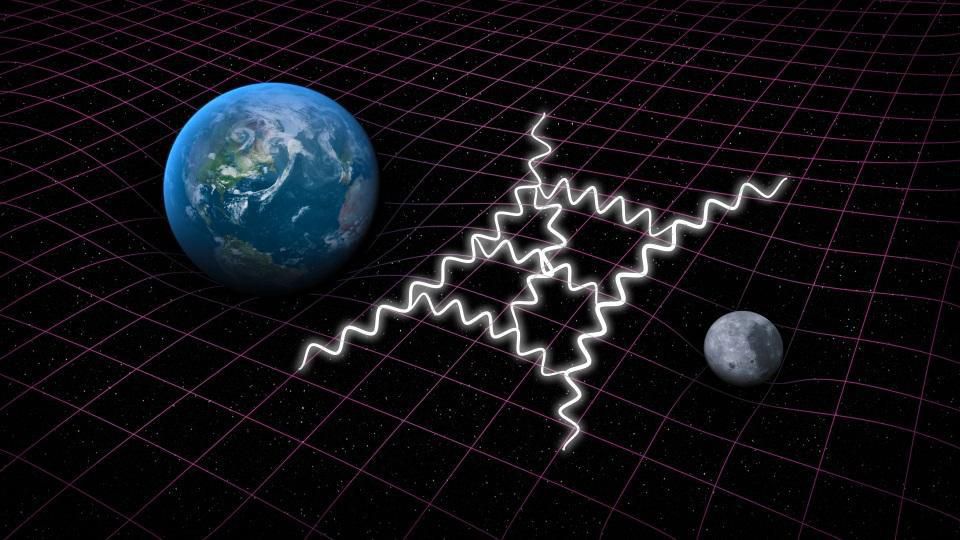
Trying to solve quantum gravity is frustrating. We have made tremendous progress in quantum theory, but it seems that every time we find a new quantum technique, there's a reason it doesn't quite work with gravity. Take, for example, the case of quantum fluctuations and renormalization.
There are many ways to calculate quantum interactions, but one of them involves quantum fluctuations. Suppose you wanted to determine the odds of an electron at point A being later observed at point B. It's possible that the electron could just travel from A to B. But because of quantum uncertainty, it's also possible that a virtual electron-positron pair appears, interacts with your electron, and shifts the odds. Less likely, but not impossible, you might have two virtual pairs, or three, or fifteen. If you want to calculate the odds of your electron going from A to B, you have to calculate the odds of all possible paths and interactions. You may have seen these represented as Feynman diagrams.
This works great for individual particles, though the calculations can be tedious. But when you use this approach to quantize things such as an electromagnetic field, you start to see problems. The possibilities grow and grow, and when you try to add everything up, you get infinity rather than a finite probability. Mathematically, your sum diverges. This was a big problem with quantum field theory until we figured out you could use a trick known as renormalization. Basically, the total sum isn't what's important. What matters is how that sum differs from the background. Thanks to renormalization you can cancel out the (infinite) background to get an accurate finite result.
So why not do the same thing for a gravitational field? Well, it turns out that quantum renormalization only works for Euclidean space. In general relativity, the mass-energy of a system warps space and time. So all those quantum fluctuations curve spacetime, and curved spacetime induces even more virtual particles, which warp space even more... oh no! It all breaks down, and we can't quantize gravitational fields the way we quantize the other fundamental forces.
Problems like these have led some researchers to develop a model known as loop quantum gravity. Rather than trying to calculate the behavior of quantum particles in a timey-wimey background, why not treat the entire mass-energy-spacetime structure as a single quantum system? It's like imagining the Universe within an unseen background that is Euclidean. This way the problem of renormalization can be overcome in many cases. One case where it doesn't work well is the cosmological constant. In most cosmological models, the cosmological constant is what drives cosmic expansion. Since it is a universal dark energy field, it amplifies the loop quantum gravity sums, and once again the whole thing diverges. You can handle this by fixing the cosmological constant to a specific value, but that isn't really a solution to the problem. It's the cosmology equivalent of ignoring the engine light in your car...
A new study finds this might not be too bad after all. In it, the authors demonstrate an interesting similarity between the cosmological constant in loop quantum gravity and the quantum Hall effect in standard quantum theory.
The Hall effect is what occurs when you pass the current in a wire through a magnetic field perpendicular to the wire. The electrons are deflected by the magnetic field, which induces a voltage in the wire. This also affects the conductivity of the wire in that section. In the classical Hall effect, the induced voltage can have any value, depending on the current and magnetic field. The quantum Hall effect is the quantum version of this, where the induced voltage and conductivity are locked into discrete values. In other words, the conductivity is quantized.
The authors find that for a particular model known as the Chern-Simons-Kodama state, the cosmological constant is locked into discrete values in the way the Hall state can be quantized. This means that the cosmological constant isn't affected by secondary quantum fluctuations. The energy of those fluctuations is too small or improbable to shift the cosmological constant to a new value. This could explain why simply fixing the value of the constant works. Within certain limits, the value is locked by the quantum effect itself.
As the authors point out, the real work is in the details. They plan to explore the idea further in future work. But the paper does show that perhaps we understand quantum cosmology a bit better than we thought.
Reference: Alexander, Stephon, Heliudson Bernardo, and Aaron Hui. "Cosmological Constant from Quantum Gravitational θ Vacua and the Gravitational Hall Effect." Physical Review Letters 136.15 (2026): 151501.