Universe Today
There is a particular kind of iron that cannot be made on Earth. It forms only inside massive stars, in the extraordinary pressures of their cores, and it reaches us only one way, when those stars explode. Iron-60 is a radioactive isotope with a half life of 2.6 million years, that’s short enough, on cosmic timescales, that every atom present when our Solar System formed 4.5 billion years ago has long since decayed to nothing. Any iron-60 found on Earth today came from somewhere else.
Scientists have known for years that our Solar System was struck by iron-60 from nearby supernovae on at least two occasions millions of years ago, the evidence is written in deep sea sediments and in rocks on the Moon. But then something puzzling turned up, iron-60 in Antarctic surface snow less than twenty years old. There had been no nearby stellar explosion to explain it. So where was it coming from?
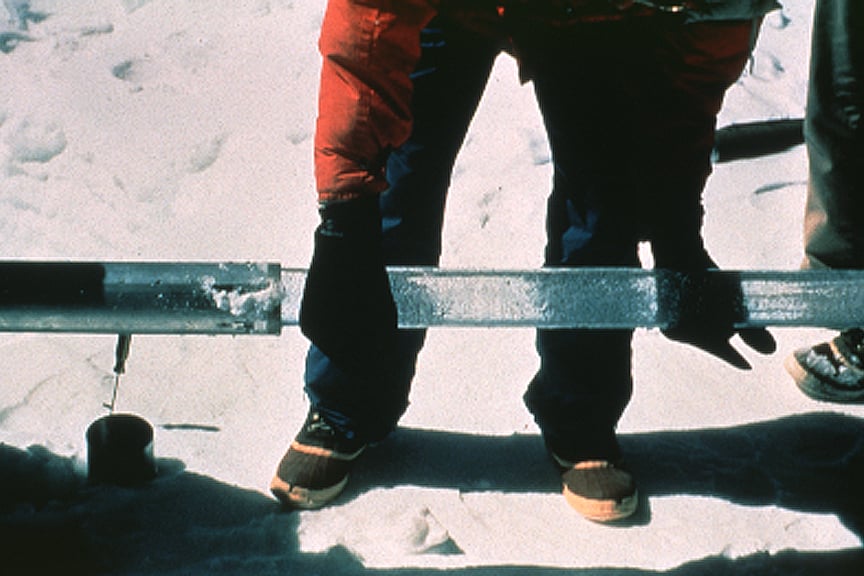 Ice core sample taken from drill (Credit : Lonnie Thompson)
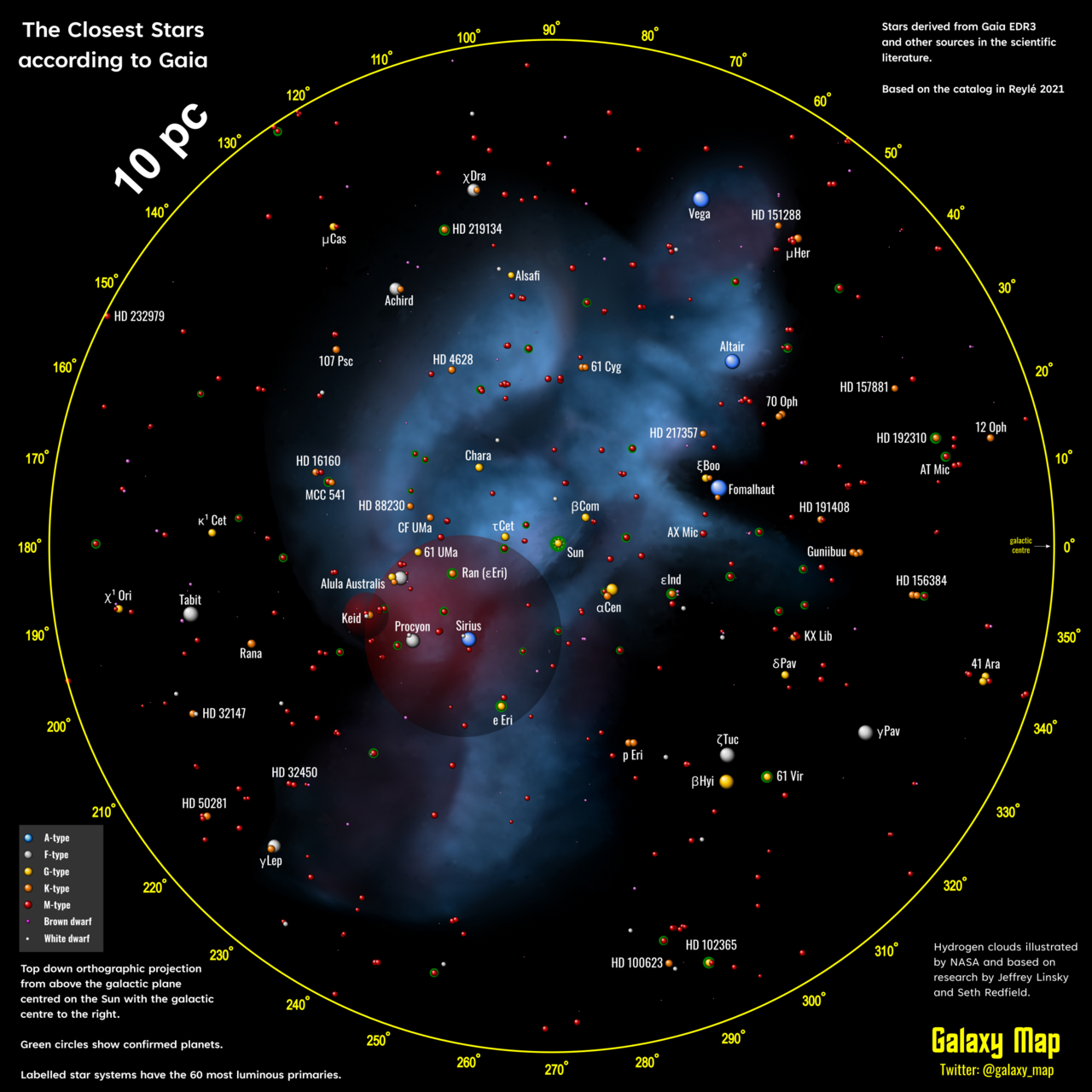
The answer, it turns out, has been all around us, quite literally. Our Solar System is currently passing through the Local Interstellar Cloud, a vast, wispy region of gas and dust drifting through our corner of the Milky Way. Scientists suspected this cloud might be acting as a reservoir, storing iron-60 from a long past supernova and gradually dusting Earth as our Solar System moves through it.
An international team led by Dr. Dominik Koll and Prof. Anton Wallner at HZDR in Dresden analysed ice cores from the Antarctic EPICA drilling project, ice dating back between 40,000 and 80,000 years, capturing the period around when our Solar System first entered the cloud. The iron-60 signal is there, clearly above background, and it varies. Between 40,000 and 80,000 years ago, less iron-60 was reaching Earth than in more recent samples, suggesting the Solar System was then moving through a less dense part of the cloud before drifting into the thicker region where it sits today.
That variation is crucial. It rules out alternative explanations, such as the slow decay of iron-60 from million year old supernova events. The signal changes too quickly for that so the cloud itself is the source. Getting to that conclusion was extraordinary work. The team transported around 300 kilograms of Antarctic ice from Bremerhaven to Dresden, processed it chemically through painstaking step by step isolation, and ended up with just a few hundred milligrams of dust. From that dust, they had to find iron-60 atoms.
"It's like searching for a needle in 50,000 football stadiums filled to the roof with hay. The machine finds the needle in an hour,” - Annabel Rolofs from the University of Bonn.
That machine in question is the Heavy Ion Accelerator Facility at the Australian National University, currently the only instrument in the world sensitive enough to detect iron-60 in such vanishingly small quantities. Using electric and magnetic filters, the team separated unwanted atoms by mass until only the iron-60 remained. Our Solar System will leave the Local Interstellar Cloud in just a few thousand years. Before it does, the team plans to analyse ice from before we entered it getting a snapshot of a time when this particular rain of stardust had not yet begun. The Beyond EPICA project is already working to recover ice old enough to make that possible.
Source : Iron-60 Discovery in Antarctic Ice Reveals How Local Interstellar Cloud Leaves Its Mark