Universe Today
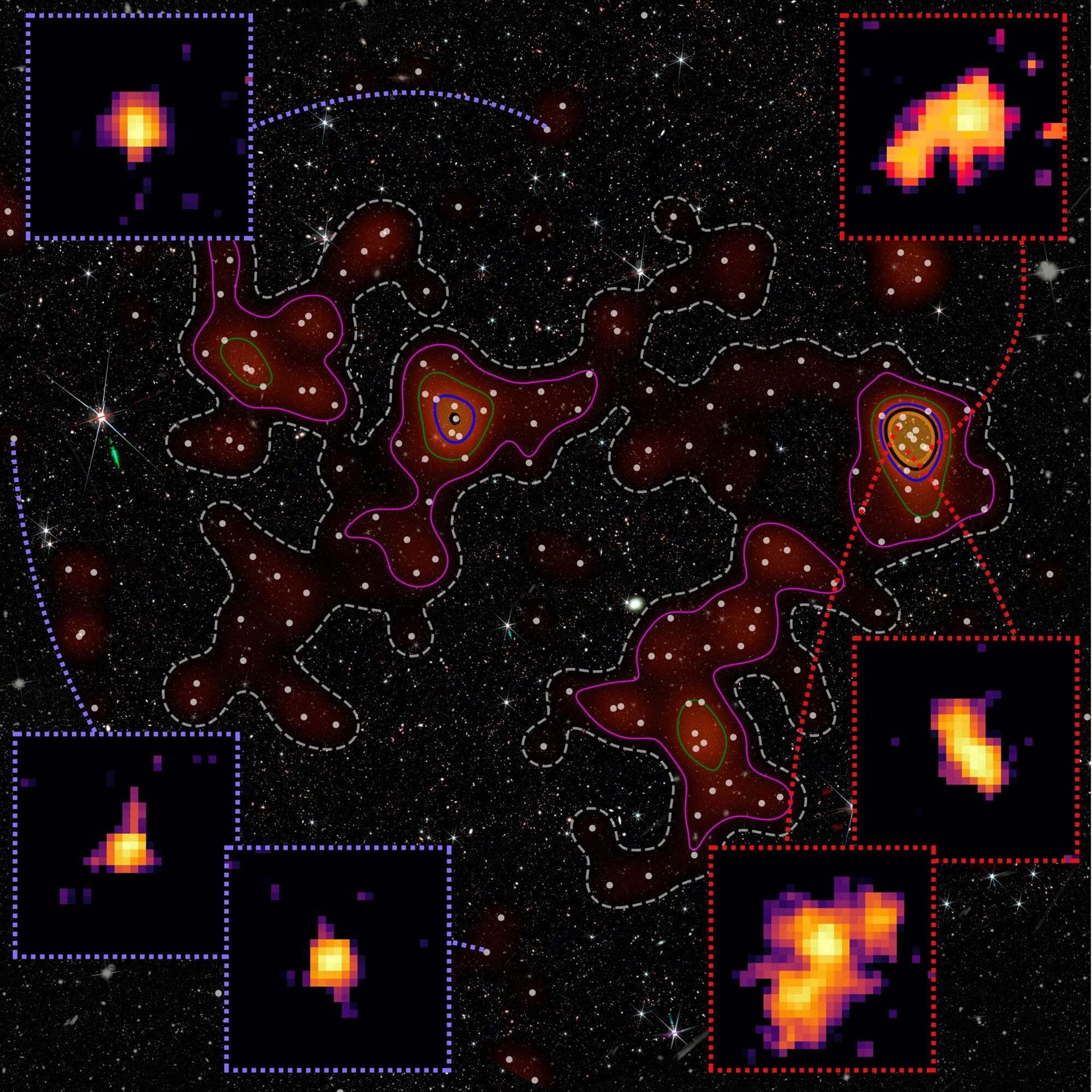
An early galaxy cluster named after an Indian lake is teaching astronomers about influences on galaxy evolution in the infant Universe. Astronomer Ronaldo Laishram of the National Astronomical Observatory of Japan (NAOJ) used the Subaru Telescope’s wide-field camera, Hyper Suprime-Cam (HSC), to conduct a large sky survey to look for early galaxies with active star formation. The result was the discovery of a massive protocluster of galaxies that existed some 12.6 billion years ago, very early in cosmic time. A more detailed study of this region gives additional new insight into how galaxies and their clusters form and evolve.
The same team returned to the scene to do detailed observations and analysis of the light from the galaxies. They've found that the growth and evolution of young galaxies were being influenced by their environment at a time when the Universe was only 1.2 billion years old. "Protoclusters are the construction sites of the most massive structures in the present-day Universe," said Laishram. "Finding such a clearly organized system at this early epoch gives us a rare chance to study how environment affects galaxy growth in the young Universe."
Laishram and his colleagues named the infant protocluster Loktak, after Loktak Lake in Manipur India (Laishram's home). That's because the distant interconnected concentrations of galaxies reminded him of the lake's connected masses of vegetation, soil, and other materials that float on its surface. They form circular shapes and the lake provides fresh water and fishing access for the local population.
 A view of part of Loktak Lake in Manipur India, with its masses of floating material reminiscent of the distribution of young galaxies in a protocluster early in the Universe. Courtesy: Nabachandra Kahajam CC BY-SA 4.0
The Growth of Galaxies
When we look at the sky with high-resolution telescopes, we can see galaxies grouped into clusters and superclusters. That's not how they started out, though. Those early protogalaxies took billions of years to form. In the early Universe, they began as dense regions of matter that grew under the influence of gravity and collisions. The first galaxies began grouping into clusters that astronomers now know influenced their shapes and growth. The big question is: when did those environments in protoclusters and clusters begin their influence? It's not clear whether that began in the first epochs of cosmic history or whether it appeared only after galaxy clusters had fully matured.
To figure this out, the team turned to the Subaru and its instruments to conduct a large sky survey. That's when they discovered the Loktak massive Loktak protocluster. They they used the James Webb Space Telescope (JWST) to compare the young galaxies inside Loktak. JWST’s highly sensitive infrared instruments made it possible to study the visible-light structure of the distant galaxies.
Focusing JWST on the Protocluster
Young galaxies burst with star formation, which astronomers detect through the ultraviolet light the stars give off. There's a special set of wavelengths they exhibit called Lyman-alpha emission. It's produced when radiation from those hot young stars excites surrounding hydrogen gas. Galaxies found through this signal are called "Lyman-alpha emitters", and they are useful markers for tracing structure in the early Universe.
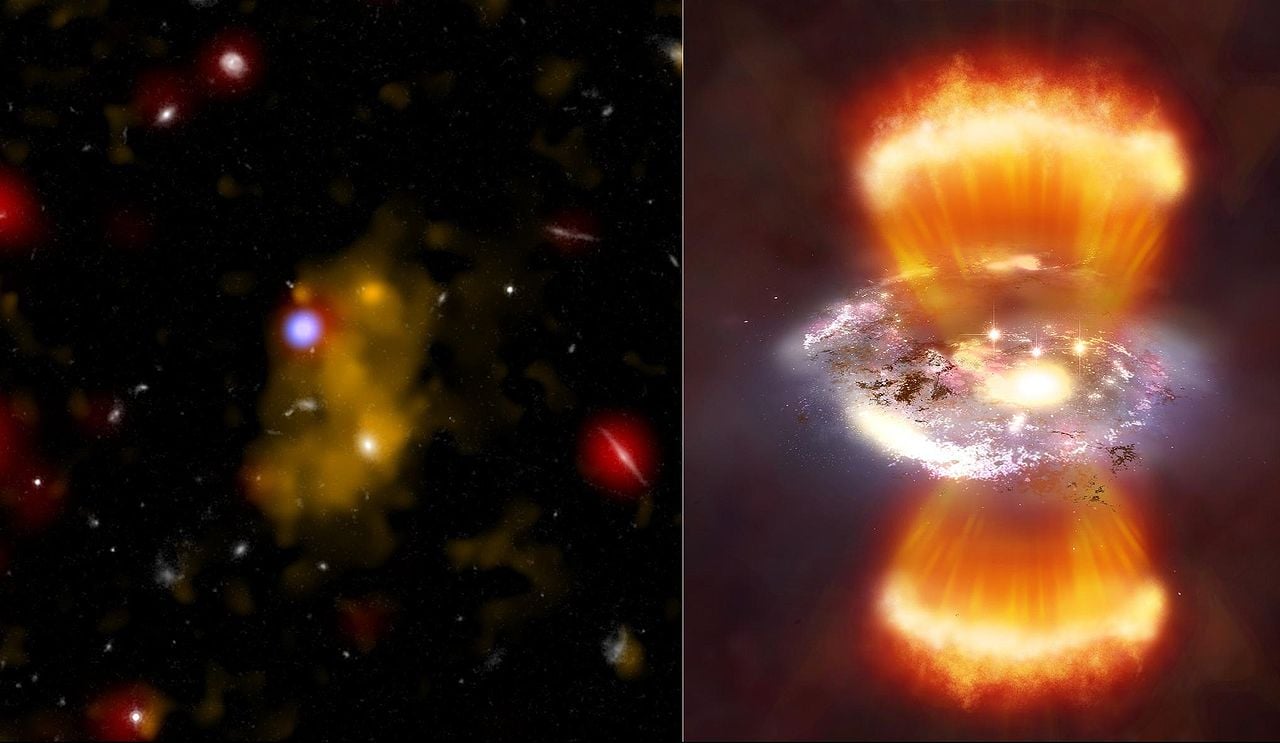 A Lyman alpha emitter (left) and an artist's impression of what one might look like if viewed at a relatively close distance (right). Courtesy Chandra X-Ray Observatory Library.
JWST infrared images allowed the team to compare galaxies inside the protocluster with galaxies in more typical environments at the same cosmic epoch. In ultraviolet light—which traces regions where stars are forming—the two galaxy populations showed little difference in size. However, in optical light, which traces the overall distribution of previously formed stars, galaxies in the protocluster were on average about 1.4 times larger than galaxies in normal environments.
In other words, although the star-forming cores looked similar, the overall galaxies had grown differently. This suggests that star formation in galaxy centers proceeded similarly, but galaxies in dense environments built up their outer stellar structures earlier and more rapidly.
The Galaxy is Influenced by its Environment
The results of the observations of Loktak protocluster strongly implies that the environment of the protocluster was already at work shaping the cluster's galaxies early in the process. In fact, it was happening before the cluster was completely formed. In the "big picture" of galaxy formation, we see material being pulled together (either by gravity or through collisions). The process of collision and coalescence continues to shape the galaxy. But now, astronomers see that the evolution of a given galaxy is also affected by its surroundings in the cluster environment from an early stage of development.
Now the next big question is whether or not this "protocluster environmental influence" occurs across all clusters in the early Universe. Or, was it only happening within Loktak? The team will be using the Subaru Telescope along with JWST observations to scan other early protoclusters. These galaxy protoclusters are the progenitors of our "modern" universe of galaxy clusters. That means the observations behind Loktak and its influences provide a fine "laboratory" experiment to investigate the environments in the first epochs of cosmic history that influenced the birth and grown of galaxies and their cluster regions. The team would like to extend measurements to galaxies across a range of distances, with larger samples and deeper imaging.
For More Information
Just 1.2 Billion Years After the Big Bang, Galaxies Were Already Shaped by Where They Lived