 Universe Today
Comets inhabit the cold reaches of the Solar System: the Kuiper Belt and the Oort Cloud. Occasionally, one passes through the inner Solar System, but mostly they keep to themselves out there. These dirty snowballs are agglomerations of rock and dust, and frozen volatiles like water, carbon dioxide, methane, and ammonia. They also contain organic materials.
But one of comets' key components is crystal silicates, and their presence creates a puzzling paradox. They're only created in extremely hot environments, ones far hotter than the Kuiper Belt or the Oort Cloud.
Crystal silicates are the most abundant mineral on Earth, making up about 90% of the planet's crust. They're part of what it means to be a rocky planet, which have mantles made of crystalline silicates. These types of planets form in the inner Solar System, where it's hot enough for these silicates to form.
How does something born in heat find its way into objects so cold?
New research in Nature has an explanation. It's titled "Accretion bursts crystallize silicates in a planet-forming disk," and the lead author is Professor Jeong-Eun Lee. Lee is from the Department of Physics and Astronomy at Seoul National University in South Korea.
"Crystalline silicates form at high temperatures (>900 K)," the researchers write. "Their presence in comets suggests that high-temperature dust processing occurred in the early Solar System and was subsequently transported outwards to comet-forming regions."
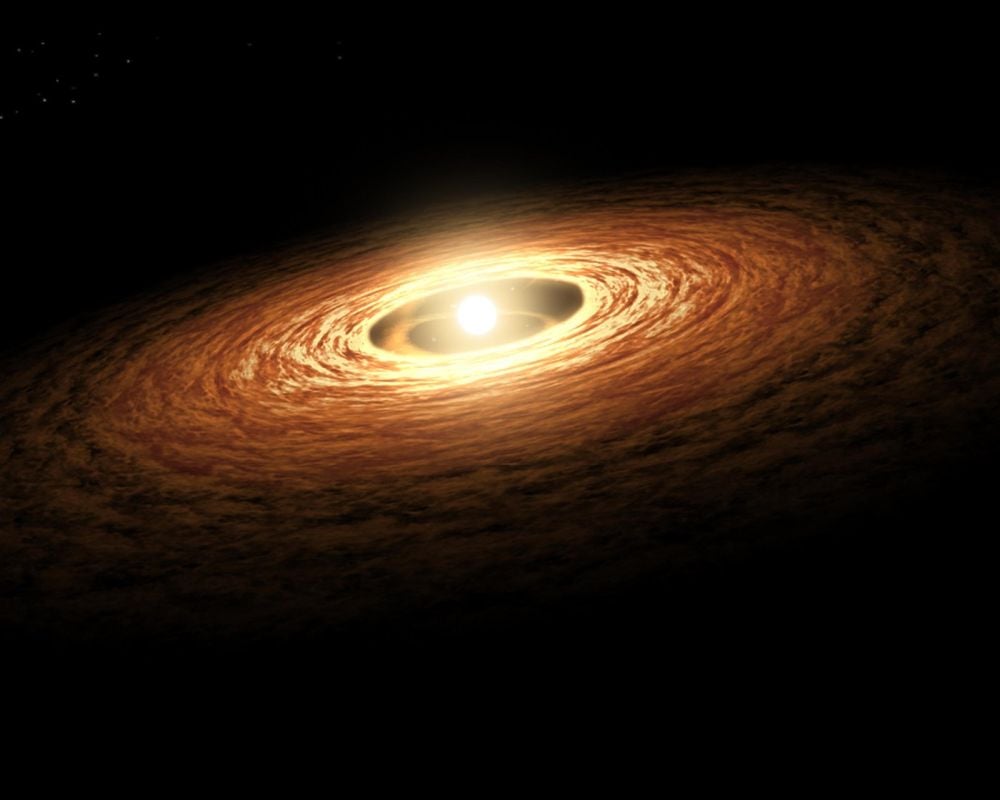 This artist's illustration shows a young star surrounded by its protoplanetary disk. As young stars accrete material, they experience powerful outbursts of heat and wind. The heat can create crystalline silicates, and new research shows how the winds could push the silicates out into the distant reaches of the disk. Once there, they can be taken up in comet formation. Image Credit: NASA/JPL-Caltech
These dust grains are rarely present in interstellar space, but are found in comet nuclei. For example, research from 2018 found crystalline olivine and crystalline pyroxene in the nucleus of Comet 17P/Holmes.
Crystalline silicates have to form near the Sun, and somehow be transported to the domain of the icy comets, but the details of that process have never been clearly revealed. "However, direct evidence for this crystallization and redistribution in Sun-like protostars has remained unknown," the authors write.
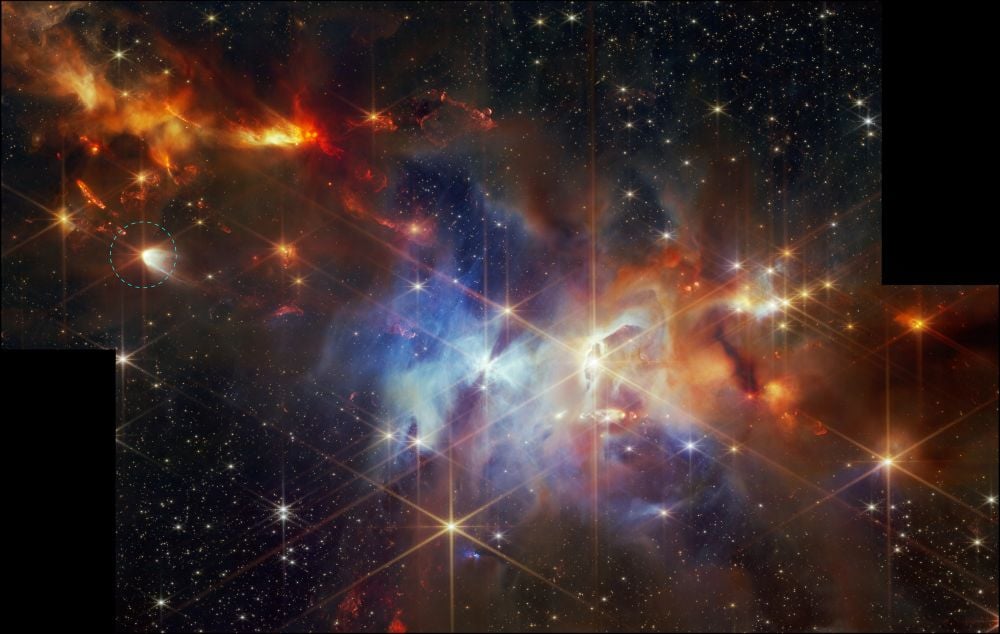
The researchers used the JWST to observe EC 53, a periodically bursting protostar about 1400 light-years away. They detected two crystalline silicates, forsterite and enstatite, during the star's outbursts, and only during its outbursts. "The emergence of these features indicates active crystal formation by thermal annealing in the hot inner disk during the accretion burst," the researchers explain.
“Even as a scientist, it is amazing to me that we can find specific silicates in space, including forsterite and enstatite near EC 53,” said Doug Johnstone, a co-author and a principal research officer at the National Research Council of Canada. “These are common minerals on Earth. The main ingredient of our planet is silicate.”
The silicate starts out as non-crystallized, amorphous particles. Young stars accrete material unevenly from their accretion disks, and as this process plays out, the star experiences bursts of luminosity and heat. This can warm up the material in the disk, melting the amorphous particles which then cool and crystallize. In 2008, NASA's Spitzer Space Telescope saw this happening around EX Lupi, a young Sun-like star about 500 light-years away.
The creation of crystalline silicates is fairly well-understood, but how they find their way into comets has been more difficult to understand.
Protostars do more than heat their disks during outbursts. They're also known for strong stellar winds, much stronger than the sedate wind that the Sun blows. In this research, the JWST detected strong outflows from the young star, strong enough to deliver crystalline silicates to the outer regions of the star's disk.
“EC 53’s layered outflows may lift up these newly formed crystalline silicates and transfer them outward, like they’re on a cosmic highway,” said lead author Lee in a press release. “Webb not only showed us exactly which types of silicates are in the dust near the star, but also where they are both before and during a burst.”
EC 53 is a much-studied young star. While young protostars are known for energetic outbursts, the outbursts can be unpredictable. But not EC 53. About every 18 months, it begins a 100-day long outburst. During these bursts, it accretes gas and dust rapidly, while ejecting excess energy as wind and polar jets. These powerful outflows could drive crystalline silicates into the further reaches of the young star's disk, where they could be taken up in comet formation.
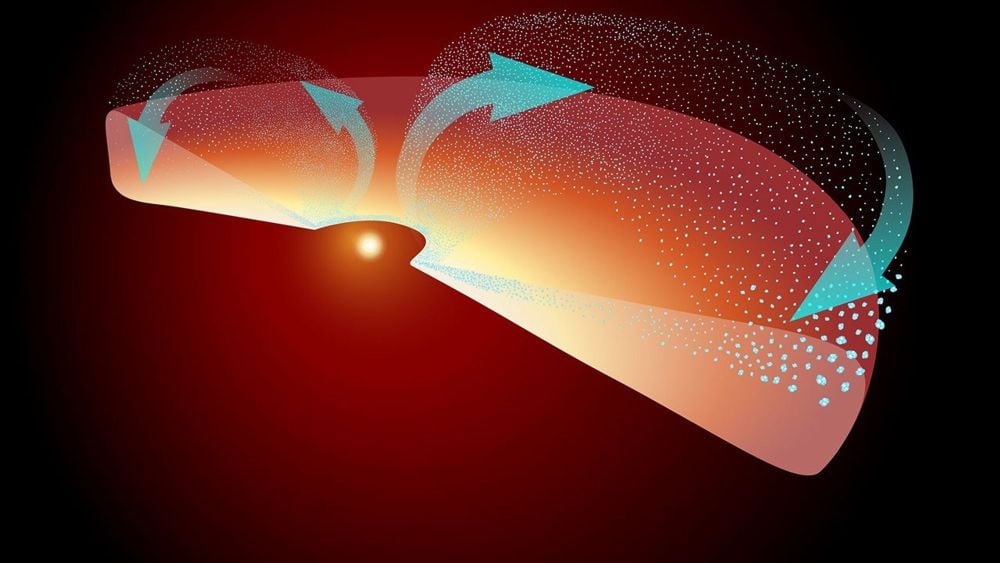 This illustration represents half the disk of gas and dust surrounding the protostar EC 53. Stellar outbursts periodically form crystalline silicates, which are launched up and out to the edges of the system, where comets and other icy rocky bodies may eventually form. Illustration: NASA, ESA, CSA, Elizabeth Wheatley (STScI)
“It’s incredibly impressive that Webb can not only show us so much, but also where everything is,” said Joel Green, a co-author and an instrument scientist at the Space Telescope Science Institute in Baltimore, Maryland. “Our research team mapped how the crystals move throughout the system. We’ve effectively shown how the star creates and distributes these superfine particles, which are each significantly smaller than a grain of sand.”
The idea that protostars create crystalline silicates and then spread them outward with their winds is not new. But finding evidence of a young star actually doing it has been challenging. This research and the JWST's observations have bolstered the evidence supporting the process.
"With these observations, I would say that we have significantly helped bolster this idea," study co-author Doug Johnstone told Universe Today. "By witnessing the formation of the crystalline silicates during the burst, we clarify the inner disk as a formation site. Then, the lack of this feature between bursts suggests that they are either destroyed or that they migrate, inward or outward."
"That we also see a wind coming from the disk we have a clear mechanism for outward dispersal, as opposed to needing first inward migration to the jet," Johnstone added.
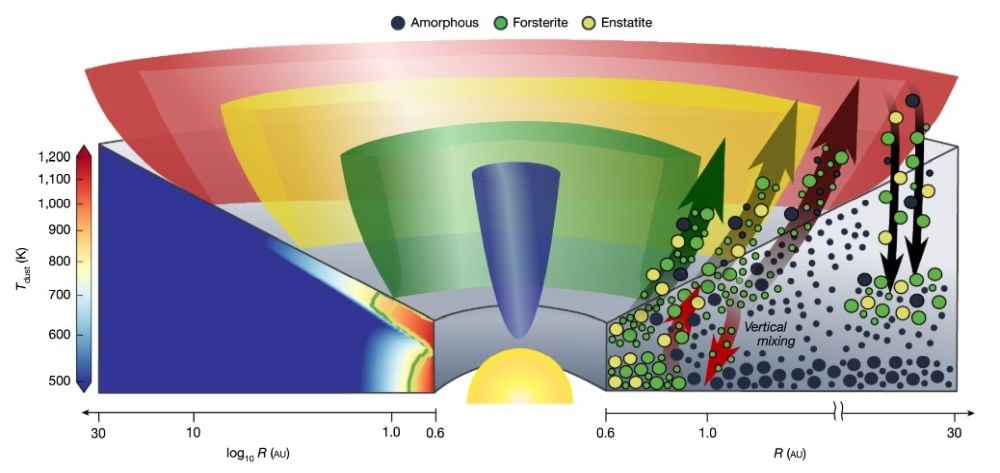 This figure from the research helps illustrate the results. It shows silicate crystallization and redistribution by magnetohydrodynamic disk winds. Note the two separate scales on the x-axis: logarithmic on the left and linear on the right. The left side of the disk shows the two-dimensional temperature distribution of the disk during the burst phase, highlighting the crystallization regions for each silicate species: greenish-yellow for enstatite and green for forsterite. The right side of the disk shows the crystallization and subsequent mixing of silicates. Green and greenish-yellow spheres represent forsterite and enstatite, respectively. These crystallized silicates can be uplifted and transported to the outer regions of the disk, the comet-forming zone, by MHD disk winds, which can drive the nested morphology of atomic jet and molecular outflows, presented by vertical layers. Efficient vertical mixing also increases the fraction of crystalline silicates in the disk midplane with a mixing timescale of a few years at about 1 au. Image Credit: Lee et al. 2026. Nature.
But the researchers also advise an appropriate amount of caution regarding their results. "Given that the jet is launched from very near to the star, the survival of the crystalline silicates in such an adventure is not at all secure."
"The exciting thing about these observations is that they both confirm formation of crystalline silicates in the inner disk and reveal that the same system has a disk wind that should be capable of launching these crystalline silicates to the outer disk (though that part is still speculation on our part)," Johnstone said.
These results also extend to the early days of our own Solar System, and offer an explanation of how crystalline silicates end up in comets in the System's outer reaches.
"Our discovery of crystallization occurring during a burst phase of an embedded protostar, EC 53, therefore, implies that the proto-Sun probably could have experienced a similar sequence of episodic accretion events early in its evolution. These bursts would have produced crystalline silicates in the hot, sub-au inner disk and transported them outwards to the cold, comet-forming regions at tens of au by MHD disk winds," the researchers conclude.

