 Universe Today
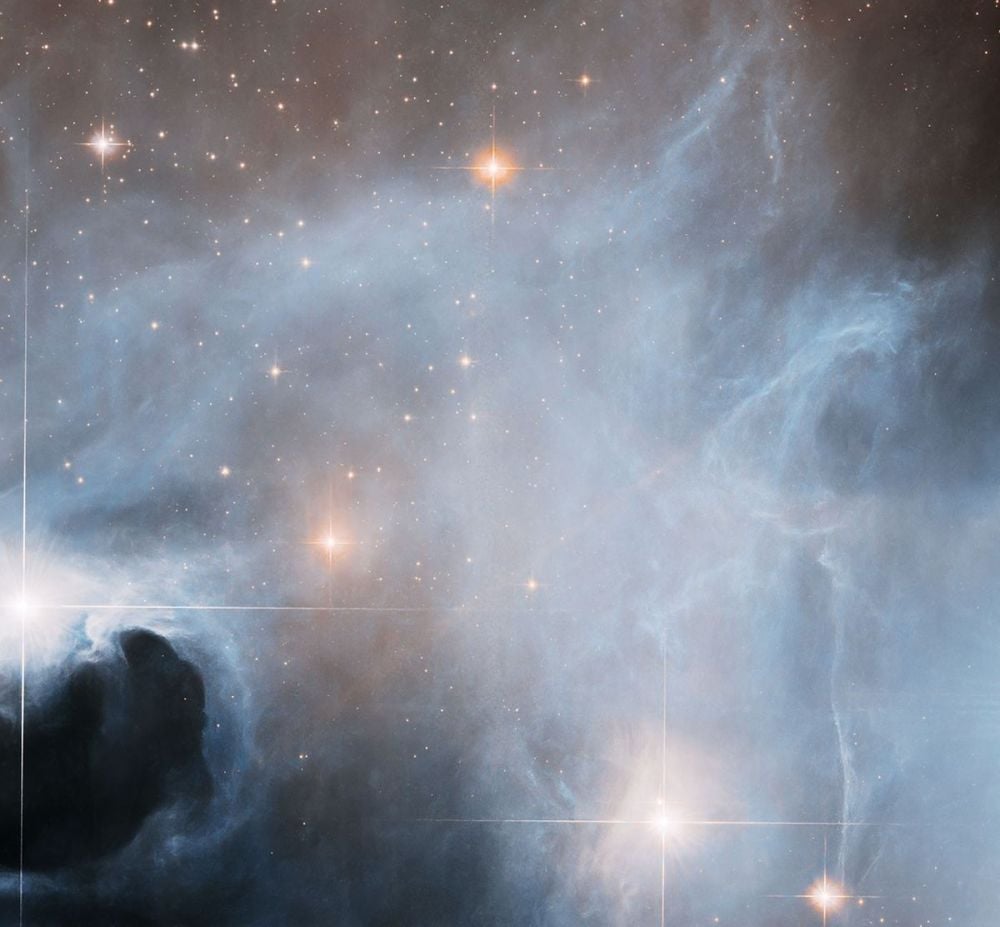
The Hubble Mission Team has been feeding us a steady stream of images from the space telescope that are focused on star formation. The latest image is of Lupus 3, a star-forming region about 500 light-years away. Lupus 3 features bright young stars that have emerged from their gaseous cocoons, and those that are still growing inside of theirs.
Lupus 3 is a dark molecular cloud, also known as a dark nebula. They're called dark clouds because they're so thick they block visible light. It's part of the much larger Lupus Cloud Complex. While previous star-formation images from Hubble focused on high-mass stars and the questions that limit our understanding of them and how they form, the Lupus Clouds are known for forming lower-mass stars.
Lupus 3 presents a striking contrast between its dark regions and its clusters of brilliant young stars. Depending on which wavelength it's being observed in, it appears quite different.
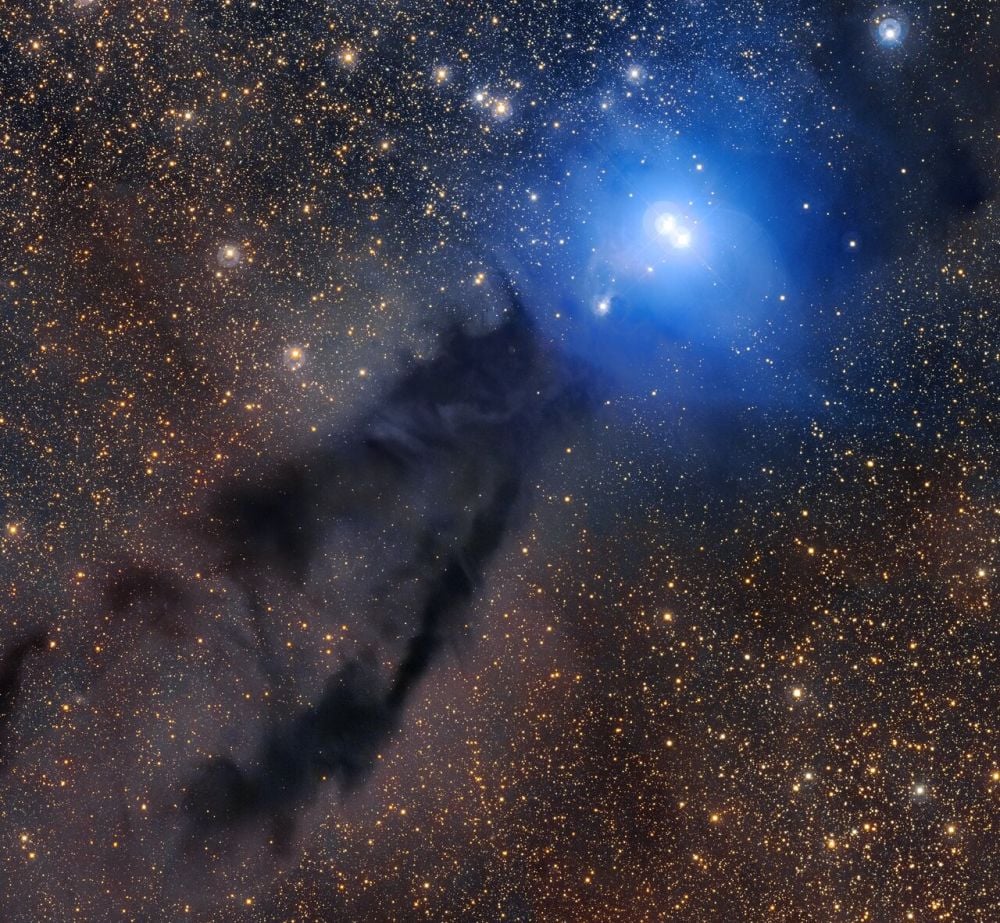 This image of Lupus 3 comes from the VLT Survey Telescope and the MPG/ESO 2.2-metre telescope. It shows the dark Lupus 3 cloud, as well as a pair of hot young stars named HR 5999 and HR 6000 that have formed in it. Their light has created a blue reflection nebula named Bernes 149. Image Credit: ESO/R. Colombari
The cloud is known to host dense stellar cores with very high extinction, caused by the thick dust. It's home to different types of young stellar objects (YSO), including the bright T-Tauri stars that dot the image. Research from 2006 showed that Lupus 3 has two distinct populations of T-Tauri stars. An older group ranges from 5 to 27 million years old, while the younger group is only about one million years old. "Half of the identified 1 Myr old stars lie in the tight group of mostly classical T Tauri stars associated with the Lupus 3 dark filament," that research stated.
It indicates that the Lupus association is the result of two separate, spatially separated cores. "A short-lived star formation episode occurs when two flows converge locally at a moderate relative velocity," the authors of the 2006 researchers explain. "Dynamical interaction of gas flows damps the velocity difference, so that the new stars formed in a short burst have similar initial velocities and slowly drift away from the site." That can explain the two distinct age populations.
T-Tauri stars are young, actively-forming stars in a particular stage of development. At this stage, the young stars are less than 10 million years old, yet have cleared out their surrounding gas. They exhibit brightness changes that are both random and periodic. The random ones may be cause by material falling from their accretion disks onto the star. The periodic ones could be caused by sunspots that rotate into and out of view.
T-Tauri stars are on their way to the main sequence, but won't get there for a while. They've begun contracting, have strong stellar winds and circumstellar disks, but haven't begun hydrogen fusion, the hallmark of a main sequence star. That happens when they become ZAMS, Zero-Age Main Sequence stars. How long it takes a T-Tauri star to reach the main sequence depends on their masses. Higher-mass stars evolve through the pre-main-sequence stages faster than lower-mass stars.
The Lupus 3 dark filament is partly visible in the Hubble image. But in other images, it's more visible and so are some of its stars and other features.
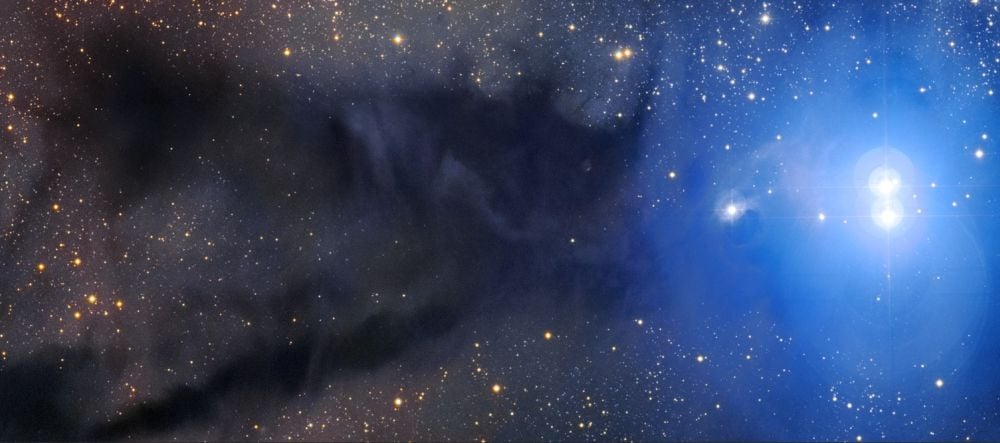 This zoomed-in image highlights the pair of young stars that create the nebula, and part of the thick dust that makes up Lupus 3. Image Credit: ESO/R. Colombari
The Hubble image doesn't reveal everything going on in this region. Lupus 3 and the surrounding parts of the Lupus complex contain many features associated with star-formation and young stars, including pre-stellar cores, jets, and circumstellar disks. It even contains Herbig-Haro objects and Herbig Ae/Be Stars, which are sometimes referred to as the missing link in star formation. Lupus 3 has been called "a picture more complex and interesting than the quiescent formation inside dense molecular clouds."

