 Universe Today
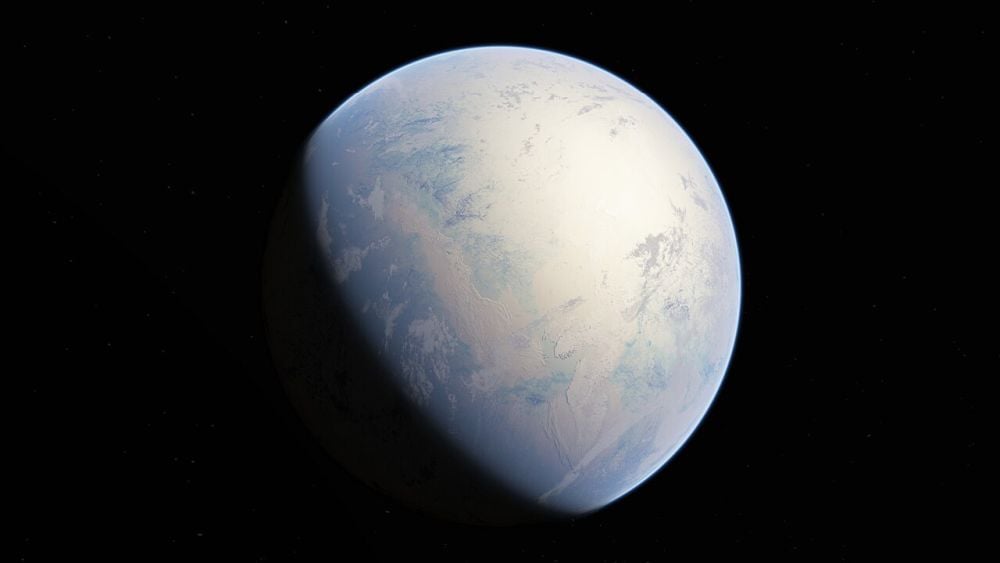
Decades of research shows that Earth was once entirely or almost entirely frozen. The episode is known as Snowball Earth, and though its occurrence is widely accepted, many of its details remain hypothetical. Snowball Earth took place in Earth's Cryogenian Period, which spanned from about 720–635 million years ago during the Neoproterozoic Era.
The Cryogenian had two major global ice ages that are commonly referred to as Snowball Earth. One is the Sturtian glaciation and the other is the Marinoan glaciation. Researchers have puzzled over these events. Research shows that the Sturtian lasted 56 million years, but climate models have struggled to explain how it could've endured for so long.
Researchers at the Harvard John A. Paulson School of Engineering and Applied Sciences (SEAS) have a new explanation for the Sturtian glaciation's length. They're presenting it in new research published in the Proceedings of the National Academy of Sciences. It's titled "Repeated snowball–hothouse cycles within the Neoproterozoic Sturtian glaciation," and the lead author is Charlotte Minsky from the SEAS.
There's ample evidence of the Sturtian glaciation in rocks all around the world. These sedimenatry rocks are a stratigraphic record of the advance and retreat of glaciers. But though the evidence is solid, existing climate models are at odds with it.
In their research the authors point out that arriving at a coherent explanation for the Sturtian glaciation is a longstanding problem. How life survived it is difficult to explain, as are aspects of the geologic record. The main challenge is explaining how it lasted for 56 million years, "far longer than can be accommodated by standard models of climate evolution," the authors write. A global glaciation that long would've had severe consequences for life.
"Global glaciations near the dawn of animal life—the so-called Neoproterozoic Snowball Earth events—are among the most extreme climatic perturbations in Earth’s history and likely exerted a strong influence on biological evolution," the authors explain. "Nonetheless, the cause(s), severity, and environmental/biological effects of these glaciations are still vigorously debated."
The team used simulations to try to unerstand what happened during the Sturtian. They're centered on a large volcanic region in Canada called the Franklin Large Igneous Province that erupted more than 700 million years ago and persisted for about 2 million years. It was one of the largest magmatic episodes in Earth's history and had a powerful effect on the planet's climate.
The authors say there's was a sort of tug-of-war between the carbon released by volcanoes and the weathering of newly exposed basalt. When volcanoes (and other processes) built carbon up in Earth's atmosphere, the climate warmed. That caused the ice to retreat, which exposed more basalt. That increased the weathering of basalt, which slowly removed carbon from the atmosphere. As carbon was removed, the climate cooled.
The researchers found that rather than one single glaciation event, the Sturtian actually consisted of multiple events. "Thus, instead of a single, continuous Snowball, the climate repeatedly flipped between short, self-terminating Snowball glaciations and similarly short warm, largely ice-free interglacial climates," the researchers write in their paper.
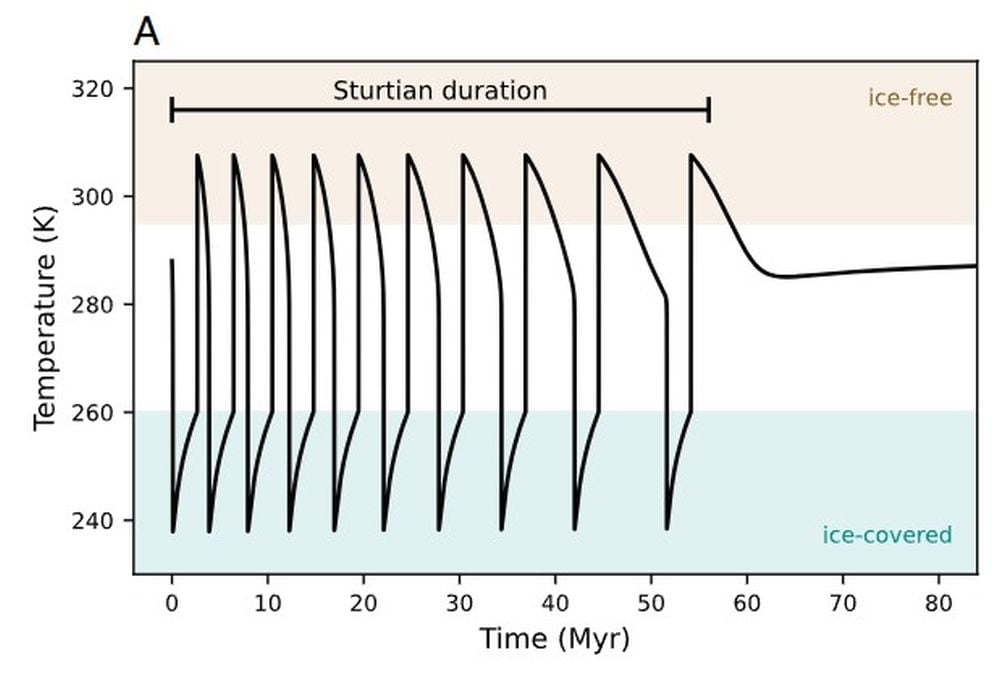 This figure from the research shows how Earth alternated between Snowball episodes and warm episoded during the Sturtian glaciation. Image Credit: Minsky et al. 2026 PNAS
Their model explains some of the disagreement between the geologic evidence and existing climate models.
One of those sticking points concerns atmospheric oxygen and the persistence of life. "In the traditional Snowball scenarios, maintaining an oxygenated atmosphere requires the biosphere to be productive enough to continually replace oxygen lost via chemical reaction with volcanic reduced gases," the authors explain. In those scenarios, the lack of oxygen due to extreme cold and volcanic output is a severe barrier to life if the Sturtian did last for 56 million years. So are "a lack of light in the surface ocean, and a severely limited nutrient supply."
But if there were instead repeated cycles of glaciation and warming, those barriers, though still in existence, are not as severe.
"In the limit cycle scenario, the biosphere would have only had to persist through shorter—million year timescale—Snowballs. These Snowballs are short enough that even in the absence of photosynthetic oxygen production, the atmospheric O2 reservoir could have persisted without being fully depleted," the authors explain.
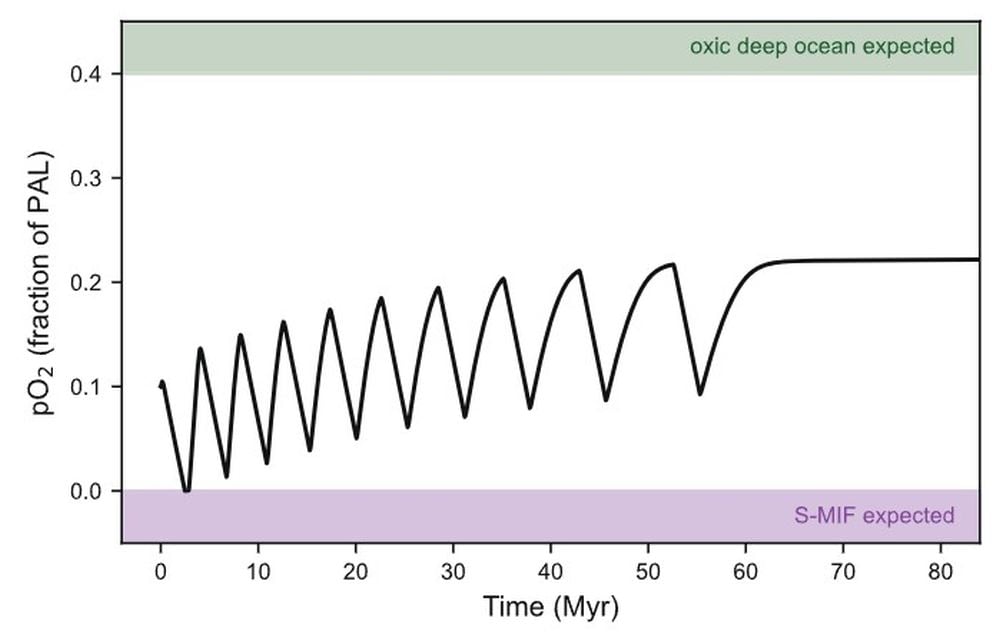 This figure from the research shows the "Evolution of the atmospheric oxygen inventory during the Snowball limit cycle," as explained by the authors. p02 describes the abundance of oxygen in the atmosphere, and PAL means Present Atmospheric Level, which for oxygen is 21%. The figure shows how enough oxygen could've persisted in the atmosphere if the authors' limit cycle model is correct. Image Credit: Minsky et al. 2026 PNAS
If Snowball Earth was repeatedly interrupted by warmer periods, the atmosphere wouldn't have become depleted of oxygen. “This could help explain how aerobic life persisted through such an extreme interval,” lead author Minsky said in a press release.
If Earth went through global glaciations interspersed with warmer periods, so could other exoplanets. So these results, which go a long way to explaining how life survived these frigid episodes, could also help scientists understand the growing number of exoplanets.
"Finally, the mechanism discussed here has potentially observable implications for understanding more generally when repeated Snowball episodes might occur on Earth-like exoplanets," the authors conclude.

