Universe Today
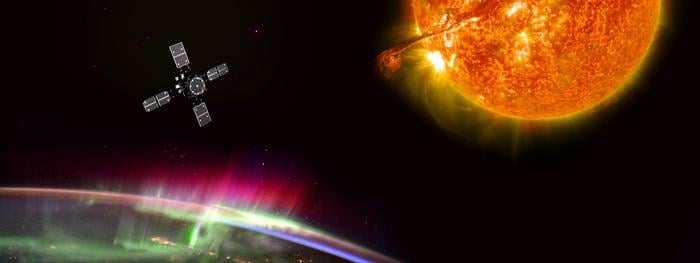
The May 2024 Gannon Solar Storm had a massive impact of the Earth’s space weather environment.
Nothing unites a hemisphere, like a good solar storm. Such an event transpired on the night of May 10/11, 2024, when an intense solar storm slammed into the Earth’s protective magnetic sheath. Now, a recent study shows just how intrusive that storm was, and how long it took for the Earth’s plasma layer to recover.
A powerful geomagnetic superstorm is a once a generation event, happening once every 20-25 years. It’s arguably no coincidence that this is also roughly equal to one 22-year Hale cycle. This is the period of two 11-year solar cycles, the length of time it takes the Sun’s magnetic field to return to the same north-south polarity.
Such an extreme G5 space weather event struck the Earth early last year, offering space weather researchers worldwide a chance to study its effects. The event was named the ‘Gannon Storm’ earlier this year in honor of solar researcher Jennifer Lea Gannon, who passed away just eight days prior to the event. The event is only the second solar storm to receive an informal name, after the infamous Carrington Event of 1859. The Gannon storm is also referred to as the Mother’s Day Storm.
 The May 2024 solar storm as seen from Canada. Credit: Andrew Symes.
The study by researchers out of Nagoya University in Japan shows just how intense the storm was, and how it really rang the planet’s magnetosphere like a bell. The study found that Earth’s magnetosphere shrunk down to an amazing fifth of its usual size during the event, and took a full four days to recover.
“By modernizing the temporal and spatial evolution of electron density in the plasmasphere and ionosphere from the Arase satellite and ground GNSS-TEC observations, we found (a) rapid compression of the plasmasphere and slow recovery of the plasmasphere due to negative storm in the ionosphere during the May 2024 super geomagnetic storm.” Lead researcher on the study Atsuki Shinbori (University of Nagoya) told Universe Today. “Thanks to the coordinated ground and satellite observations, we made important scientific results.”
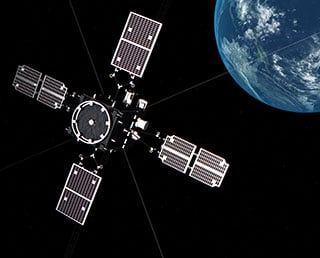 An artist's impression, of the Arase mission in space. Credit: JAXA.
The Arase mission was key to the finding. Launched on the second flight of JAXA’s small Epsilon launcher on December 20th, 2016, Arase studies the Earth’s Van Allen radiation belts. The study also looked at the storm’s effect on the ionosphere via ground based receivers.
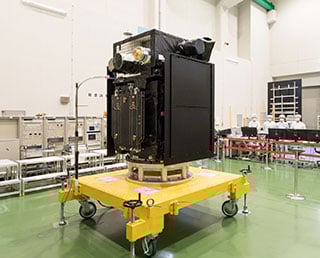 Arase in the clean room on Earth, prior to launch. Credit: JAXA.
An incoming solar storm typically compresses the plasmasphere surrounding the Earth. This is the sheath of charged particles surrounding our planet. This protects us from the worst of solar and cosmic radiation. The May 2024 solar storm condensed the Earth’s plasmasphere from its usual 44,000 kilometers above Earth’s surface, down to just 9,600 kilometers. This is well within geosynchronous orbit.
“The spatial distribution of electron density in the plasmasphere controls the generation of high energetic particles (radiation belts) in the inner magnetosphere, and the low density condition is favorable for building the radiation belts,” says Shinbori. “Because these particles have a negative impact on satellites, our scientific results are important for space weather science. Furthermore, the electron density variation in the ionosphere enhances the errors of satellite positioning for drone operation. Therefore, we need to predict such electron density variation during super geomagnetic storms.”
Solar Cycle 25: More in Store?
“Because solar activity is very high, we will have a good opportunity to survey severe and/or super geomagnetic storms such as Gannon storm,” says Shinbori. “In this case, only the JAXA Arase satellite provides us with valuable data in the inner magnetosphere, plasmasphere, and ionosphere during super geomagnetic storms. Accumulation of such the datasets is important for us to understand what happens in these regions during super storms. Such new knowledge will lead to improvement of the scheme of space weather prediction for such severe events.”
We remember seeing a definite reddish glow over central Germany on the night of May 10th. Seeing a powerful auroral storm can be a life-changing event; I’d put it right up there with a total solar eclipse and a good meteor storm in terms of amazing astronomical events.
And Solar Cycle 25 is far from over. The Sun reminded us of this on U.S. Veteran’s Day last month, pummeling our local space weather environment. And we may be in for more this week, as massive sunspot group Active Region AR4294 aims our way.
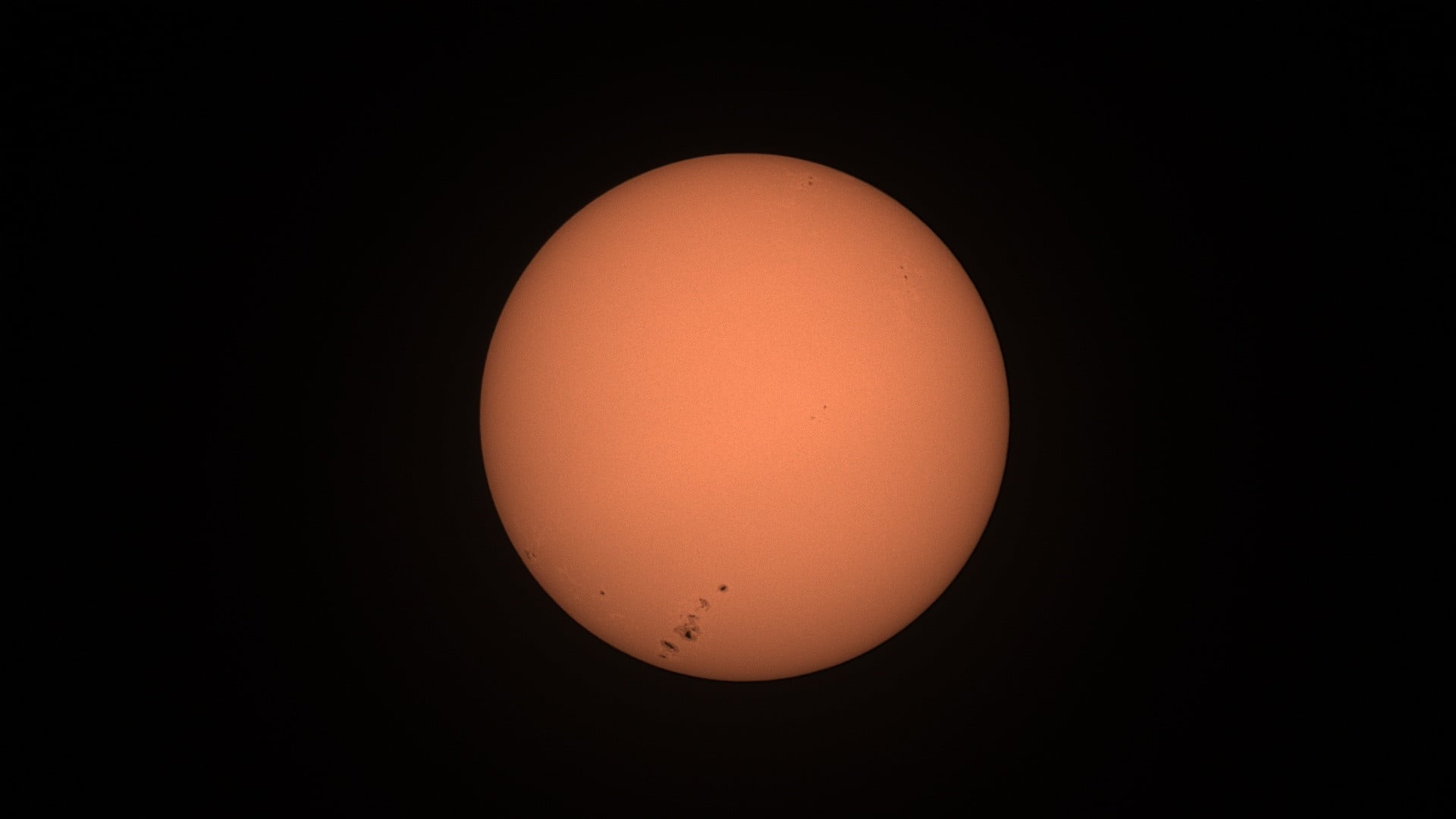 A massive sunspot emerges from around the solar limb, in the first week of December 2025. Credit: Dave Dickinson-Shot with a Dwarf Labs Dwarf3 smartscope.
This one is large enough to see with eclipse glasses if skies are clear, no magnification needed.
The study of space weather and its impact on our technological society is crucial. This comes as Airbus identified a possible space weather link to an in-flight incident that injured passengers and caused an emergency landing late this past October.
Such is the life we live, inside the atmosphere of a tempestuous star. Studies like these prove there’s lots more to learn from our Sun, in terms of space weather and solar activity.