Universe Today
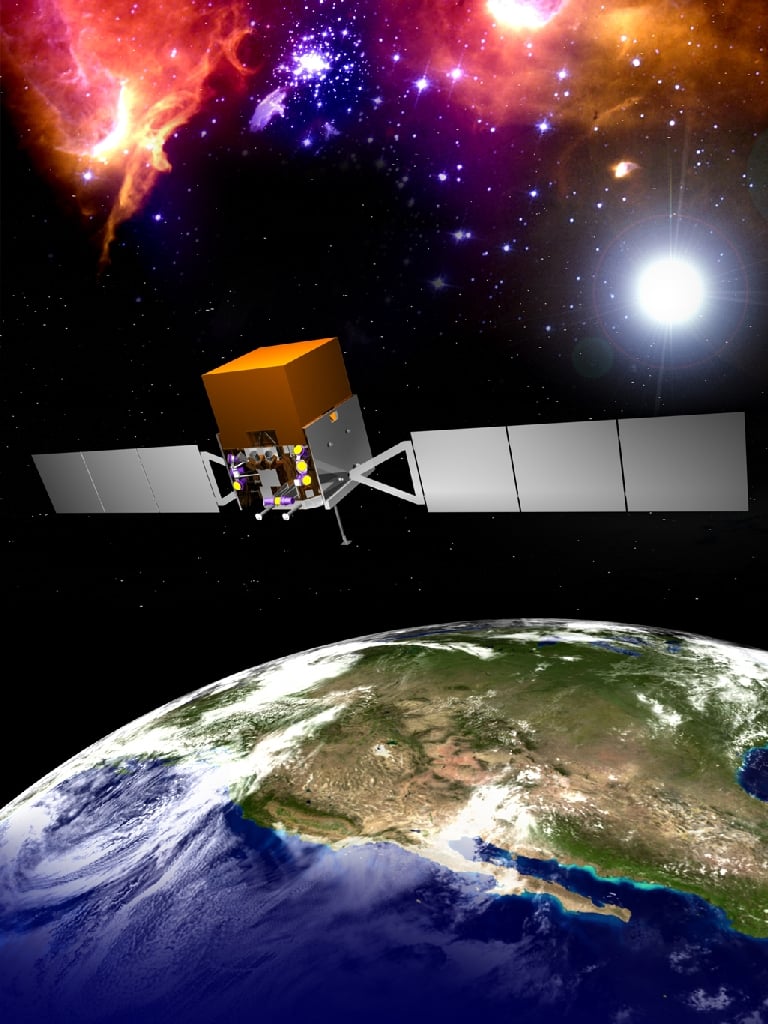
It's not hard to grab someone's attention when you mention the words "super massive black holes," "gamma ray bursts," "cosmic rays," and " dark matter." NASA's next space telescope will attempt to grab data about some of these high-energy objects in our universe to help us understand their mysteries. GLAST, the Gamma-ray Large Area Space Telescope will use its instruments to study those objects that generate gamma-ray radiation, the most energetic form of radiation we know of, billions of times more energetic than the type of light visible to our eyes. Liftoff for GLAST is set for Thursday, June 5, and the launch window extends from 11:45 a.m. to 1:40 p.m. EDT.
GLAST will reside in a circular, low Earth orbit of about 560 km ( 350 miles ). This orbit was chosen to minimize the effects of charged particles that surround Earth, and which would create additional unwanted background signals in the detectors. At that altitude, the observatory will circle Earth every 90 minutes. In sky-survey mode, GLAST will be able to view the entire sky in just two orbits, or about 3 hours.
The instruments on the GLAST mission are the Large Area Telescope (LAT) and the GLAST Burst Monitor. Lat has a tracker for gamma-ray detection and direction measurement, and can also measure the energies of the rays. The GBM will have two types of scintillators mounted on the sides of the spacecraft to detect electromagnetic waves.
Phil over at Bad Astronomy has a couple of very nice (and fun)
videos
with info about GLAST (one starring Phil himself), but these are the major goals of GLAST:
• Explore the most extreme environments in the Universe, where nature harnesses energies far beyond anything possible on Earth. • Search for signs of new laws of physics and what composes the mysterious Dark Matter. • Explain how black holes accelerate immense jets of material to nearly light speed. • Help crack the mysteries of the stupendously powerful explosions known as gamma-ray bursts. • Answer long-standing questions across a broad range of topics, including solar flares, pulsars and the origin of cosmic rays.
GLAST should provide some very interesting data about these spectacular and remarkable objects in our universe, and will create a full-sky map of gamma radiation.
Kapla GLAST!
Source:
GLAST site