 Universe Today
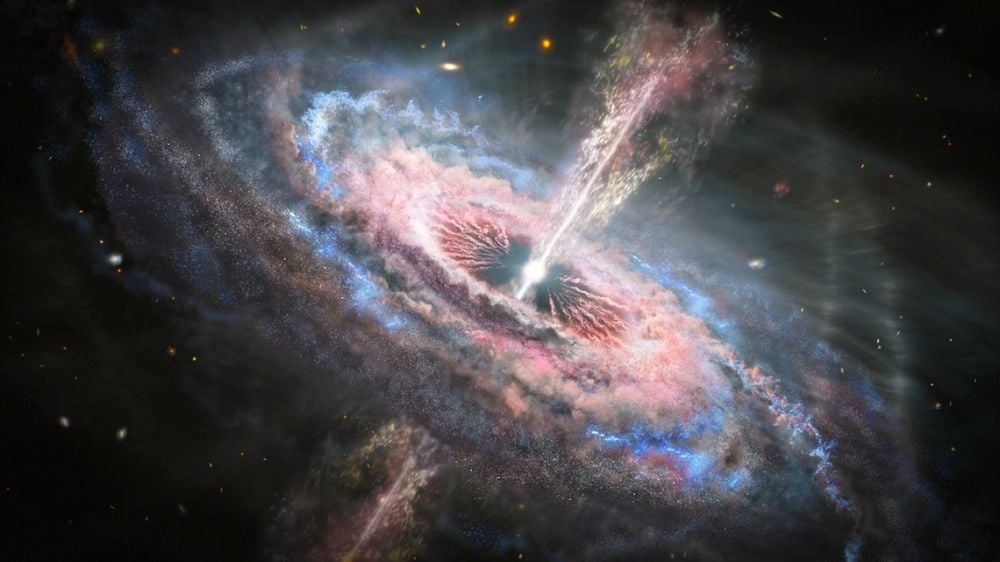
The JWST has shown us that even very ancient galaxies have supermassive black holes in their centers, a finding that clashes with our understanding of the early Universe and how galaxies and black holes grow. Though not all of the ancient galaxies the telescope has observed appear to have SMBH, most do. This suggests a clear link between SMBH and galaxy evolution, but the exact nature of that link has so far eluded astrophysicists.
The JWST's puzzling observations don't end there. For some reason, many galaxies seem to have stopped forming stars as early as only two billion years after the Big Bang. This discovery has also puzzled scientists.
New research shows that quasars may have something to do with it. When SMBH are actively accreting material, they're called active galactic nuclei (AGN). AGN emit an overwhelming amount of energy, and the most energetic and brightest ones are called quasars. Quasars are extremely energetic, and some are thousands of times more luminous than the combined light of galaxies like the Milky Way. The energy from these quasars can severely restrict new star formation in the galaxies that have them. This is called quenching, and it creates quiescent galaxies.
The new research is published in Nature and is titled "Extreme galaxy-scale outflows are frequent among luminous early quasars." The lead author is Weizhe Liu from the Steward Observatory at the University of Arizona.
"The existence of abundant post-starburst/quiescent galaxies just ∼1–2 Gyrs after the Big Bang challenges our current paradigm of galaxy evolution," the authors write. "Cosmological simulations suggest that quasar feedback is likely the most promising mechanism responsible for such rapid quenching."
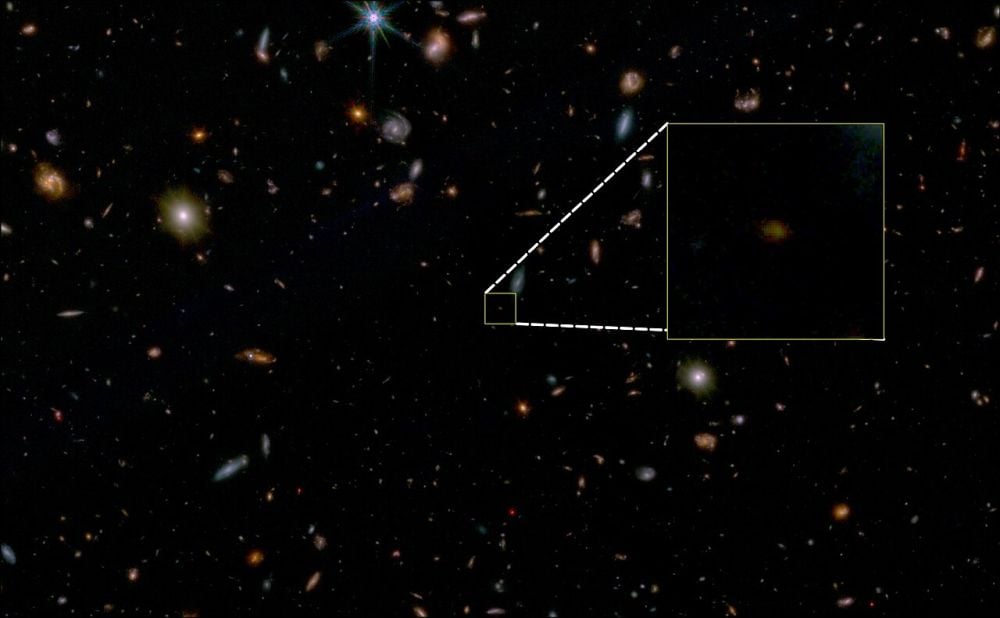 This is JADES-GS-z7-01-QU, an ancient red and dead galaxy discovered by the JWST. It stopped creating new stars shortly after its formation. Image Credit: By JADES Collaboration, CC0, https://commons.wikimedia.org/w/index.php?curid=146127241
Star formation requires hydrogen, and the hydrogen must be cool. Otherwise it can't collapse and form stars. Without new stars, which are hot and blue, a galaxy's stellar population gradually ages. It becomes dominated by older, cooler, and redder stars. The JWST found far more red, quenched galaxies in the early Universe than expected.
"Many of those galaxies looked 'old' in the sense that they had stopped forming stars long before it would be expected," first author Liu said in a press release. "How could they have formed so early and become so massive, when they quit star formation so early? That surprising discovery challenged our current paradigm of galaxy evolution, and that was one of the main motivations behind our paper."
Astrophysicist suspected that quasars were responsible. Their enormous energy output heats the star-forming hydrogen, preventing new stars from forming. But astronomers couldn't find enough quasars to account for this heating. Only a few examples were found.
Until now.
In this work, the research team used the JWST to search the high-redshift Universe for quasars. They found 27 of them only one billion years after the Big Bang. Out of those 27, six of them had extremely fast winds.
"Here we report a high detection rate (6/27) of exceptionally fast and powerful galaxy-scale outflows traced by [O iii] emission in z ∼ 5–6 luminous quasars as revealed by the James Webb Space Telescope (JWST)," the authors write. These outflows reached velocities up to ∼8400 km s−1.
"These extreme outflows are comparable to or even faster than the most rapid [O iii] outflows reported at z ≲ 3, and could reach the circumgalactic medium (CGM) or even the intergalactic medium (IGM)," the researchers explain.
"In other words, quasars with extreme outflows were much more common in the early universe and became scarcer over time, which is surprising," said co-author Xiaohui Fan, associate head of the Department of Astronomy at the UofA. These super-quasars are responsible for the red, quenched galaxies in the early Universe, according to the researchers.
Quasars are known for their astrophysical jets, which travel at relativistic speeds. But they're narrow, and can't really explain all of the quenching. "Those jets move at speeds close to the speed of light," Fan said. "They essentially just punch a narrow hole into the galaxy."
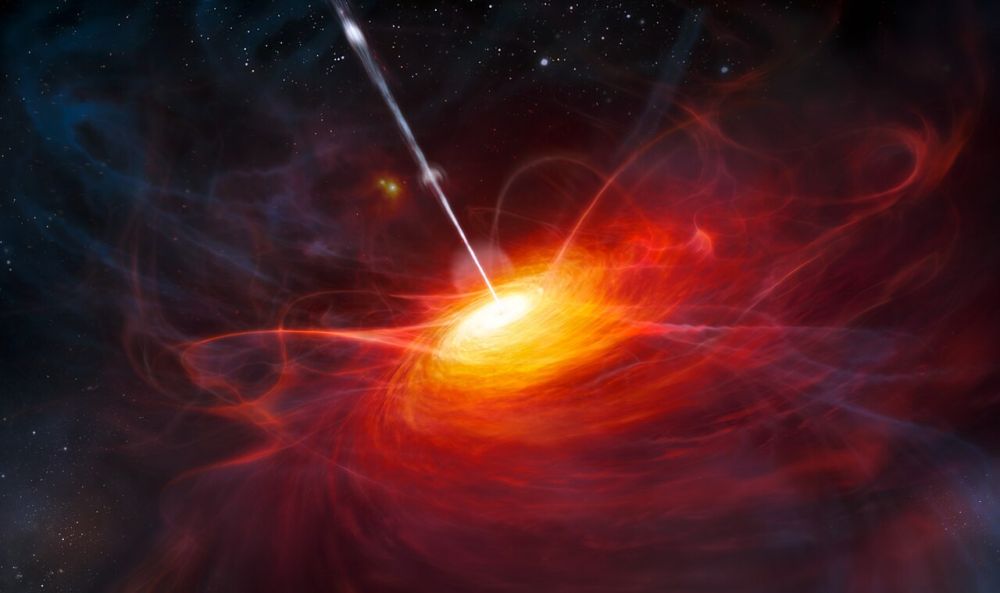 This artist's illustration shows a quasar and its powerful astrophysical jet. Though these jets are enormously powerful, and can reach relativistic speeds, they alone can't explain why some ancient galaxies are red and quenched. Image Credit: By ESO/M. Kornmesser - http://www.eso.org/public/images/eso1122a/, CC BY 4.0, https://commons.wikimedia.org/w/index.php?curid=15700804
Quasars do more than heat gas and preventing it from forming new stars. They also expel gas. "In contrast, the outflows we are talking about here are more like stellar wind, and we think they could be driven in many directions by radiation pressure from the quasar's extreme bright light," said Fan.
The researchers also think that these extreme quasars aren't long-lived, and can become dormant in only 100 million years. They also think that every year, one of these super-quasars removes gas equivalent to thousands of solar masses from their host galaxies.
"That is a very high rate of mass loss," Liu said. "Apply that over the course of – at least – a million years, and you will see you can remove a lot of gas from an entire galaxy over a relatively short period of time."
These extremely windy quasars can affect their intergalactic surroundings, too. The effect could extend for hundreds of thousands of light years.
Those effects are harder to measure, but this research seems to supply an answer to some of the questions posed by the JWST's observations of the early Universe.
"The substantially higher frequency of outflows with energetics well above the threshold for negative feedback in our sample strongly suggests that quasar feedback plays a significant role in efficiently quenching/regulating early massive galaxies," the authors write.
The researchers also point out that while only 6 of the 27 observed quasars have extremely powerful winds, the rest still have winds faster than those found in samples of quasars from later in the Universe.
"Overall, the high detection rate of extremely fast and powerful quasar outflows at z∼5–6 draws a compelling picture where intense quasar feedback on galaxy scale is already at work just ∼1 Gyr after the Big Bang," the authors explain. These powerful quasars are the likely cause of quenched galaxies in the high-redshift Universe.
They also say that these super-quasars can explain the JWST's other puzzling finding from the Universe. Early galaxies contain SMBH that are far more massive than expected, considering their stellar masses.
"Furthermore, the suppression of stellar mass growth caused by such intense feedback may also help explain the overmassive BHs with respect to their host galaxies at z>5 when compared to local relations," the authors conclude.
"In short, the impact of the black holes on their host galaxies through this process would have been more effective than in an older, more evolved galaxy in the later universe," Liu said.

