 Universe Today
When the Hubble Space Telescope began operations 35 years ago, it was motivated by some ambitious science goals. From its position in Low-Earth Orbit (LEO), the Hubble was poised to address fundamental questions in astronomy. It was tasked with determining the size and the age of the Universe, studying the formation and evolution of galaxies, and investigating quasars and black holes, among other things.
Its mission also included studying the characteristics of stars as they form and evolve, and how planets form in protoplanetary disks. These two topics are intricately linked, and its observations from LEO, unobstructed by Earth's atmosphere, have fed into the progress scientists have made on these questions.
A new gallery of Hubble images of protoplanetary disks around young stars illustrates how the space telescope is still doing important science.
Young stars form in clouds of gas when a density forms a pre-stellar core. Eventually, gravitational collapse turns the core into a protostar. Surrounding material is drawn toward the protostar, forming a disk of gas and dust. In its early stages, the disk is often referred to as a circumstellar disk, but when planets start to form in the disk, it's called a protoplanetary disk.
Regardless of what we call it, the disk is a dynamic place, powerfully influenced by the nature of the star it encircles. And it, in turn, is part of the star's formation.
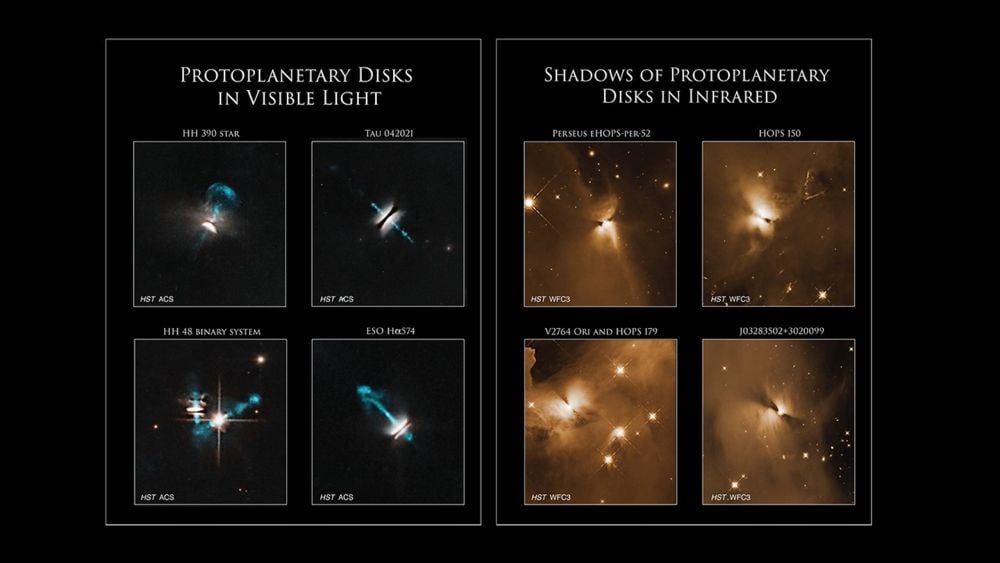
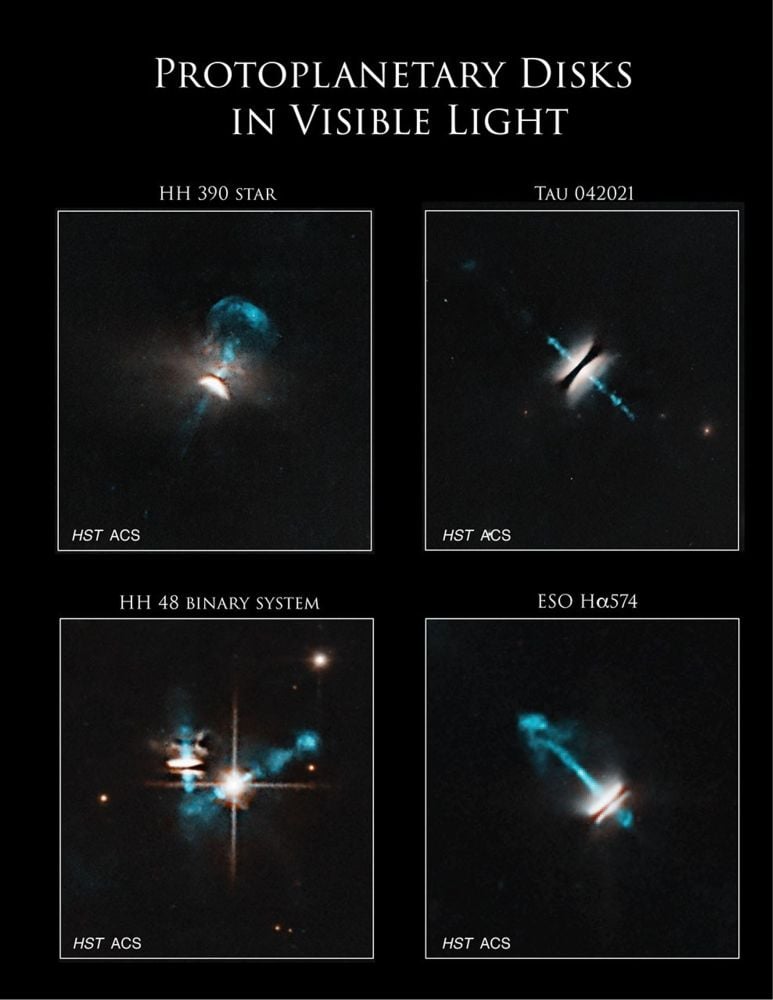 These Hubble image show four protoplanetary disks in visible light, captured with the space telescope's Advanced Camera for Surveys. Polar jets of gas are visible in each one, and so are brightly-lit nebulae. The dark band around each star is a shadow cast onto the nebula by the disks. HH 390 is not quite edge-on, and only one side of its nebulosity is visible. Tau 042021 is seen edge-on, and is in a later stage of evolution. Its dust grains have clumped together into larger grains. HH 48 is a binary protostar, and the gravitational power from the larger star is shaping the disk around its less massive binary partner. ESO Hα574 is a much more compact disk, and has a highly-collimated jet with a linear outflow. NASA, ESA, and K. Stapelfeldt (Jet Propulsion Laboratory); Processing: Gladys Kober (NASA/Catholic University of America)
When material is drawn toward a protostar, it has angular momentum. This momentum makes the disk rotate around the star. For hundreds of thousands of years, material in the disk accretes onto the star. One of the holes in accretion disk theory concerns how material falls from the disk into the star. Astrophysicists still aren't certain how that happens.
The protostar stage is also marked by polar jets. As material falls toward the star, not all of it accretes onto the star. Some of it is channelled along the star's magnetic field lines and propelled out of opposing jets from the star's poles. This material travels rapidly, reaching speeds of several hundreds of km per second. When the jets slam into clumps in the ISM, they light up the material. Sometimes the jets create Herbig-Haro Objects, transient phenomena that only last a few tens of thousands of years.
The infrared images below show the bright protostars despite the fact that they're surrounded by dust. Dust absorb starlight and then re-emits it in the infrared, allowing the Hubble to see the stars. Jets are still present, but Hubble's infrared camera can't sense them.
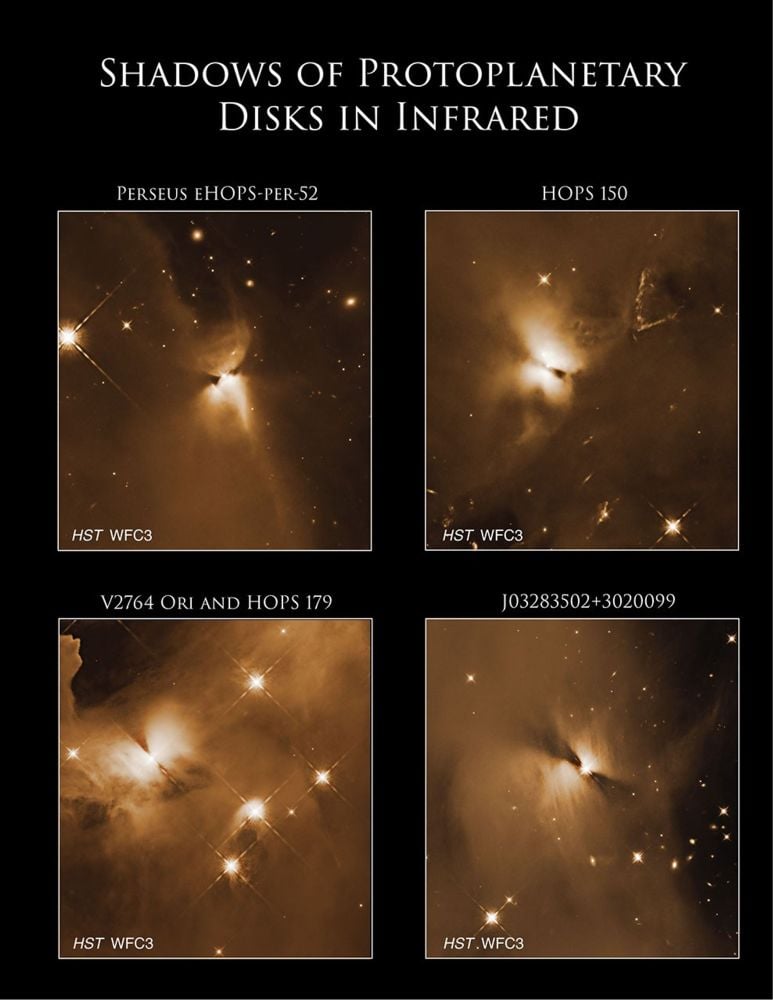 These infrared images of protoplanetary disks were captured in infrared with the Hubble's Wide Field Camera 3. This is the space telescope's most powerful camera, and can see in optical, UV, and in part of the infrared spectrum. It shows three bright protostars and their dusty disks. Note that the jets aren't visible in these images. HOPS 150 and V2764 Orionis and HOPS 179 are in the Orion Molecular Cloud Complex. PERSEUS eHOPS-per-52 and the star in the bottom right panel are both in the Perseus Molecular Cloud. Image Credit: NASA, ESA, and T. Megeath (University of Toledo); Processing: Gladys Kober (NASA/Catholic University of America)
When the JWST was launched, it had a similarly ambitious list of science themes. The Birth of Stars and Planetary Systems was one of them, and it's observed protostars, protoplanetary disks, and jets, too. 2024 research based on JWST observations showed that some young protostars feature layered structures of winds, and that inner jets were surrounded by outer, cone-shaped jets.
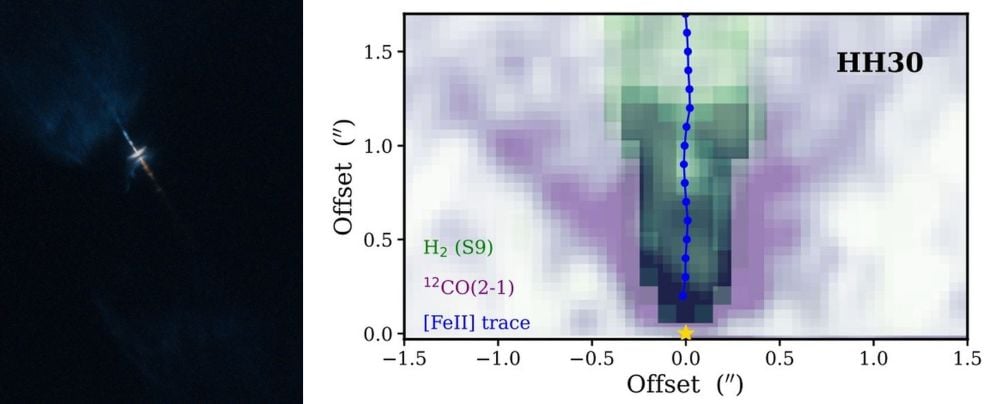 The panel on the left shows a Hubble image of HH30, a protoplanetary disk in the Taurus Molecular Cloud. The image on the right is of the same object, but from JWST data. Each colour represents a different chemical tracer in different parts of the protostar's jet. It illustrates the nested structure of the star's winds and jets. Image Credit: Pascucci et al. 2024. NatAstr
When the Hubble was launched in 1990, NASA expected 15 years of operations. But the space telescope has lasted more than 35 years, a remarkable feat made possible by five separate servicing missions. It may be reaching its end, as it continues to lose gyroscopes. The telescope takes more time to be pointed at targets, and observations are down by about 12%, with a concomitant reduction in science output.
Even so, NASA expects the venerable telescope to keep operating into the 2030s. And if a rumoured servicing mission comes to fruition, it may last even longer than that.
If that's the case, then it'll keep contributing to our understanding of how stars form and grow, and how planets form in their protoplanetary disks.

